
钙蛋白酶-3 缺失肌肉中的再生受损与 mTORC1 信号的扰动和线粒体生物发生缺陷有关。
Impaired regeneration in calpain-3 null muscle is associated with perturbations in mTORC1 signaling and defective mitochondrial biogenesis.
机构信息
Center for Gene Therapy, The Research Institute at Nationwide Children's Hospital, Columbus, OH, USA.
Current Address: King Chulalongkorn Memorial Hospital and Department of Medicine, Faculty of Medicine, Chulalongkorn University, Bangkok, Thailand.
出版信息
Skelet Muscle. 2017 Dec 14;7(1):27. doi: 10.1186/s13395-017-0146-6.
BACKGROUND
Previous studies in patients with limb-girdle muscular dystrophy type 2A (LGMD2A) have suggested that calpain-3 (CAPN3) mutations result in aberrant regeneration in muscle.
METHODS
To gain insight into pathogenesis of aberrant muscle regeneration in LGMD2A, we used a paradigm of cardiotoxin (CTX)-induced cycles of muscle necrosis and regeneration in the CAPN3-KO mice to simulate the early features of the dystrophic process in LGMD2A. The temporal evolution of the regeneration process was followed by assessing the oxidative state, size, and the number of metabolic fiber types at 4 and 12 weeks after last CTX injection. Muscles isolated at these time points were further investigated for the key regulators of the pathways involved in various cellular processes such as protein synthesis, cellular energy status, metabolism, and cell stress to include Akt/mTORC1 signaling, mitochondrial biogenesis, and AMPK signaling. TGF-β and microRNA (miR-1, miR-206, miR-133a) regulation were also assessed. Additional studies included in vitro assays for quantifying fusion index of myoblasts from CAPN3-KO mice and development of an in vivo gene therapy paradigm for restoration of impaired regeneration using the adeno-associated virus vector carrying CAPN3 gene in the muscle.
RESULTS
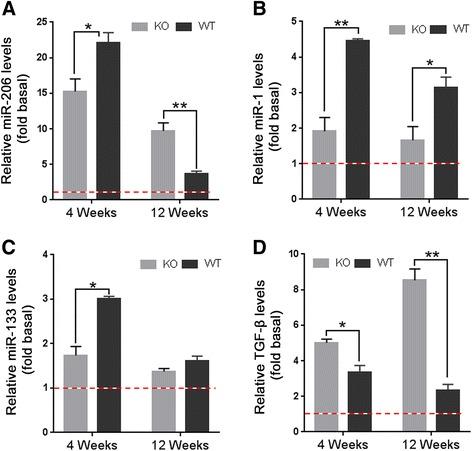
At 4 and 12 weeks after last CTX injection, we found impaired regeneration in CAPN3-KO muscle characterized by excessive numbers of small lobulated fibers belonging to oxidative metabolic type (slow twitch) and increased connective tissue. TGF-β transcription levels in the regenerating CAPN3-KO muscles were significantly increased along with microRNA dysregulation compared to wild type (WT), and the attenuated radial growth of muscle fibers was accompanied by perturbed Akt/mTORC1 signaling, uncoupled from protein synthesis, through activation of AMPK pathway, thought to be triggered by energy shortage in the CAPN3-KO muscle. This was associated with failure to increase mitochondria content, PGC-1α, and ATP5D transcripts in the regenerating CAPN3-KO muscles compared to WT. In vitro studies showed defective myotube fusion in CAPN3-KO myoblast cultures. Replacement of CAPN3 by gene therapy in vivo increased the fiber size and decreased the number of small oxidative fibers.
CONCLUSION
Our findings provide insights into understanding of the impaired radial growth phase of regeneration in calpainopathy.
背景
先前在肢带型肌营养不良症 2A 型(LGMD2A)患者中的研究表明,钙蛋白酶-3(CAPN3)突变导致肌肉中出现异常再生。
方法
为了深入了解 LGMD2A 中异常肌肉再生的发病机制,我们使用心脏毒素(CTX)诱导的肌肉坏死和再生循环的范例,在 CAPN3-KO 小鼠中模拟 LGMD2A 中营养不良过程的早期特征。通过评估最后一次 CTX 注射后 4 周和 12 周时的氧化状态、大小和代谢纤维类型的数量,来跟踪再生过程的时间演变。在这些时间点分离的肌肉还进一步研究了涉及各种细胞过程的关键调节剂,例如蛋白质合成、细胞能量状态、代谢和细胞应激,包括 Akt/mTORC1 信号通路、线粒体生物发生和 AMPK 信号通路。还评估了 TGF-β 和 microRNA(miR-1、miR-206、miR-133a)的调节。其他研究包括从 CAPN3-KO 小鼠中定量肌母细胞融合指数的体外测定,以及使用携带 CAPN3 基因的腺相关病毒载体在肌肉中进行恢复受损再生的体内基因治疗范例。
结果
在最后一次 CTX 注射后 4 周和 12 周,我们发现 CAPN3-KO 肌肉的再生受损,特征是属于氧化代谢型(慢收缩)的小裂片纤维数量过多,并增加了结缔组织。与野生型(WT)相比,再生的 CAPN3-KO 肌肉中的 TGF-β 转录水平显着增加,同时存在 microRNA 失调,并且肌肉纤维的径向生长减弱伴随着 Akt/mTORC1 信号通路的失调,与蛋白质合成脱耦,通过 AMPK 通路的激活,据认为这是由 CAPN3-KO 肌肉中的能量短缺引起的。这与在再生的 CAPN3-KO 肌肉中未能增加线粒体含量、PGC-1α 和 ATP5D 转录物有关。体外研究表明,CAPN3-KO 成肌细胞培养中的肌管融合存在缺陷。体内基因治疗中 CAPN3 的替代增加了纤维大小,并减少了小氧化纤维的数量。
结论
我们的发现为理解钙蛋白酶病中再生的径向生长阶段提供了深入的了解。




 Zotero 插件