Chen Shi-Lu, Lu Shi-Xun, Liu Li-Li, Wang Chun-Hua, Yang Xia, Zhang Zhi-Yi, Zhang Hui-Zhong, Yun Jing-Ping
Sun Yat-sen University Cancer Center, State Key Laboratory of Oncology in South China, Collaborative Innovation Center for Cancer Medicine, Guangzhou 510060, China; Department of Pathology, Sun Yat-sen University Cancer Center, Guangzhou 510060, China.
Sun Yat-sen University Cancer Center, State Key Laboratory of Oncology in South China, Collaborative Innovation Center for Cancer Medicine, Guangzhou 510060, China; Department of Pathology, Sun Yat-sen University Cancer Center, Guangzhou 510060, China.
Transl Oncol. 2018 Feb;11(1):125-131. doi: 10.1016/j.tranon.2017.11.001. Epub 2017 Dec 18.
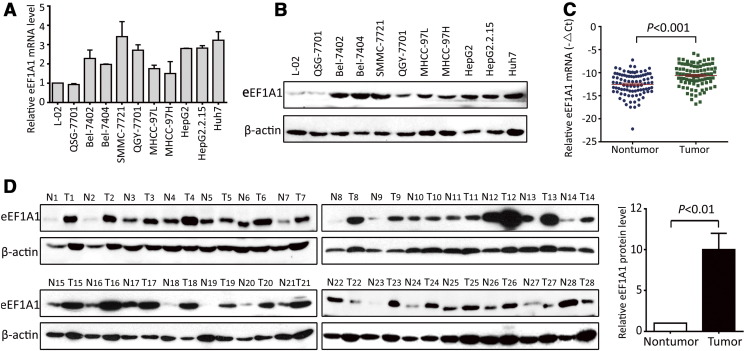
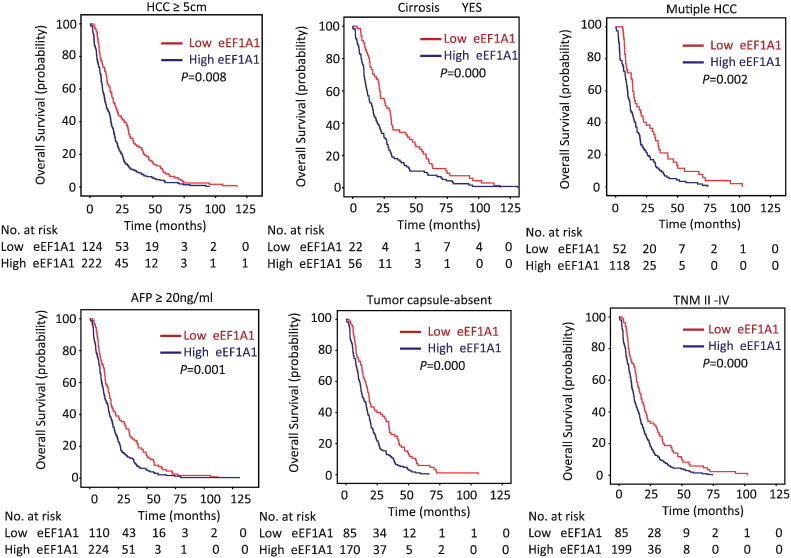
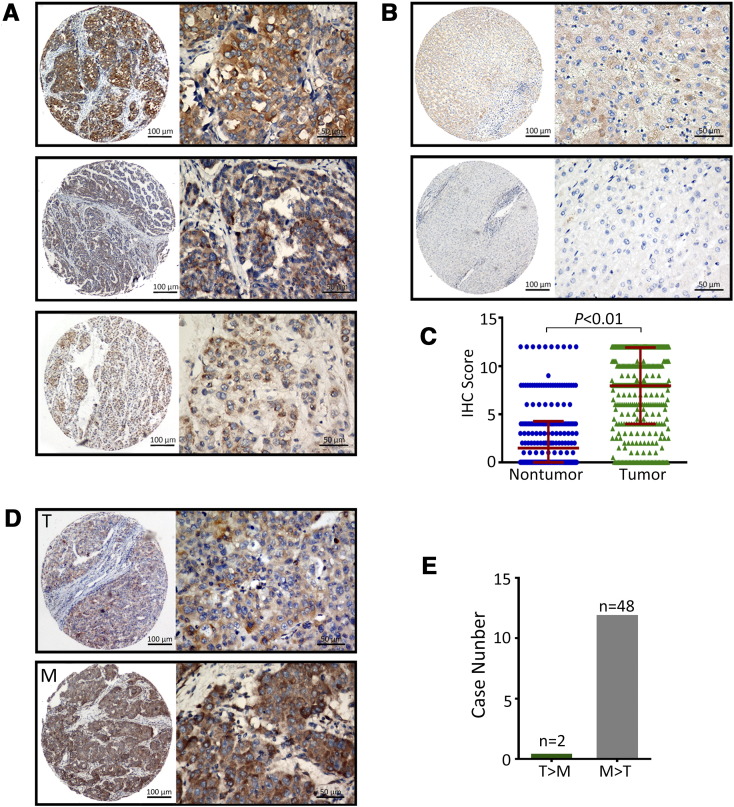
Liver is a major contributor of protein production physiologically. The aberrant state of protein synthesis leads to tumor progression. Eukaryotic elongation factor 1 alpha 1 (eEF1A1) is a major member of the eukaryotic elongation factor family that regulates protein synthesis. Although eEF1A1 plays an essential role in controlling the cell fate, its clinical significance in tumor development and progression has not been reported. Here, we aimed to uncover the expression and prognostic significance of eEF1A1 in hepatocellular carcinoma (HCC). Our data indicated that eEF1A1 expression was elevated in HCC cell lines and clinical samples at both the mRNA and protein levels. Immunohistochemistry revealed that eEF1A1 expression was upregulated in HCC samples compared with corresponding non-tumorous tissues. In 50 HCC cases with portal vein embolus, higher eEF1A1 immunoreactivity was detected in tumor metastases compared with the primary lesions. Kaplan-Meier analysis indicated that increased eEF1A1 expression was closely associated with unfavorable post-surgical overall and disease-free survival in 453 HCC patients. Moreover, multivariate analysis indicated eEF1A1 as an independent predictor for overall and disease-free survival. Collectively, our study suggests eEF1A1 as a novel prognostic biomarker and potential therapeutic target for HCC patients.
肝脏是生理状态下蛋白质产生的主要贡献器官。蛋白质合成的异常状态会导致肿瘤进展。真核生物延伸因子1α1(eEF1A1)是真核生物延伸因子家族的主要成员,可调节蛋白质合成。尽管eEF1A1在控制细胞命运中起着至关重要的作用,但其在肿瘤发生和进展中的临床意义尚未见报道。在此,我们旨在揭示eEF1A1在肝细胞癌(HCC)中的表达及预后意义。我们的数据表明,在HCC细胞系以及临床样本中,eEF1A1在mRNA和蛋白质水平的表达均升高。免疫组织化学显示,与相应的非肿瘤组织相比,HCC样本中eEF1A1表达上调。在50例伴有门静脉栓塞的HCC病例中,与原发灶相比,在肿瘤转移灶中检测到更高的eEF1A1免疫反应性。Kaplan-Meier分析表明,在453例HCC患者中,eEF1A1表达增加与术后总体生存率和无病生存率不佳密切相关。此外,多因素分析表明eEF1A1是总体生存率和无病生存率的独立预测因子。总体而言,我们的研究表明eEF1A1是HCC患者一种新的预后生物标志物和潜在的治疗靶点。