Department of Psychology, Lancaster University, Lancaster, UK.
General Practice and Primary Care, School of Medicine, Dentistry and Nursing, College of Medical, Veterinary & Life Sciences, University of Glasgow, Glasgow, UK.
Lancet Public Health. 2017 Dec;2(12):e551-e559. doi: 10.1016/S2468-2667(17)30217-7. Epub 2017 Dec 5.
Addressing the causes of low engagement in health care is a prerequisite for reducing health inequalities. People who miss multiple appointments are an under-researched group who might have substantial unmet health needs. Individual-level patterns of missed general practice appointments might thus provide a risk marker for vulnerability and poor health outcomes. We sought to ascertain the contributions of patient and practice factors to the likelihood of missing general practice appointments.
For this national retrospective cohort analysis, we extracted UK National Health Service general practice data that were routinely collected across Scotland between Sept 5, 2013, and Sept 5, 2016. We calculated the per-patient number of missed appointments from individual appointments and investigated the risk of missing a general practice appointment using a negative binomial model offset by number of appointments made. We then analysed the effect of patient-level factors (including age, sex, and socioeconomic status) and practice-level factors (including appointment availability and geographical location) on the risk of missing appointments.
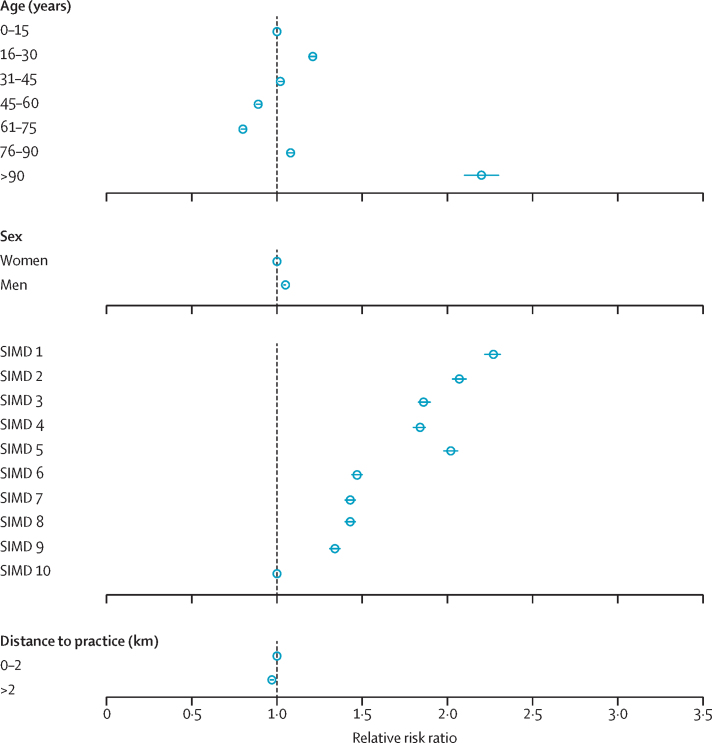
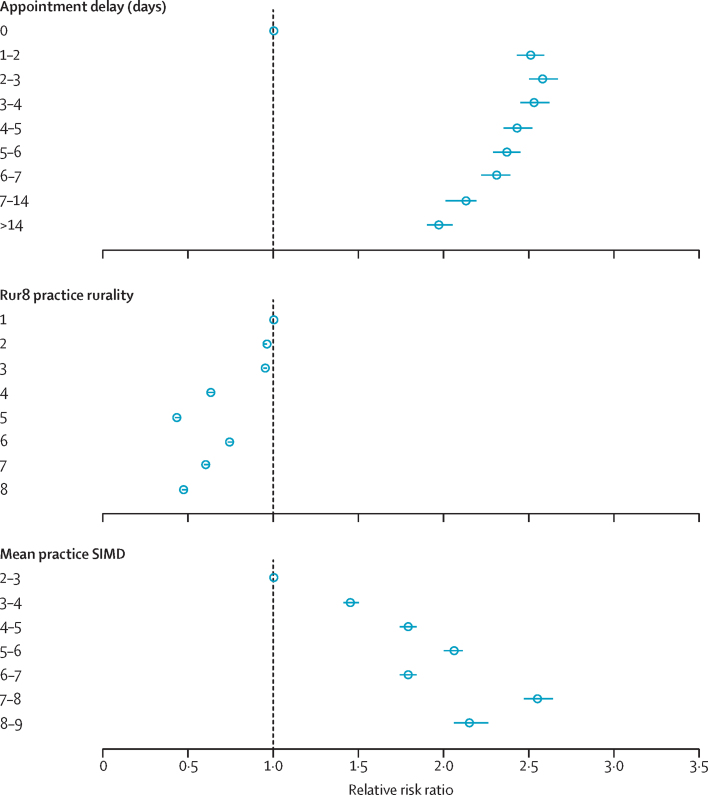
The full dataset included information from 909 073 patients, of whom 550 083 were included in the analysis after processing. We observed that 104 461 (19·0%) patients missed more than two appointments in the 3 year study period. After controlling for the number of appointments made, patterns of non-attendance could be differentiated, with patients who were aged 16-30 years (relative risk ratio [RRR] 1·21, 95% CI 1·19-1·23) or older than 90 years (2·20, 2·09-2·29), and of low socioeconomic status (Scottish Index of Multiple Deprivation decile 1: RRR 2·27, 2·22-2·31) significantly more likely to miss multiple appointments. Men missed fewer appointments overall than women, but were somewhat more likely to miss appointments in the adjusted model (1·05, 1·04-1·06). Practice factors also substantially affected attendance patterns, with urban practices in affluent areas that typically have appointment waiting times of 2-3 days the most likely to have patients who serially miss appointments. The combination of both patient and practice factors to predict appointments missed gave a higher pseudo R value (0·66) than models using either group of factors separately (patients only R=0·54; practice only R=0·63).
The findings that both patient and practice characteristics contribute to non-attendance of general practice appointments raise important questions for both the management of patients who miss multiple appointments and the effectiveness of existing strategies that aim to increase attendance. Addressing these issues should lead to improvements in provision of services and public health.
Scottish Government Chief Scientist Office and Data Sharing and Linkage Service of the Scottish Government.

解决医疗保健参与度低的问题是减少健康不平等的前提。错过多次预约的人是一个研究不足的群体,他们可能有大量未满足的健康需求。因此,一般实践预约的个体模式可能提供一个脆弱性和不良健康结果的风险标志物。我们试图确定患者和实践因素对错过一般实践预约的可能性的贡献。
对于这项全国性的回顾性队列分析,我们从苏格兰 2013 年 9 月 5 日至 2016 年 9 月 5 日期间常规收集的英国国家卫生服务机构一般实践数据中提取了信息。我们从个别预约中计算了每个患者错过的预约次数,并使用负二项式模型(由预约次数偏移)调查了错过一般实践预约的风险。然后,我们分析了患者水平因素(包括年龄、性别和社会经济地位)和实践水平因素(包括预约可用性和地理位置)对错过预约的风险的影响。
完整数据集包含了 909073 名患者的信息,经过处理后,其中 550083 名患者被纳入分析。我们观察到,在 3 年的研究期间,有 104461 名(19.0%)患者错过了两次以上的预约。在控制预约次数后,可以区分非就诊模式,年龄在 16-30 岁(相对风险比[RRR]1.21,95%CI1.19-1.23)或 90 岁以上(2.20,2.09-2.29)的患者和社会经济地位较低(苏格兰多维贫困指数十分之一)的患者(第 1 组:RRR2.27,2.22-2.31)更有可能多次错过预约。与女性相比,男性总体上错过的预约较少,但在调整后的模型中(1.05,1.04-1.06),男性更有可能错过预约。实践因素也对就诊模式产生了实质性影响,通常预约等待时间为 2-3 天的城市富裕地区的实践更有可能让连续错过预约的患者就诊。将患者和实践因素结合起来预测错过的预约,比单独使用任何一组因素(仅患者 R=0.54;仅实践 R=0.63)的模型提供更高的伪 R 值(0.66)。
患者和实践特征都对一般实践预约的不参加产生影响,这对管理多次错过预约的患者和提高现有旨在提高就诊率的策略的有效性提出了重要问题。解决这些问题应该会改善服务的提供和公共卫生。
苏格兰政府首席科学家办公室和苏格兰政府的数据共享和链接服务。