Laboratory of Cytogenetics and Molecular Genetics, Faculty of Medicine, Biopolis, University of Thessaly, 41500 Larissa, Greece.
Laboratory of Medical Genetics, Medical School, National and Kapodistrian University of Athens, Athens, Greece.
Clin Epigenetics. 2017 Dec 12;9:127. doi: 10.1186/s13148-017-0428-1. eCollection 2017.
MicroRNAs (miRNAs) in circulation have emerged as promising biomarkers. In this study, we aimed to identify a circulating miRNA signature for osteoarthritis (OA) patients and in combination with bioinformatics analysis to evaluate the utility of selected differentially expressed miRNAs in the serum as potential OA biomarkers.
Serum samples were collected from 12 primary OA patients, and 12 healthy individuals were screened using the Agilent Human miRNA Microarray platform interrogating 2549 miRNAs. Receiver Operating Characteristic (ROC) curves were constructed to evaluate the diagnostic performance of the deregulated miRNAs. Expression levels of selected miRNAs were validated by quantitative real-time PCR (qRT-PCR) in all serum and in articular cartilage samples from OA patients ( = 12) and healthy individuals ( = 7). Bioinformatics analysis was used to investigate the involved pathways and target genes for the above miRNAs.
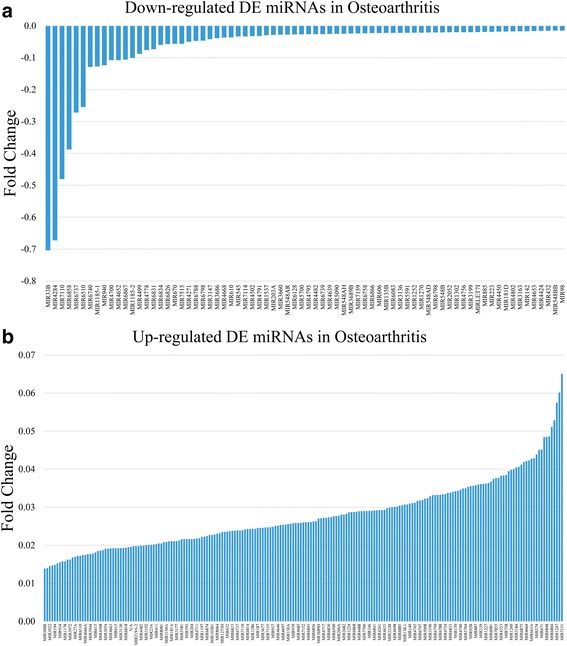
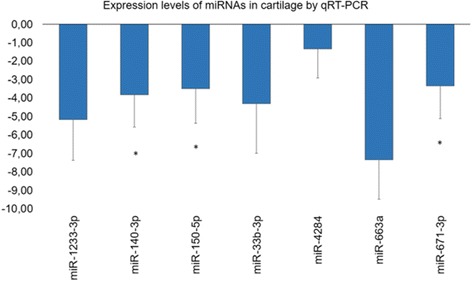
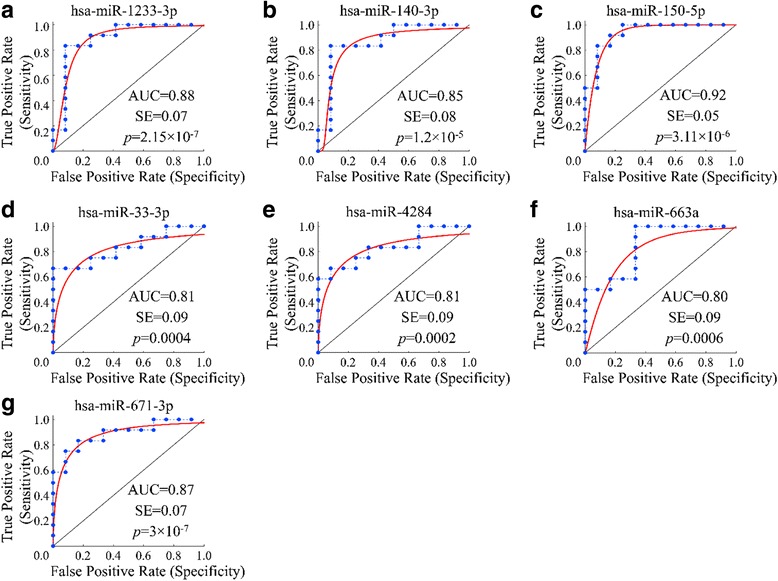
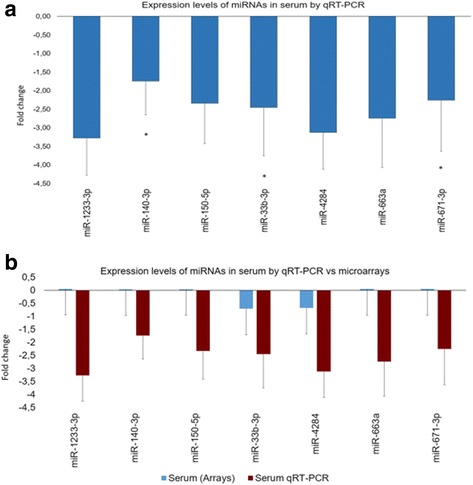
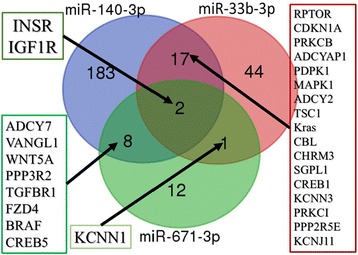
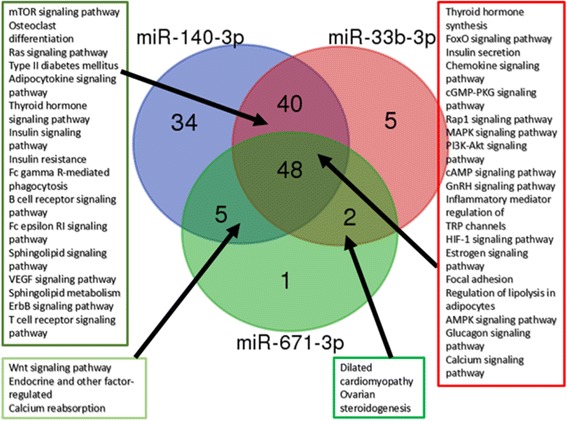
We identified 279 differentially expressed miRNAs in the serum of OA patients compared to controls. Two hundred and five miRNAs (73.5%) were upregulated and 74 (26.5%) downregulated. ROC analysis revealed that 77 miRNAs had area under the curve (AUC) > 0.8 and < 0.05. Bioinformatics analysis in the 77 miRNAs revealed that their target genes were involved in multiple signaling pathways associated with OA, among which FoxO, mTOR, Wnt, pI3K/akt, TGF-β signaling pathways, ECM-receptor interaction, and fatty acid biosynthesis. qRT-PCR validation in seven selected out of the 77 miRNAs revealed 3 significantly downregulated miRNAs (hsa-miR-33b-3p, hsa-miR-671-3p, and hsa-miR-140-3p) in the serum of OA patients, which were in silico predicted to be enriched in pathways involved in metabolic processes. Target-gene analysis of hsa-miR-140-3p, hsa-miR-33b-3p, and hsa-miR-671-3p revealed that and were common targets of all three miRNAs, highlighting their involvement in regulation of metabolic processes that contribute to OA pathology. Hsa-miR-140-3p and hsa-miR-671-3p expression levels were consistently downregulated in articular cartilage of OA patients compared to healthy individuals.
A serum miRNA signature was established for the first time using high density resolution miR-arrays in OA patients. We identified a three-miRNA signature, hsa-miR-140-3p, hsa-miR-671-3p, and hsa-miR-33b-3p, in the serum of OA patients, predicted to regulate metabolic processes, which could serve as a potential biomarker for the evaluation of OA risk and progression.
循环中的 microRNAs(miRNAs)已成为有前途的生物标志物。本研究旨在鉴定骨关节炎(OA)患者的循环 miRNA 特征,并结合生物信息学分析,评估血清中选定差异表达 miRNA 作为潜在 OA 生物标志物的效用。
使用 Agilent Human miRNA Microarray 平台对 12 名原发性 OA 患者和 12 名健康个体的血清样本进行筛选,该平台可检测 2549 个 miRNAs。构建接收器操作特征(ROC)曲线以评估失调 miRNA 的诊断性能。通过定量实时 PCR(qRT-PCR)在所有血清样本以及 OA 患者(n=12)和健康个体(n=7)的关节软骨样本中验证选定 miRNA 的表达水平。使用生物信息学分析研究上述 miRNA 的涉及途径和靶基因。
与对照组相比,我们在 OA 患者的血清中鉴定出 279 个差异表达的 miRNAs。205 个 miRNA(73.5%)上调,74 个 miRNA(26.5%)下调。ROC 分析显示,77 个 miRNAs 的曲线下面积(AUC)>0.8 且<0.05。在 77 个 miRNAs 的生物信息学分析中,它们的靶基因参与了与 OA 相关的多种信号通路,其中 FoxO、mTOR、Wnt、pI3K/akt、TGF-β 信号通路、ECM-受体相互作用和脂肪酸生物合成。在从 77 个 miRNAs 中选择的七个 miRNA 的 qRT-PCR 验证中,在 OA 患者的血清中发现三个明显下调的 miRNA(hsa-miR-33b-3p、hsa-miR-671-3p 和 hsa-miR-140-3p),这些 miRNA 在代谢过程中富集途径的计算机预测。hsa-miR-140-3p、hsa-miR-33b-3p 和 hsa-miR-671-3p 的靶基因分析表明, 和 是所有三个 miRNA 的共同靶标,突出了它们在调节代谢过程中的作用,这些过程有助于 OA 病理学。与健康个体相比,hsa-miR-140-3p 和 hsa-miR-671-3p 在 OA 患者的关节软骨中的表达水平持续下调。
本研究首次使用高分辨率 miR-arrays 在 OA 患者中建立了血清 miRNA 特征。我们鉴定出了一组三个 miRNA 标志物,hsa-miR-140-3p、hsa-miR-671-3p 和 hsa-miR-33b-3p,在 OA 患者的血清中预测可以调节代谢过程,可作为评估 OA 风险和进展的潜在生物标志物。