Pandey Anamika, Ploubidis George B, Clarke Lynda, Dandona Lalit
Public Health Foundation of India, Gurugram, National Capital Region, India.
Department of Population Health, London School of Hygiene and Tropical Medicine, London, UK.
BMJ Open. 2017 Dec 19;7(12):e014188. doi: 10.1136/bmjopen-2016-014188.
We report hospitalisation trends for different age groups across the states of India and for various disease groups, compare the hospitalisation trends among the older (aged 60 years or more) and the younger (aged under 60 years) population and quantify the factors that contribute to the change in hospitalisation rates of the older population over two decades.
Serial cross-sectional study.
Nationally representative sample, India.
Three consecutive National Sample Surveys (NSS) on healthcare utilisation in 1995-1996, 2004 and 2014.
Six hundred and thirty-three thousand four hundred and five individuals in NSS 1995-1996, 385 055 in NSS 2004 and 335 499 in NSS 2014.
Descriptive statistics, multivariable analyses and a regression decomposition technique were used to attain the study objectives.
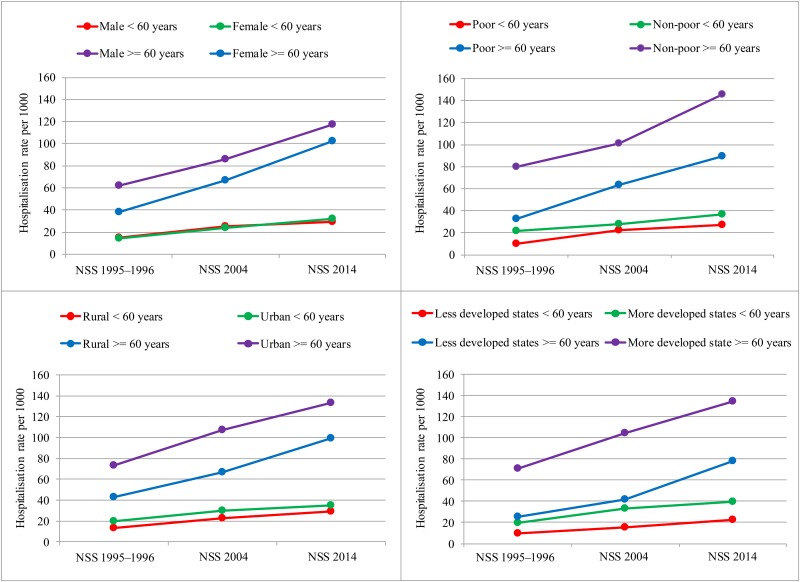
The annual hospitalisation rate per 1000 increased from 16.6 to 37.0 in India from 1995-1996 to 2014. The hospitalisation rate was about half in the less developed than the more developed states in 2014 (26.1 vs 48.6 per 1000). Poor people used more public than private hospitals; this differential was higher in the more developed (40.7% vs 22.9%) than the less developed (54.3% vs 40.1%) states in 2014. When compared with the younger population, the older population had a 3.6 times higher hospitalisation rate (109.9 vs 30.7) and a greater proportion of hospitalisation for non-communicable diseases (80.5% vs 56.7%) in 2014. Among the older population, hospitalisation rates were comparatively lower for females, poor and rural residents. Propensity change contributed to 86.5% of the increase in hospitalisation among the older population and compositional change contributed 9.3%.
The older population in India has a much higher hospitalisation rate and has continuing greater socioeconomic differentials in hospitalisation rates. Specific policy focus on the requirements of the older population for hospital care in India is needed in light of the anticipated increase in their proportion in the population.
我们报告了印度各邦不同年龄组以及各类疾病组的住院趋势,比较了老年人(60岁及以上)和年轻人(60岁以下)的住院趋势,并量化了二十年来导致老年人口住院率变化的因素。
系列横断面研究。
印度具有全国代表性的样本。
1995 - 1996年、2004年和2014年连续三次关于医疗保健利用情况的全国抽样调查(NSS)。
1995 - 1996年全国抽样调查中有633405人,2004年全国抽样调查中有385055人,2014年全国抽样调查中有335499人。
采用描述性统计、多变量分析和回归分解技术来实现研究目标。
从1995 - 1996年到2014年,印度每1000人的年住院率从16.6上升到37.0。2014年,欠发达邦的住院率约为发达邦的一半(每1000人分别为26.1和48.6)。穷人使用公立医院的比例高于私立医院;2014年,发达邦这种差异更大(40.7%对22.9%),而欠发达邦则为(54.3%对40.1%)。与年轻人相比,2014年老年人的住院率高出3.6倍(109.9对30.7),因非传染性疾病住院的比例更大(80.5%对56.7%)。在老年人群中,女性、贫困和农村居民的住院率相对较低。倾向变化占老年人口住院率上升的86.5%,构成变化占9.3%。
印度老年人口的住院率高得多,且住院率在社会经济方面的差异持续存在。鉴于老年人口在总人口中的比例预计会增加,需要针对印度老年人口的住院护理需求制定具体的政策重点。