Baldaranov Dobri, Khomenko Andrei, Kobor Ines, Bogdahn Ulrich, Gorges Martin, Kassubek Jan, Müller Hans-Peter
Department of Neurology, University of Regensburg, Regensburg, Germany.
Department of Neurology, University of Ulm, Ulm, Germany.
Front Hum Neurosci. 2017 Dec 5;11:567. doi: 10.3389/fnhum.2017.00567. eCollection 2017.
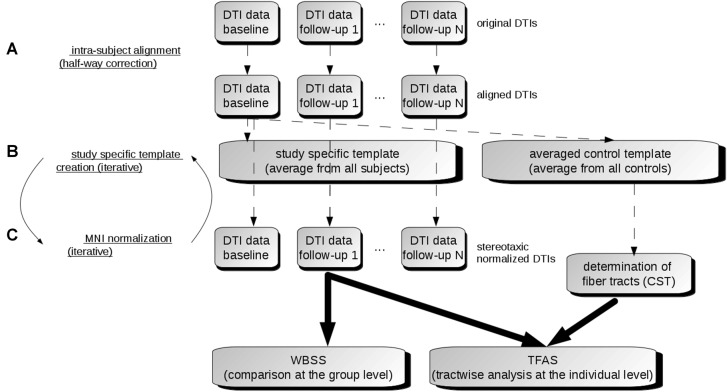
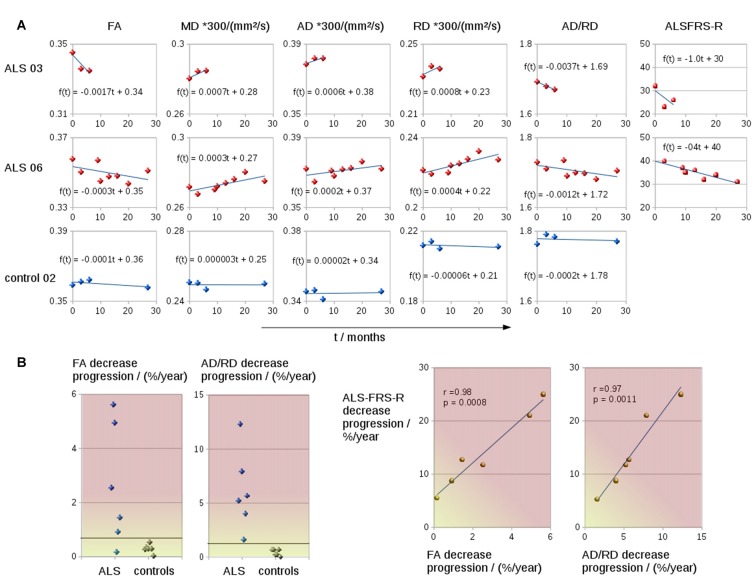
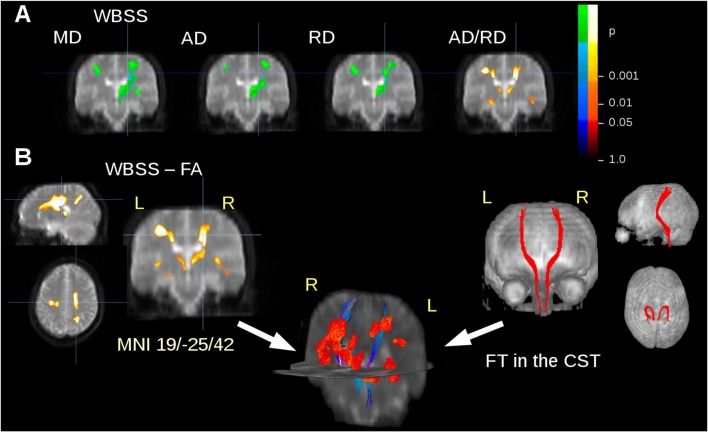
: The potential of magnetic resonance imaging (MRI) as a technical biomarker for cerebral microstructural alterations in neurodegenerative diseases is under investigation. In this study, a framework for the longitudinal analysis of diffusion tensor imaging (DTI)-based mapping was applied to the assessment of predefined white matter tracts in amyotrophic lateral sclerosis (ALS), as an example for a rapid progressive neurodegenerative disease. : DTI was performed every 3 months in six patients with ALS (mean = 7.7; range 3 to 15 scans) and in six controls ( = 3; range 2-5 scans) with the identical scanning protocol, resulting in a total of 65 longitudinal DTI datasets. Fractional anisotropy (FA), mean diffusivity (MD), axonal diffusivity (AD), radial diffusivity (RD), and the ratio AD/RD were studied to analyze alterations within the corticospinal tract (CST) which is a prominently affected tract structure in ALS and the tract correlating with Braak's neuropathological stage 1. A correlation analysis was performed between progression rates based on DTI metrics and the revised ALS functional rating scale (ALS-FRS-R). : Patients with ALS showed an FA and AD/RD decline along the CST, while DTI metrics of controls did not change in longitudinal DTI scans. The FA and AD/RD decrease progression correlated significantly with ALS-FRS-R decrease progression. : On the basis of the longitudinal assessment, DTI-based metrics can be considered as a possible noninvasive follow-up marker for disease progression in neurodegeneration. This finding was demonstrated here for ALS as a fast progressing neurodegenerative disease.
磁共振成像(MRI)作为神经退行性疾病脑微结构改变的一种技术生物标志物的潜力正在研究中。在本研究中,一个基于扩散张量成像(DTI)图谱的纵向分析框架被应用于评估肌萎缩侧索硬化症(ALS)中预先定义的白质束,ALS是一种快速进展的神经退行性疾病的实例。
对6例ALS患者(平均 = 7.7;扫描次数范围为3至15次)和6例对照者( = 3;扫描次数范围为2至5次)按照相同的扫描方案每3个月进行一次DTI检查,共获得65个纵向DTI数据集。研究了分数各向异性(FA)、平均扩散率(MD)、轴突扩散率(AD)、径向扩散率(RD)以及AD/RD比值,以分析皮质脊髓束(CST)内的变化,CST是ALS中一个明显受影响的束结构,且与Braak神经病理学1期相关的束。基于DTI指标的进展率与修订的ALS功能评定量表(ALS-FRS-R)之间进行了相关性分析。
ALS患者沿CST的FA和AD/RD下降,而对照组的DTI指标在纵向DTI扫描中未发生变化。FA和AD/RD下降的进展与ALS-FRS-R下降的进展显著相关。
基于纵向评估,基于DTI的指标可被视为神经退行性疾病疾病进展的一种可能的非侵入性随访标志物。这一发现在此以ALS这种快速进展的神经退行性疾病得到了证实。