Čvorović Jovana, Passamonti Sabina
Department of Life Sciences, University of Trieste, Trieste, Italy.
Front Pharmacol. 2017 Dec 5;8:887. doi: 10.3389/fphar.2017.00887. eCollection 2017.
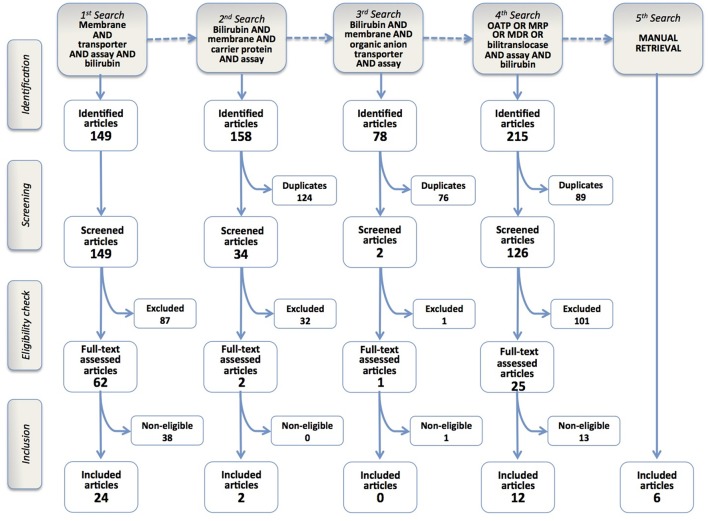
Bilirubin is a highly-hydrophobic tetrapyrrole which binds to plasma albumin. It is conjugated in the liver to glucuronic acid, and the water-soluble glucuronides are excreted in urine and bile. The membrane transporters of bilirubin diglucuronide are well-known. Still undefined are however the transporters performing the uptake of bilirubin from the blood into the liver, a process known to be fast and not rate-limited. The biological importance of this process may be appraised by considering that in normal adults 200-300 mg of bilirubin are produced daily, as a result of the physiologic turnover of hemoglobin and cellular cytochromes. Nevertheless, research in this field has yielded controversial and contradicting results. We have undertaken a systematic review of the literature, believing in its utility to improve the existing knowledge and promote further advancements. We have sourced the PubMed database until 30 June 2017 by applying 5 sequential searches. Screening and eligibility criteria were applied to retain research articles reporting results obtained by using bilirubin molecules in membrane transport assays or by assessing serum bilirubin levels in experiments. We have identified 311 articles, retaining 44, reporting data on experimental models having 6 incremental increases of complexity (isolated proteins, membrane vesicles, cells, organ fragments, rodents, and human studies), demonstrating the function of 19 membrane transporters, encoded by either or genes. Three other bilirubin transporters have no gene, though one, i.e., bilitranslocase, is annotated in the Transporter Classification Database. This is the first review that has systematically examined the membrane transporters for bilirubin and its conjugates. Paradoxically, the remarkable advancements in the field of membrane transport of bilirubin have pointed to the elusive mechanism(s) enabling bilirubin to diffuse into the liver as if no cellular boundary existed.
胆红素是一种与血浆白蛋白结合的高度疏水的四吡咯。它在肝脏中与葡萄糖醛酸结合,水溶性的葡萄糖醛酸苷通过尿液和胆汁排出。双葡萄糖醛酸胆红素的膜转运体是众所周知的。然而,负责将胆红素从血液摄取到肝脏的转运体仍不明确,这一过程已知速度很快且不受速率限制。考虑到在正常成年人中,由于血红蛋白和细胞色素的生理更新,每天会产生200 - 300毫克胆红素,这一过程的生物学重要性可见一斑。尽管如此,该领域的研究结果却存在争议且相互矛盾。我们对文献进行了系统综述,相信其有助于增进现有知识并推动进一步发展。我们通过5次连续检索,查询了截至2017年6月30日的PubMed数据库。应用筛选和合格标准来保留那些报告了在膜转运实验中使用胆红素分子或在实验中评估血清胆红素水平所获结果的研究文章。我们共识别出311篇文章,最终保留了44篇,这些文章报道了关于具有6种递增复杂性的实验模型(分离的蛋白质、膜囊泡、细胞、器官片段、啮齿动物和人体研究)的数据,展示了由不同基因编码的19种膜转运体的功能。另外三种胆红素转运体没有相应基因,不过其中一种,即胆红素转运酶,已在转运体分类数据库中有所标注。这是首次对胆红素及其结合物的膜转运体进行系统研究的综述。矛盾的是,胆红素膜转运领域的显著进展却指向了使胆红素能像不存在细胞边界一样扩散进入肝脏的难以捉摸的机制。