Imai Toshio, Yasuda Nobuyuki
KAN Research Institute, Inc., 6-8-2 Minatojima-minamimachi Chuo-ku, Kobe, Hyogo 650-0047 Japan.
Inflamm Regen. 2016 Jun 15;36:9. doi: 10.1186/s41232-016-0017-2. eCollection 2016.
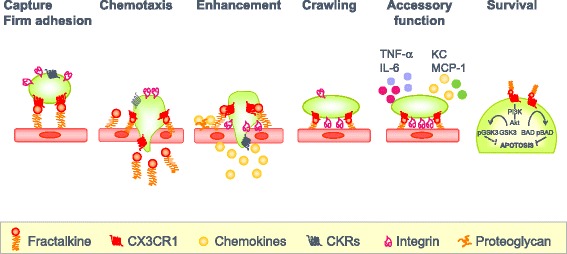
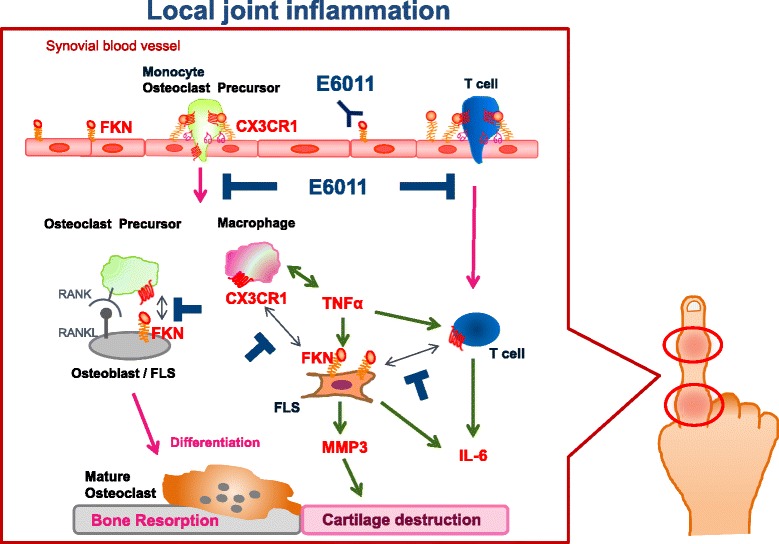
Inflammatory and immune responses are generated locally by the selective invasion and accumulation of the immune cells into the lesion site. The infiltration process of the immune cells into the tissue from the blood through the vascular endothelial cells is closely regulated by a number of chemotactic factors and cell adhesion molecules. Fractalkine (FKN)/CX3CL1 is a membrane-bound chemokine possessing a chemokine/mucin hybrid structure and a transmembrane domain and has a dual function as an adhesion molecule and a chemoattractant. FKN is mainly expressed on activated endothelial cells, activated fibroblasts, and osteoblasts. Its receptor, CX3CR1, is expressed on cytotoxic effector lymphocytes, monocytes/macrophages, and osteoclasts. To date, a lot of key functional aspects of the FKN-CX3CR1 axis has been identified: (1) the rapid capture and firm adhesion of immune cells to vascular endothelial cells, (2) chemotaxis, (3) the enhancement of the transmigration to other chemokines, (4) the crawling behavior of the monocytes that patrol on vascular endothelial cells, (5) the retention of monocytes as the accessory cells of the inflamed endothelium to recruit inflammatory cells, and (6) the survival of the macrophage. In this review, we will focus on the pathological role of FKN in rheumatoid arthritis (RA) and the physiological role of FKN on osteoclast differentiation. Furthermore, we will discuss the therapeutic potential of anti-FKN mAb for RA patients and its distinct mode of action from other cytokine inhibitors.
炎症和免疫反应是由免疫细胞选择性侵入并聚集到病变部位而在局部产生的。免疫细胞从血液通过血管内皮细胞浸润到组织中的过程受到多种趋化因子和细胞黏附分子的密切调控。趋化因子配体(Fractalkine,FKN)/CX3CL1是一种膜结合趋化因子,具有趋化因子/黏蛋白杂交结构和跨膜结构域,兼具黏附分子和趋化因子的双重功能。FKN主要表达于活化的内皮细胞、活化的成纤维细胞和成骨细胞上。其受体CX3CR1表达于细胞毒性效应淋巴细胞、单核细胞/巨噬细胞和破骨细胞上。迄今为止,FKN-CX3CR1轴的许多关键功能已被确定:(1)免疫细胞与血管内皮细胞的快速捕获和牢固黏附;(2)趋化作用;(3)增强向其他趋化因子的迁移;(4)单核细胞在血管内皮细胞上巡逻的爬行行为;(5)单核细胞作为炎症内皮的辅助细胞保留以募集炎症细胞;(6)巨噬细胞的存活。在本综述中,我们将重点关注FKN在类风湿关节炎(RA)中的病理作用以及FKN在破骨细胞分化中的生理作用。此外,我们将讨论抗FKN单克隆抗体对RA患者的治疗潜力及其与其他细胞因子抑制剂不同的作用方式。