Department of Translational Research and New Technologies in Medicine and Surgery, University of Pisa, Via Roma 55, 56126 Pisa, Italy.
I.R.C.C.S. Neuromed, Via Atinense 18, Pozzilli, 86077 Isernia, Italy.
Biomed Res Int. 2017;2017:7082696. doi: 10.1155/2017/7082696. Epub 2017 Nov 13.
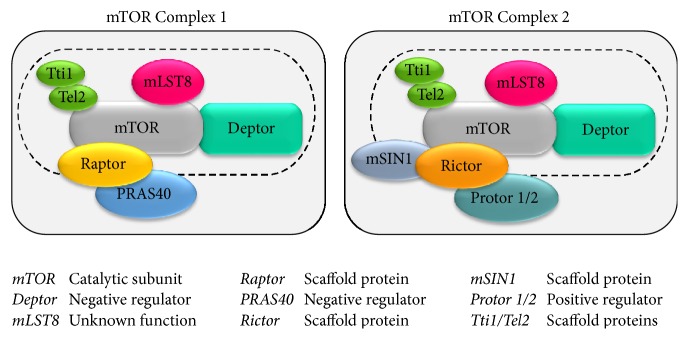
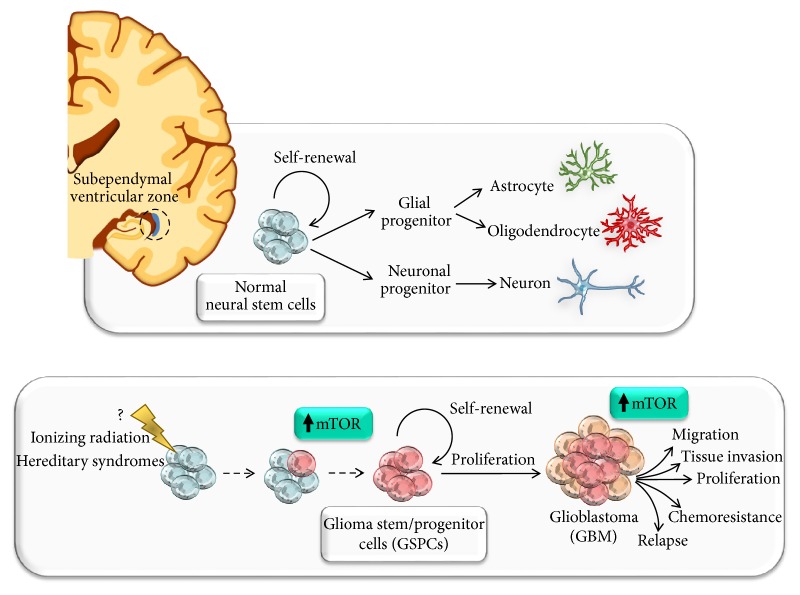
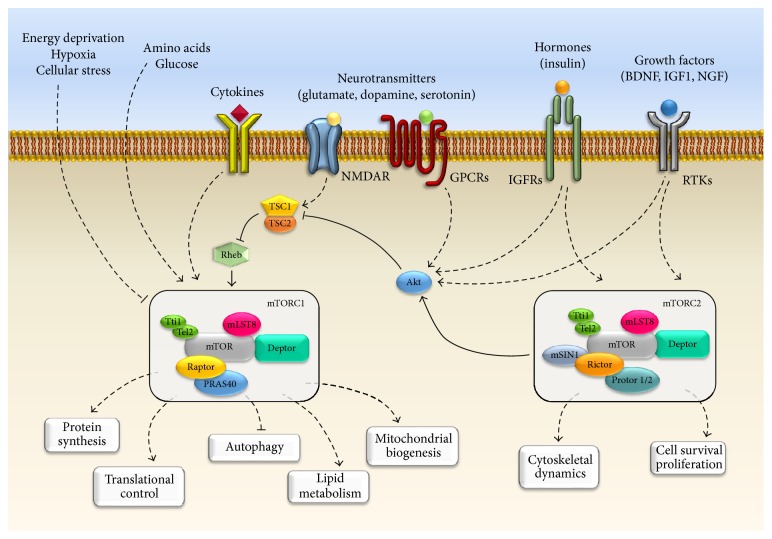
The mammalian Target of Rapamycin (mTOR) is a molecular complex equipped with kinase activity which controls cell viability being key in the PI3K/PTEN/Akt pathway. mTOR acts by integrating a number of environmental stimuli to regulate cell growth, proliferation, autophagy, and protein synthesis. These effects are based on the modulation of different metabolic pathways. Upregulation of mTOR associates with various pathological conditions, such as obesity, neurodegeneration, and brain tumors. This is the case of high-grade gliomas with a high propensity to proliferation and tissue invasion. Glioblastoma Multiforme (GBM) is a WHO grade IV malignant, aggressive, and lethal glioma. To date, a few treatments are available although the outcome of GBM patients remains poor. Experimental and pathological findings suggest that mTOR upregulation plays a major role in determining an aggressive phenotype, thus determining relapse and chemoresistance. Among several activities, mTOR-induced autophagy suppression is key in GBM malignancy. In this article, we discuss recent evidence about mTOR signaling and its role in normal brain development and pathological conditions, with a special emphasis on its role in GBM.
哺乳动物雷帕霉素靶蛋白(mTOR)是一种具有激酶活性的分子复合物,它控制着细胞活力,是 PI3K/PTEN/Akt 通路中的关键。mTOR 通过整合多种环境刺激来调节细胞生长、增殖、自噬和蛋白质合成。这些作用是基于对不同代谢途径的调节。mTOR 的上调与多种病理状况相关,如肥胖、神经退行性变和脑肿瘤。这就是高级别神经胶质瘤的情况,它具有高度增殖和组织侵袭的倾向。胶质母细胞瘤(GBM)是一种 WHO 分级为 IV 级的恶性、侵袭性和致命性神经胶质瘤。迄今为止,虽然 GBM 患者的预后仍然很差,但已有一些治疗方法可用。实验和病理发现表明,mTOR 的上调在决定侵袭性表型方面起着主要作用,从而决定了复发和化疗耐药性。在多种活性中,mTOR 诱导的自噬抑制在 GBM 恶性肿瘤中是关键的。在本文中,我们讨论了关于 mTOR 信号及其在正常大脑发育和病理条件中的作用的最新证据,特别强调了它在 GBM 中的作用。