Kusano Masashi, Horibe Shuji, Tanaka Yoshinari, Yonetani Yasukazu, Kanamoto Takashi, Shiozaki Yoshiki, Tsujii Akira
Department of Orthopaedic Surgery, Seifu Hospital, Sakai, Japan.
Osaka Prefecture University, Graduate School of Comprehensive Rehabilitation, Habikino, Japan.
Asia Pac J Sports Med Arthrosc Rehabil Technol. 2015 May 7;2(3):95-97. doi: 10.1016/j.asmart.2015.03.001. eCollection 2015 Jul.
Mucoid degeneration of the anterior cruciate ligament (ACL) is mostly observed in middle-aged patients with knee pain and limited range of motion. Although arthroscopic resection of the degenerated ACL is the treatment of choice following the failure of conservative management, the extent of the excision and subsequent ACL reconstruction for postoperative knee instability remains controversial.
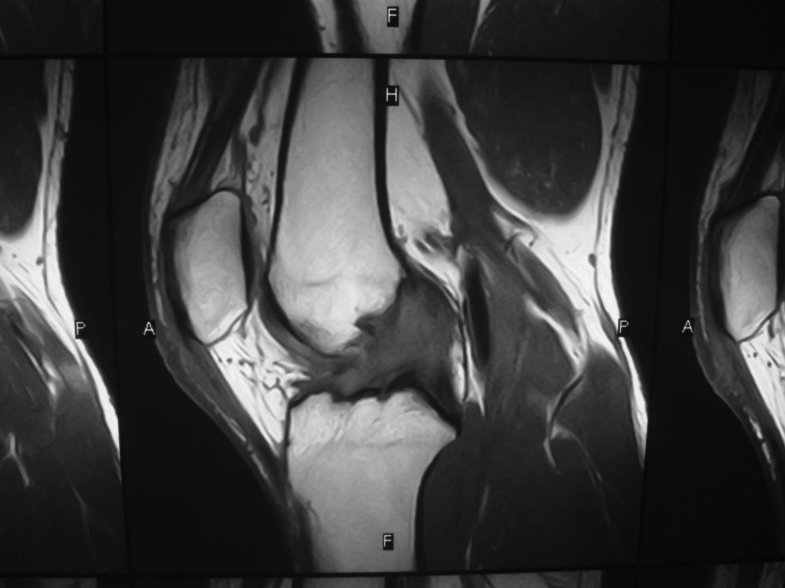
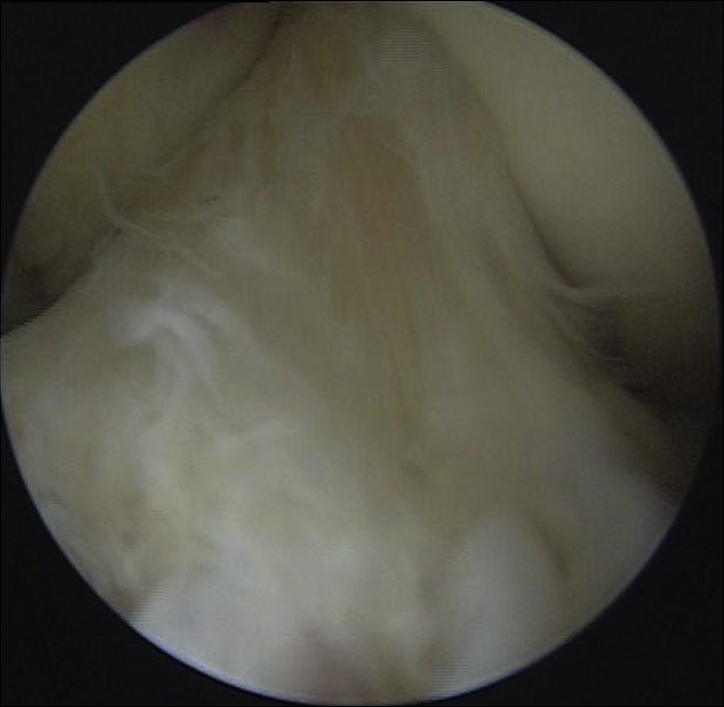
We present four cases of mucoid degeneration of the ACL in patients aged <40 years, and suggest a suitable treatment strategy for younger patients. All four patients (mean age, 33.8 years) were diagnosed with mucoid degeneration of the ACL based on characteristic clinical symptoms and magnetic resonance imaging. Arthroscopic resection of the affected portion of the ACL was performed as follows: partial resection in two cases with limited hypertrophy, and total ACL resection in the remaining two cases with degeneration involving the entire ligament. Preoperative symptoms disappeared in all cases after resection of the lesions. In the two patients with partial resection, the ACL was completely torn during subsequent sports activities despite showing no symptoms of instability for 2 years postoperatively. All four patients, including the two treated by total resection, underwent ACL reconstruction using an autogenous hamstring tendon.
Considering the rupture of residual ACL fibres after partial resection and the inevitability of total ACL resection due to degeneration of the entire ligament, ACL reconstruction should be considered in younger patients with symptomatic mucoid degeneration of the ACL.
前交叉韧带(ACL)黏液样变性多见于有膝关节疼痛和活动范围受限的中年患者。尽管在保守治疗失败后,关节镜下切除退变的ACL是首选治疗方法,但对于术后膝关节不稳定,切除范围及后续的ACL重建仍存在争议。
我们报告了4例年龄小于40岁的ACL黏液样变性患者,并为年轻患者提出了合适的治疗策略。所有4例患者(平均年龄33.8岁)根据典型临床症状和磁共振成像诊断为ACL黏液样变性。对ACL病变部位进行关节镜下切除的方式如下:2例肥大程度有限的患者行部分切除,其余2例韧带全层退变的患者行ACL全切。切除病变后,所有病例术前症状均消失。在2例行部分切除的患者中,尽管术后2年无不稳定症状,但在随后的体育活动中ACL完全撕裂。包括2例行全切的患者在内的所有4例患者均使用自体腘绳肌腱进行了ACL重建。
考虑到部分切除后残留ACL纤维的断裂以及由于韧带全层退变而不可避免的ACL全切,对于有症状的年轻ACL黏液样变性患者,应考虑进行ACL重建。