Shimizu Koichiro, Yonekawa Tadato, Yoshida Morikatsu, Miyazato Mikiya, Miura Ayako, Sakoda Hideyuki, Yamaguchi Hideki, Nakazato Masamitsu
Division of Neurology, Respirology, Endocrinology, and Metabolism, Department of Internal Medicine, Faculty of Medicine, University of Miyazaki, 5200 Kihara, Kiyotake, Miyazaki City, Miyazaki 889-1602, Japan.
Department of Biochemistry, National Cerebral and Cardiovascular Center Research Institute, 5-7-1 Fujishirodai, Suita, Osaka 565-8565, Japan.
J Endocr Soc. 2017 Sep 5;1(10):1259-1271. doi: 10.1210/js.2017-00277. eCollection 2017 Oct 1.
Kisspeptin receptor (KISS1R) is expressed in hypothalamic gonadotropin-releasing hormone neurons and responsible for pubertal onset and reproductive functions. mutations remain a rare cause of congenital hypogonadotropic hypogonadism (CHH).
The aim of this study was to identify the genetic cause of CHH in a patient and to functionally characterize a mutation.
The patient was a 47-year-old Japanese man whose parents were first cousins. He lacked secondary sexual characteristics owing to normosmic CHH. Exon segments for the gene in this patient were screened for mutations. Functional analyses were performed using HEK293 cells expressing KISS1R mutants. Molecular dynamics simulations were performed to compare the ligand-KISS1R mutant complex with those of wild-type KISS1R variants.
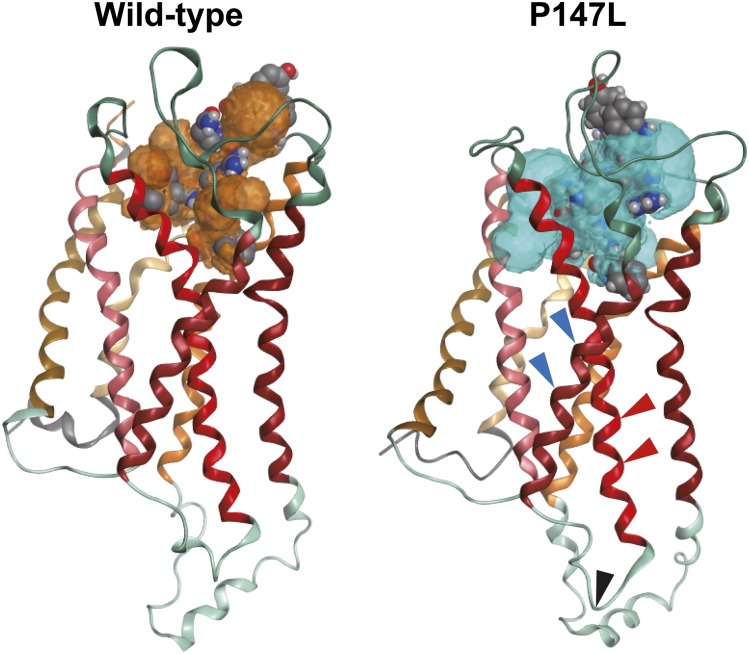
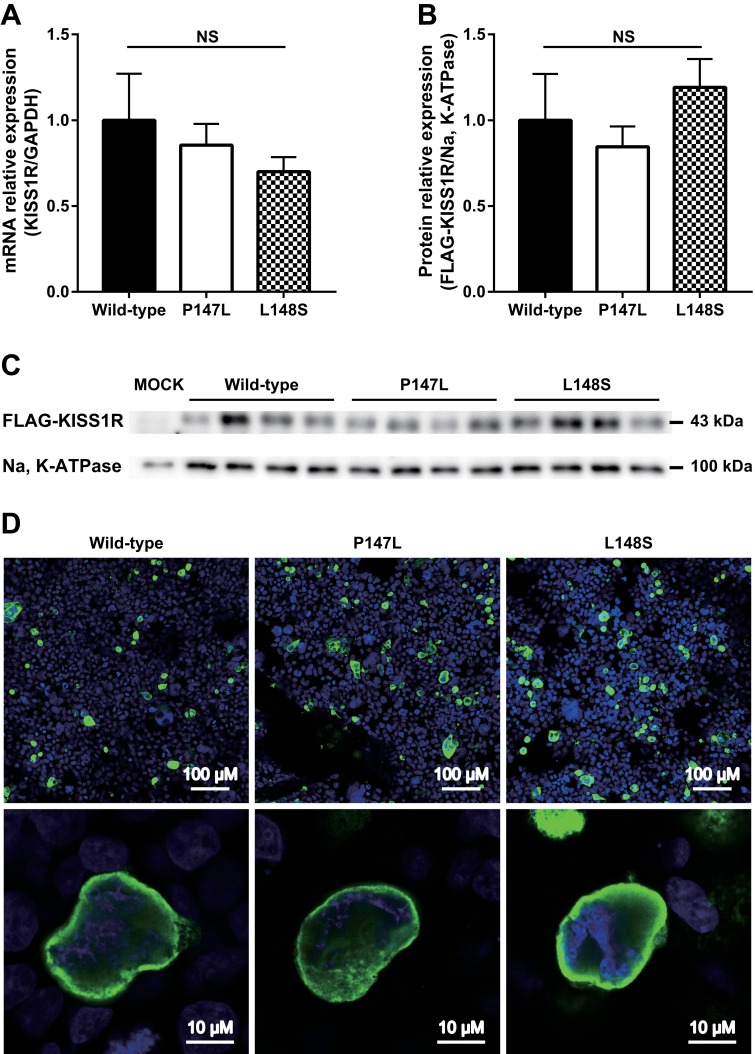
A homozygous mutation (c.440C>T, p.P147L) in was identified. The P147L mutation did not affect either receptor expression level or subcellular localization in the recombinant expression system. Intracellular calcium measurements and cellular dielectric spectroscopy demonstrated that the P147L mutation impaired receptor function to an extent more severe than that of a previously reported L148S mutation. A receptor-ligand binding assay showed the P147L mutation causes a substantial loss of ligand-binding affinity. Molecular dynamics simulations revealed the P147L mutation decreases the contact surface area of the ligand-receptor complex in an expanded ligand-binding pocket.
We identified a loss-of-function mutation in associated with CHH. Our results demonstrated that the P147L mutation causes a severe phenotype and functional impairment resulting from the loss of ligand-binding affinity due to an expanded ligand-binding pocket.
亲吻素受体(KISS1R)在下丘脑促性腺激素释放激素神经元中表达,负责青春期启动和生殖功能。突变仍然是先天性低促性腺激素性性腺功能减退(CHH)的罕见原因。
本研究旨在确定一名患者CHH的遗传病因,并对一种突变进行功能表征。
该患者是一名47岁的日本男性,其父母是近亲。由于嗅觉正常的CHH,他缺乏第二性征。对该患者KISS1R基因的外显子片段进行突变筛查。使用表达KISS1R突变体的HEK293细胞进行功能分析。进行分子动力学模拟,以比较配体-KISS1R突变体复合物与野生型KISS1R变体的复合物。
在KISS1R中鉴定出纯合突变(c.440C>T,p.P147L)。P147L突变在重组表达系统中既不影响受体表达水平也不影响亚细胞定位。细胞内钙测量和细胞介电谱表明,P147L突变对受体功能的损害程度比先前报道的L148S突变更严重。受体-配体结合试验表明,P147L突变导致配体结合亲和力大幅丧失。分子动力学模拟显示,P147L突变在扩大的配体结合口袋中减少了配体-受体复合物的接触表面积。
我们鉴定出与CHH相关的KISS1R功能丧失突变。我们的结果表明,P147L突变由于配体结合口袋扩大导致配体结合亲和力丧失,从而引起严重的表型和功能损害。