Abe Junko, Umetsu Ryogo, Uranishi Hiroaki, Suzuki Honami, Nishibata Yuri, Kato Yamato, Ueda Natsumi, Sasaoka Sayaka, Hatahira Haruna, Motooka Yumi, Masuta Mayuko, Nakamura Mitsuhiro
Laboratory of Drug Informatics, Gifu Pharmaceutical University, Daigaku-nishi, Gifu, Japan.
Medical Database Co., Ltd., Higashi, Shibuya-ku, Tokyo, Japan.
PLoS One. 2017 Dec 21;12(12):e0190102. doi: 10.1371/journal.pone.0190102. eCollection 2017.
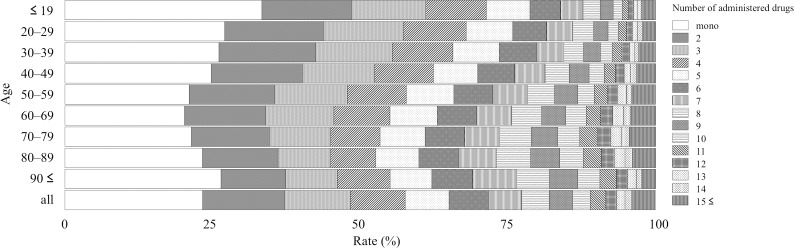
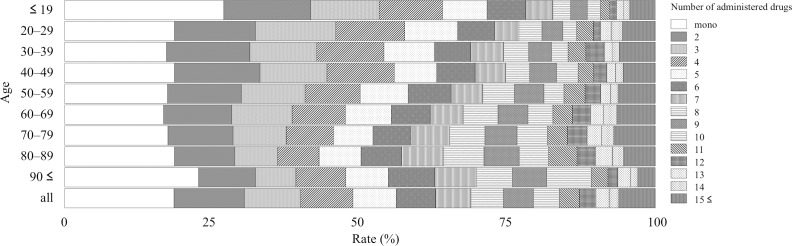
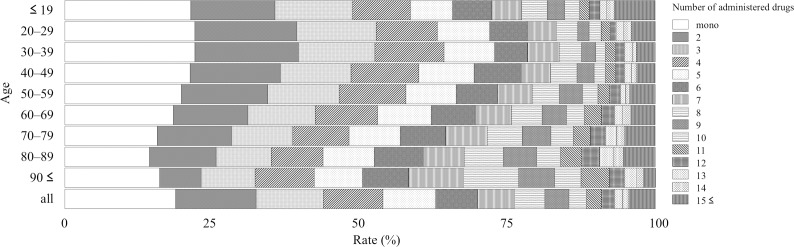
Population aging is a global phenomenon, and choosing appropriate medical care for the elderly is critical. Polypharmacy is suspected to increase the risk of adverse events (AEs) in older patients. We examined the AE profiles associated with polypharmacy and aging using the Japanese Adverse Drug Event Report (JADER) database. We attempted to mitigate the effect of patient-related factors using a multiple-logistic regression technique and data subsetting. We selected case reports for AEs as specified in the Medical Dictionary for Regulatory Activities (MedDRA). The association between polypharmacy and "renal disorder" or "hepatic disorder" was evaluated using reporting odds ratio (ROR) and adjusted for covariates using multiple-logistic regression. For renal disorder, advanced polypharmacy showed higher adjusted RORs, because the value of administered drugs group [1.82 (1.76-1.88), ≥ 10] was higher than that of the number of administered drugs group [1.27 (1.24-1.31), 5-9]. The lower limit of the 95% confidence interval (CI) of adjusted ROR for age (≥ 60 years) was > 1 for renal disorder. For hepatic disorder, the adjusted RORs were as follows: 1.17 (1.14-1.20) for the number of administered drugs group (5-9) and 1.14 (1.11-1.18) for the number of administered drugs group (≥ 10). The adjusted RORs of hepatic disorder compared to those of renal disorder had lower adjusted RORs related to the increase in the number of administered drugs. Therefore, elderly individuals should be closely monitored for the occurrence of renal disorder when they are subjected to polypharmacy. This approach might apply to the simultaneous evaluation of the AE risk of polypharmacy and aging.
人口老龄化是一种全球现象,为老年人选择合适的医疗护理至关重要。多重用药被怀疑会增加老年患者发生不良事件(AE)的风险。我们使用日本药品不良事件报告(JADER)数据库研究了与多重用药和老龄化相关的不良事件特征。我们尝试使用多元逻辑回归技术和数据子集来减轻患者相关因素的影响。我们选择了《监管活动医学词典》(MedDRA)中规定的不良事件病例报告。使用报告比值比(ROR)评估多重用药与“肾脏疾病”或“肝脏疾病”之间的关联,并使用多元逻辑回归对协变量进行调整。对于肾脏疾病,晚期多重用药显示出更高的调整后ROR,因为给药药物组的值[1.82(1.76 - 1.88),≥10]高于给药药物数量组的值[1.27(1.24 - 1.31),5 - 9]。肾脏疾病年龄(≥60岁)调整后ROR的95%置信区间(CI)下限>1。对于肝脏疾病,调整后的ROR如下:给药药物数量组(5 - 9)为1.17(1.14 - 1.20),给药药物数量组(≥10)为1.14(1.11 - 1.18)。与肾脏疾病相比,肝脏疾病的调整后ROR与给药药物数量增加相关的调整后ROR较低。因此,老年人在接受多重用药时应密切监测肾脏疾病的发生。这种方法可能适用于同时评估多重用药和老龄化的不良事件风险。