Griggs Ryan B, Laird Don E, Donahue Renee R, Fu Weisi, Taylor Bradley K
Department of Physiology, University of Kentucky, College of Medicine, Lexington, KY, United States.
Center for Analgesia Research Excellence, University of Kentucky College of Medicine, Lexington, KY, United States.
Front Neurosci. 2017 Dec 6;11:679. doi: 10.3389/fnins.2017.00679. eCollection 2017.
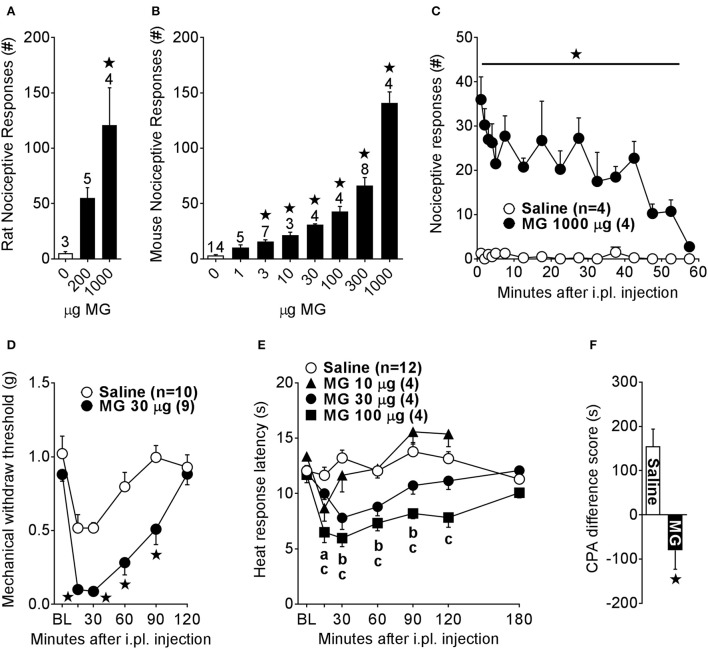
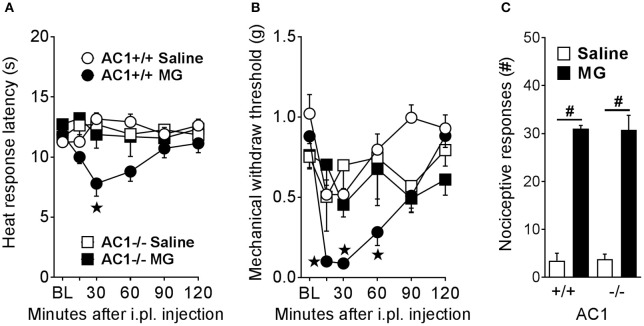
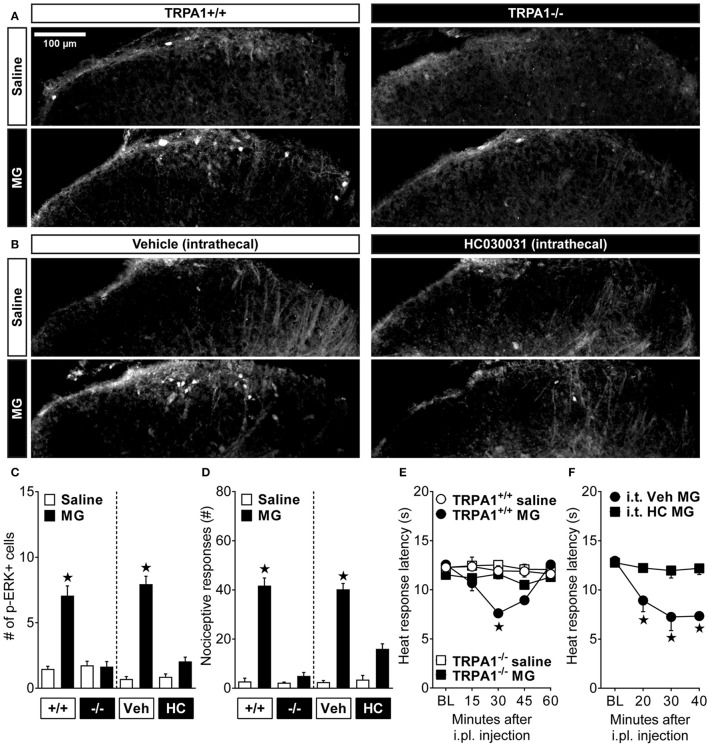
Methylglyoxal (MG) is a metabolite of glucose that may contribute to peripheral neuropathy and pain in diabetic patients. MG increases intracellular calcium in sensory neurons and produces behavioral nociception via the cation channel transient receptor potential ankyrin 1 (TRPA1). However, rigorous characterization of an animal model of methylglyoxal-evoked pain is needed, including testing whether methylglyoxal promotes negative pain affect. Furthermore, it remains unknown whether methylglyoxal is sufficient to activate neurons in the spinal cord dorsal horn, whether this requires TRPA1, and if the calcium-sensitive adenylyl cyclase 1 isoform (AC1) contributes to MG-evoked pain. We administered intraplantar methylglyoxal and then evaluated immunohistochemical phosphorylation of extracellular signal-regulated kinase (p-ERK) and multiple pain-like behaviors in wild-type rats and mice and after disruption of either TRPA1 or AC1. Methylglyoxal produced conditioned place avoidance (CPA) (a measure of affective pain), dose-dependent licking and lifting nociceptive behaviors, hyperalgesia to heat and mechanical stimulation, and p-ERK in the spinal cord dorsal horn. TRPA1 knockout or intrathecal administration of a TRPA1 antagonist (HC030031) attenuated methylglyoxal-evoked p-ERK, nociception, and hyperalgesia. AC1 knockout abolished hyperalgesia but not nociceptive behaviors. These results indicate that intraplantar administration of methylglyoxal recapitulates multiple signs of painful diabetic neuropathy found in animal models of or patients with diabetes, including the activation of spinal nociresponsive neurons and the potential involvement of a TRPA1-AC1 sensitization mechanism. We conclude that administration of MG is a valuable model for investigating both peripheral and central components of a MG-TRPA1-AC1 pathway that contribute to painful diabetic neuropathy.
甲基乙二醛(MG)是葡萄糖的一种代谢产物,可能导致糖尿病患者出现周围神经病变和疼痛。MG可增加感觉神经元内的细胞内钙,并通过阳离子通道瞬时受体电位锚蛋白1(TRPA1)产生行为性伤害感受。然而,需要对甲基乙二醛诱发疼痛的动物模型进行严格表征,包括测试甲基乙二醛是否会促进负面疼痛影响。此外,甲基乙二醛是否足以激活脊髓背角的神经元、这是否需要TRPA1以及钙敏感腺苷酸环化酶1同工型(AC1)是否参与甲基乙二醛诱发的疼痛仍不清楚。我们在野生型大鼠和小鼠以及破坏TRPA1或AC1后,进行足底内注射甲基乙二醛,然后评估细胞外信号调节激酶(p-ERK)的免疫组化磷酸化和多种疼痛样行为。甲基乙二醛产生条件性位置回避(CPA)(一种情感性疼痛指标)、剂量依赖性舔舐和抬腿伤害感受行为、对热和机械刺激的痛觉过敏以及脊髓背角的p-ERK。TRPA1基因敲除或鞘内注射TRPA1拮抗剂(HC030031)可减轻甲基乙二醛诱发的p-ERK、伤害感受和痛觉过敏。AC1基因敲除消除了痛觉过敏,但未消除伤害感受行为。这些结果表明,足底内注射甲基乙二醛可重现糖尿病动物模型或患者中发现的疼痛性糖尿病神经病变的多种体征,包括脊髓伤害反应性神经元的激活以及TRPA1-AC1致敏机制的潜在参与。我们得出结论,给予MG是研究导致疼痛性糖尿病神经病变的MG-TRPA1-AC1途径的外周和中枢成分的有价值模型。