State University of New York at Buffalo, Jacobs Multiple Sclerosis Center for Treatment and Research, Jacobs Pediatric Multiple Sclerosis Center of Excellence, New York State Multiple Sclerosis Consortium, Buffalo, NY, USA.
Novartis Pharma AG, Basel, Switzerland.
CNS Drugs. 2018 Jan;32(1):75-84. doi: 10.1007/s40263-017-0482-4.
'No evidence of disease activity' (NEDA), a composite measure of clinical and magnetic resonance imaging outcomes, provides a comprehensive assessment of disease activity, but is not extensively reported in clinical practice. NEDA-3 is defined as patients with no new/enlarged T2 or gadolinium-enhancing lesions, no relapses, and no disability progression (according to Expanded Disability Status Scale scores). NEDA-4 comprises the components of NEDA-3 and a fourth criterion of ≤ 0.4% annualized brain volume loss.
The objective of this study was to assess NEDA status among patients with relapsing-remitting multiple sclerosis receiving fingolimod in clinical practice.
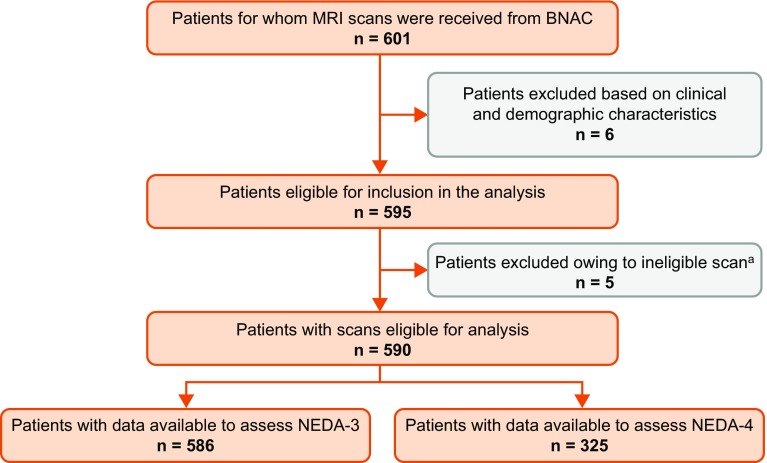
Clinical and magnetic resonance imaging data were retrospectively collected from 590 patients who initiated fingolimod at 33 multiple sclerosis centers in the USA. Patients were required to have a magnetic resonance imaging scan in the 6 months before or 1 month after fingolimod initiation (index period) and in the 9-24 months after fingolimod initiation (post-index period). Magnetic resonance imaging data were systematically quantified at a centralized reading facility. The proportions of patients with NEDA-3 or NEDA-4 status during fingolimod treatment were assessed.
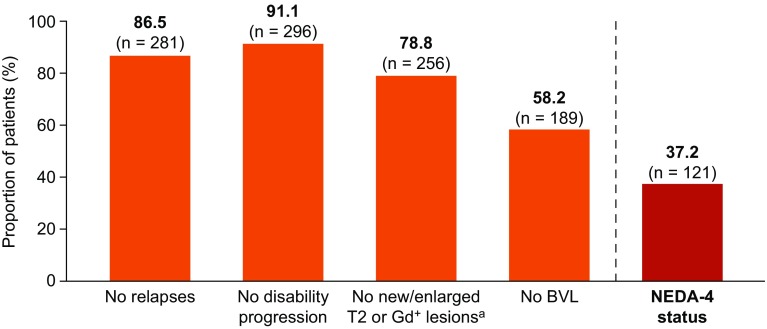
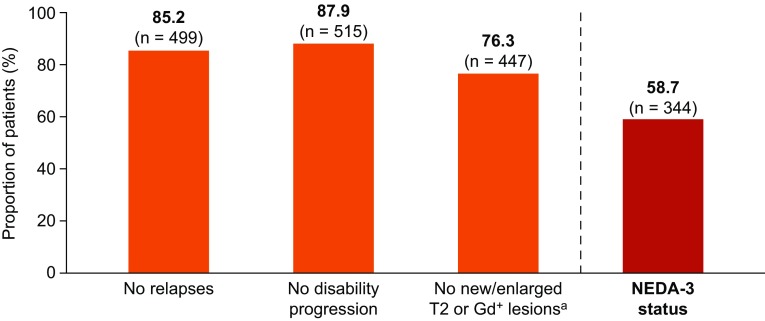
During the follow-up period (median: 16 months), data to assess NEDA-3 and NEDA-4 were available for 586 and 325 patients, respectively. In the post-index period, 58.7% of patients achieved NEDA-3 status (no relapses, 85.2%; no new/enlarged T2/gadolinium-enhancing lesions, 76.3%; no disability progression, 87.9%) and 37.2% achieved NEDA-4 status (no relapses, 86.5%; no new/enlarged T2/gadolinium-enhancing lesions, 78.8%; no disability progression, 91.1%; brain volume loss ≤ 0.4, 58.2%).
Among patients receiving fingolimod, over half achieved NEDA-3 status and over one-third achieved NEDA-4 status.
“无疾病活动证据”(NEDA)是一种临床和磁共振成像结果的综合评估指标,但在临床实践中并未广泛报告。NEDA-3 定义为无新发/扩大 T2 或钆增强病变、无复发和无残疾进展(根据扩展残疾状态量表评分)的患者。NEDA-4 包括 NEDA-3 的四个组成部分和每年脑容量损失<0.4%的标准。
本研究旨在评估接受临床实践中使用芬戈莫德治疗的复发性多发性硬化症患者的 NEDA 状态。
回顾性收集了 590 名在美国 33 个多发性硬化症中心开始使用芬戈莫德的患者的临床和磁共振成像数据。患者需要在开始使用芬戈莫德前 6 个月或开始后 1 个月(索引期)和开始后 9-24 个月(索引后期)进行磁共振成像扫描。磁共振成像数据在一个集中的阅读设施进行系统地量化。评估了在接受芬戈莫德治疗期间患者达到 NEDA-3 或 NEDA-4 状态的比例。
在随访期间(中位数:16 个月),分别有 586 名和 325 名患者有数据评估 NEDA-3 和 NEDA-4。在索引后期,58.7%的患者达到了 NEDA-3 状态(无复发,85.2%;无新/扩大 T2/钆增强病变,76.3%;无残疾进展,87.9%),37.2%达到了 NEDA-4 状态(无复发,86.5%;无新/扩大 T2/钆增强病变,78.8%;无残疾进展,91.1%;脑容量损失≤0.4%,58.2%)。
在接受芬戈莫德治疗的患者中,超过一半达到了 NEDA-3 状态,超过三分之一达到了 NEDA-4 状态。