Kueneman Jordan G, Weiss Sophie, McKenzie Valerie J
Department of Ecology and Evolutionary Biology, University of Colorado Boulder, Boulder, CO, United States.
Smithsonian Tropical Research Institute, Panama City, Panama.
Front Microbiol. 2017 Dec 8;8:2350. doi: 10.3389/fmicb.2017.02350. eCollection 2017.
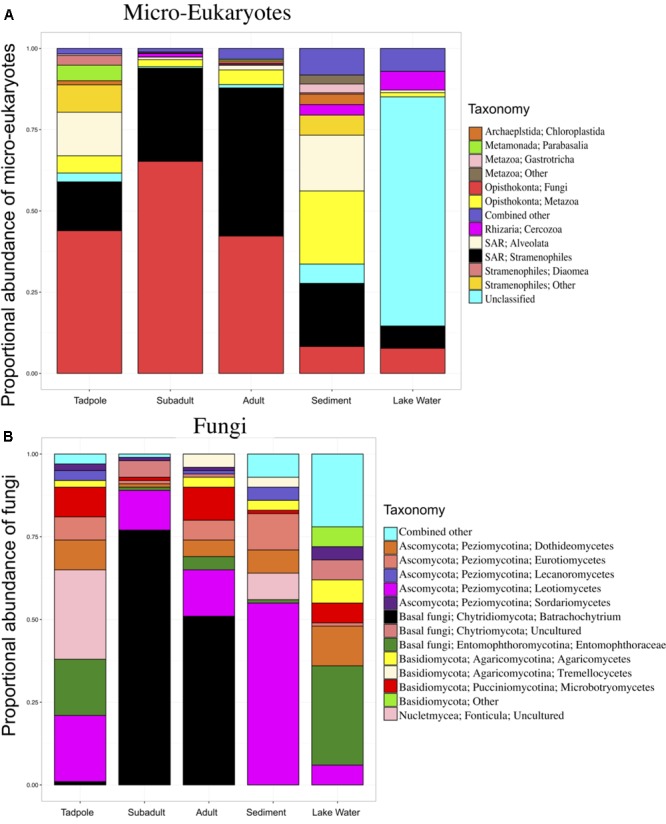
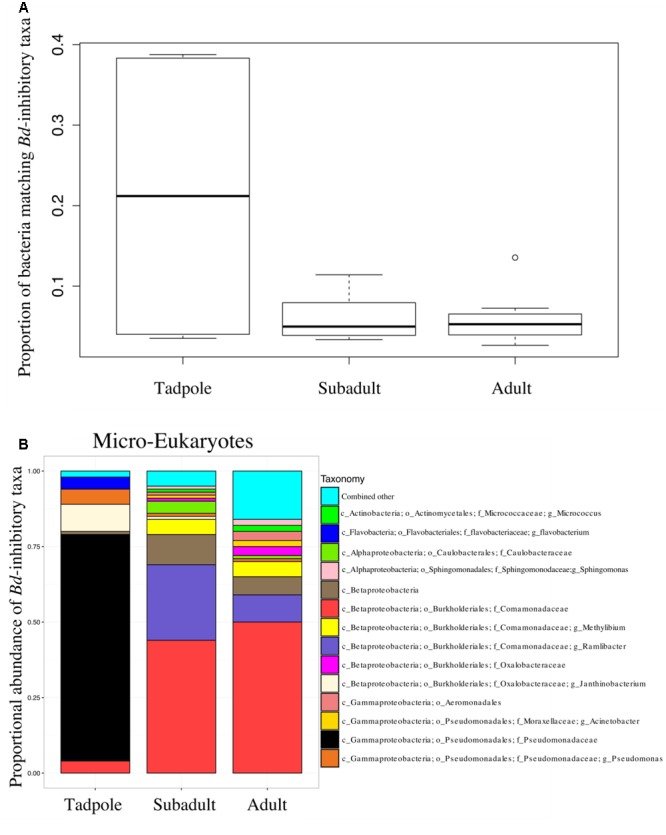
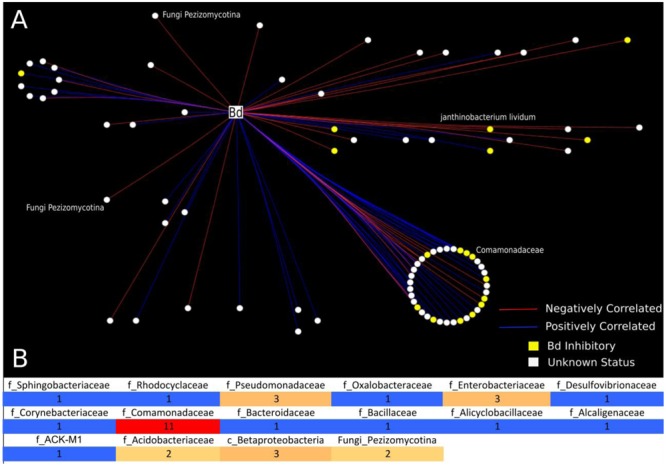
Global amphibian decline linked to fungal pathogens has galvanized research on applied amphibian conservation. Skin-associated bacterial communities of amphibians have been shown to mediate fungal skin infections and the development of probiotic treatments with antifungal bacteria has become an emergent area of research. While exploring the role of protective bacteria has been a primary focus for amphibian conservation, we aim to expand and study the other microbes present in amphibian skin communities including fungi and other micro-eukaryotes. Here, we characterize skin-associated bacteria and micro-eukaryotic diversity found across life stages of Cascades frog () and their associated aquatic environments using culture independent 16S and 18S rRNA marker-gene sequencing. Individuals of various life stages of Cascades frogs were sampled from a population located in the Trinity Alps in Northern California during an epidemic of the chytrid fungus, . We filtered the bacterial sequences against a published database of bacteria known to inhibit in co-culture to estimate the proportion of the skin bacterial community that is likely to provide defense against . Tadpoles had a significantly higher proportion of -inhibitory bacterial sequence matches relative to subadult and adult Cascades frogs. We applied a network analysis to examine patterns of correlation between bacterial taxa and , as well as micro-eukaryotic taxa and . Combined with the published database of bacteria known to inhibit , we used the network analysis to identify bacteria that negatively correlated with and thus could be good probiotic candidates in the Cascades frog system.
与真菌病原体相关的全球两栖动物数量下降激发了对两栖动物应用保护的研究。两栖动物与皮肤相关的细菌群落已被证明可介导真菌性皮肤感染,利用抗真菌细菌进行益生菌治疗的研发已成为一个新兴研究领域。虽然探索保护性细菌的作用一直是两栖动物保护的主要重点,但我们旨在扩展并研究两栖动物皮肤群落中存在的其他微生物,包括真菌和其他微真核生物。在这里,我们使用非培养的16S和18S rRNA标记基因测序,对喀斯喀特蛙()不同生命阶段及其相关水生环境中的皮肤相关细菌和微真核生物多样性进行了表征。在蛙壶菌流行期间,从加利福尼亚州北部三一山脉的一个种群中采集了喀斯喀特蛙不同生命阶段的个体。我们根据一个已发表的已知在共培养中抑制的细菌数据库对细菌序列进行筛选,以估计皮肤细菌群落中可能提供抗防御的比例。相对于亚成体和成年喀斯喀特蛙,蝌蚪中具有抑制作用的细菌序列匹配比例显著更高。我们应用网络分析来研究细菌类群与之间以及微真核生物类群与之间的相关性模式。结合已发表的已知抑制的细菌数据库,我们利用网络分析来识别与呈负相关的细菌,因此这些细菌可能是喀斯喀特蛙系统中良好的益生菌候选菌株。