Amorim Camila F, Galina Luiza, Carvalho Natália B, Sperotto Nathalia D M, Pissinate Kenia, Machado Pablo, Campos Maria M, Basso Luiz A, Rodrigues-Junior Valnês S, Carvalho Edgar M, Santos Diógenes Santiago
Serviço de Imunologia, Complexo Hospitalar Universitário Professor Edgard Santos, Universidade Federal da Bahia, Salvador, Bahia, Brazil.
Centro de Pesquisas em Biologia Molecular e Funcional, Pontifícia Universidade Católica do Rio Grande do Sul (PUCRS), Porto Alegre, Brazil.
PLoS One. 2017 Dec 27;12(12):e0190294. doi: 10.1371/journal.pone.0190294. eCollection 2017.
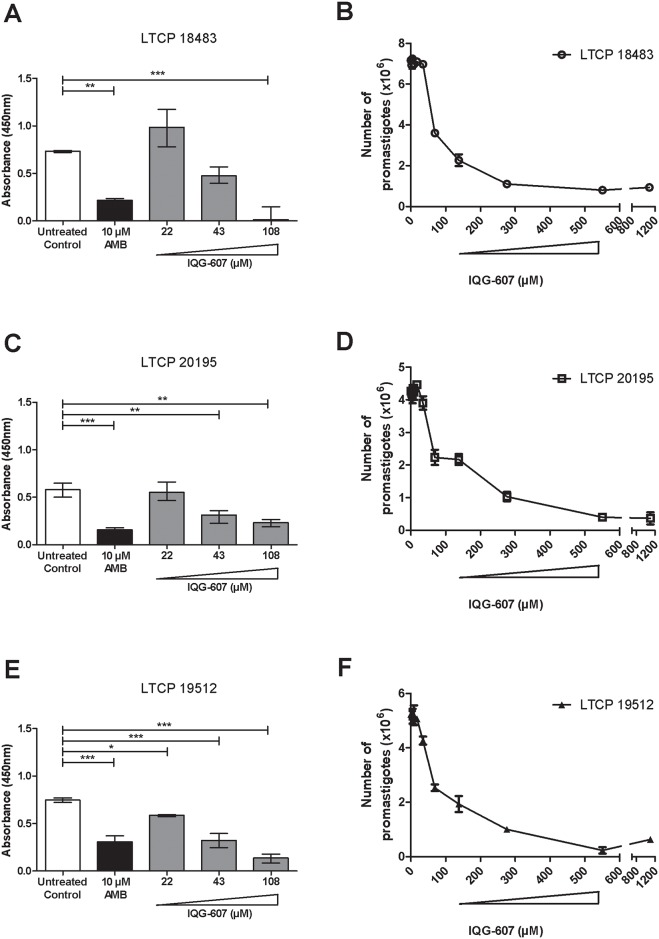
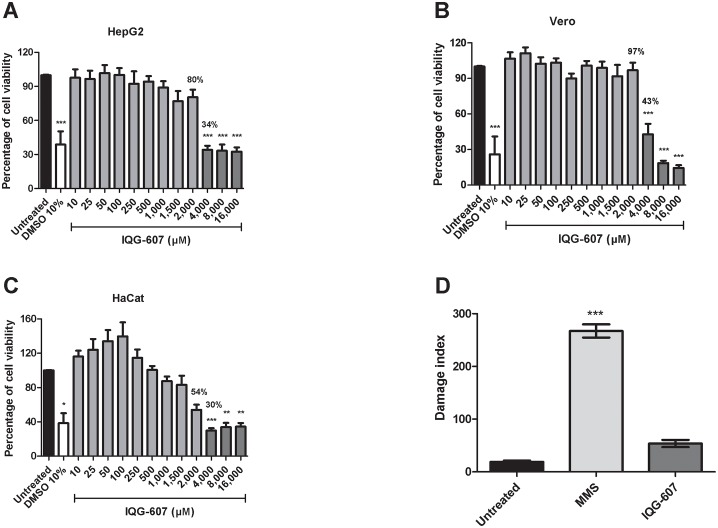
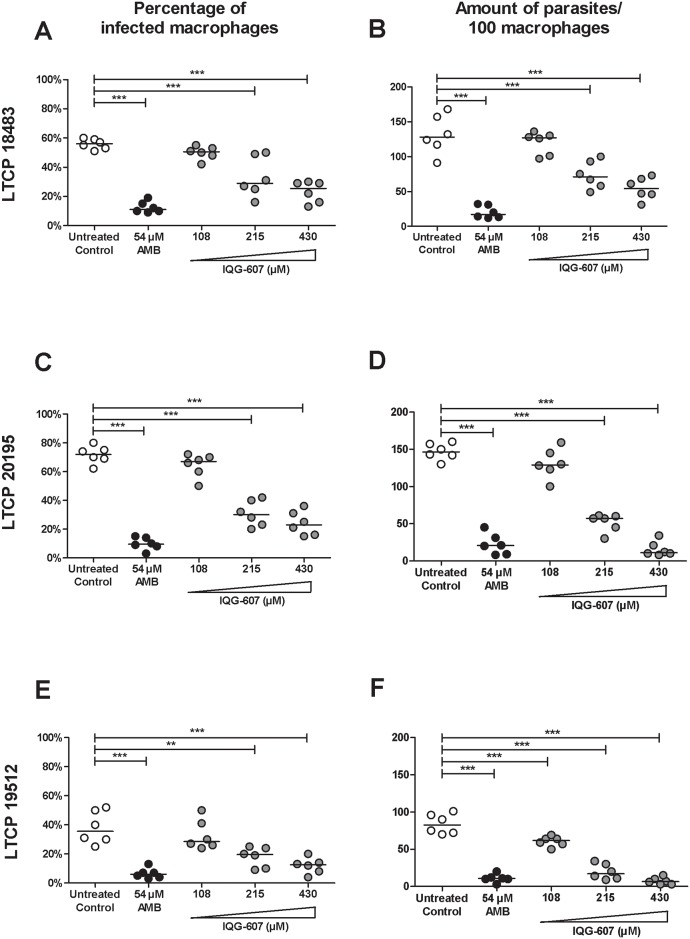
M. tuberculosis and parasites of the genus Leishmania present the type II fatty acid biosynthesis system (FASII). The pentacyano(isoniazid)ferrate(II) compound, named IQG-607, inhibits the enzyme 2-trans-enoyl-ACP(CoA) reductase from M. tuberculosis, a key component in the FASII system. Here, we aimed to evaluate the inhibitory activity of IQG-607 against promastigote and amastigote forms of Leishmania (Viannia) braziliensis isolated from patients with different clinical forms of L. braziliensis infection, including cutaneous, mucosal and disseminated leishmaniasis. Importantly, IQG-607 inhibited the proliferation of three different isolates of L. braziliensis promastigotes associated with cutaneous, mucosal and disseminated leishmaniasis. The IC50 values for IQG-607 ranged from 32 to 75 μM, for these forms. Additionally, IQG-607 treatment decreased the proliferation of intracellular amastigotes in infected macrophages, after an analysis of the percentage of infected cells and the number of intracellular parasites/100 cells. IQG-607 reduced from 58% to 98% the proliferation of L. braziliensis from cutaneous, mucosal and disseminated strains. Moreover, IQG-607 was also evaluated regarding its potential toxic profile, by using different cell lines. Cell viability of the lineages Vero, HaCat and HepG2 was significantly reduced after incubation with concentrations of IQG-607 higher than 2 mM. Importantly, IQG-607, in a concentration of 1 mM, did not induce DNA damage in HepG2 cells, when compared to the untreated control group. Future studies will confirm the mechanism of action of IQG-607 against L. braziliensis.
结核分枝杆菌和利什曼原虫属的寄生虫具有II型脂肪酸生物合成系统(FASII)。名为IQG-607的五氰基(异烟肼)铁(II)化合物可抑制结核分枝杆菌的2-反式烯酰-ACP(CoA)还原酶,该酶是FASII系统的关键组成部分。在此,我们旨在评估IQG-607对从不同临床形式的巴西利什曼原虫感染患者中分离出的巴西利什曼原虫(维安尼利什曼原虫)前鞭毛体和无鞭毛体形式的抑制活性,这些临床形式包括皮肤利什曼病、黏膜利什曼病和播散性利什曼病。重要的是,IQG-607抑制了与皮肤、黏膜和播散性利什曼病相关的三种不同巴西利什曼原虫前鞭毛体分离株的增殖。对于这些形式,IQG-607的IC50值范围为32至75μM。此外,在分析感染细胞百分比和细胞内寄生虫数量/100个细胞后,IQG-607处理降低了感染巨噬细胞中细胞内无鞭毛体的增殖。IQG-607使皮肤、黏膜和播散性菌株的巴西利什曼原虫增殖从58%降至98%。此外,通过使用不同细胞系评估了IQG-607的潜在毒性特征。与未处理的对照组相比,当IQG-607浓度高于2 mM时,Vero、HaCat和HepG2细胞系的细胞活力显著降低。重要的是,浓度为1 mM的IQG-607与未处理的对照组相比,未诱导HepG2细胞的DNA损伤。未来的研究将证实IQG-607对巴西利什曼原虫的作用机制。