University of Michigan Health System, 1011 Cornwell Pl, Ann Arbor, 48104, USA.
Cardiology and Angiology Department, General University Hospital, Prague, Czech Republic.
BMC Pulm Med. 2017 Dec 28;17(1):216. doi: 10.1186/s12890-017-0563-7.
Following positive results from the Phase III CHEST-1 study in patients with inoperable or persistent/recurrent chronic thromboembolic pulmonary hypertension (CTEPH), the Phase IIIb CTEPH early access study (EAS) was designed to assess the safety and tolerability of riociguat in real-world clinical practice, as well as to provide patients with early access to riociguat before launch. Riociguat is approved for the treatment of inoperable and persistent/recurrent CTEPH.
We performed an open-label, uncontrolled, single-arm, early access study in which 300 adult patients with inoperable or persistent/recurrent CTEPH received riociguat adjusted from 1 mg three times daily (tid) to a maximum of 2.5 mg tid. Patients switching from unsatisfactory prior pulmonary arterial hypertension (PAH)-targeted therapy (n = 84) underwent a washout period of at least 3 days before initiating riociguat. The primary aim was to assess the safety and tolerability of riociguat, with World Health Organization functional class and 6-min walking distance (6MWD) as exploratory efficacy endpoints.
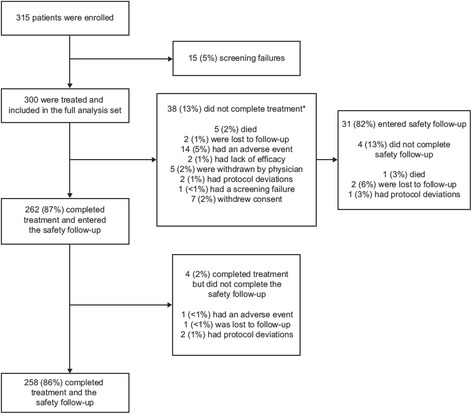
In total, 262 patients (87%) completed study treatment and entered the safety follow-up (median treatment duration 47 weeks). Adverse events were reported in 273 patients (91%). The most frequently reported serious adverse events were syncope (6%), right ventricular failure (3%), and pneumonia (2%). There were five deaths, none of which was considered related to study medication. The safety and tolerability of riociguat was similar in patients switched from other PAH-targeted therapies and those who were treatment naïve. In patients with data available, mean ± standard deviation 6MWD had increased by 33 ± 42 m at Week 12 with no clinically relevant differences between the switched and treatment-naïve subgroups.
Riociguat was well tolerated in patients with CTEPH who were treatment naïve, and in those who were switched from other PAH-targeted therapies. No new safety signals were observed.
ClinicalTrials.org NCT01784562 . Registered February 4, 2013.
在 III 期 CHEST-1 研究中,对于不能手术或持续性/复发性慢性血栓栓塞性肺动脉高压(CTEPH)患者,利奥西呱取得了阳性结果,因此开展了 IIIb 期 CTEPH 早期准入研究(EAS),旨在评估利奥西呱在真实世界临床实践中的安全性和耐受性,并在上市前为患者提供利奥西呱的早期准入。利奥西呱获批用于治疗不能手术和持续性/复发性 CTEPH。
我们开展了一项开放标签、非对照、单臂的早期准入研究,300 例不能手术或持续性/复发性 CTEPH 成人患者接受利奥西呱治疗,起始剂量为 1mg,每日 3 次(tid),最大剂量为 2.5mg tid。84 例先前接受肺动脉高压(PAH)靶向治疗效果不理想的患者(n=84)在开始利奥西呱治疗前至少洗脱 3 天。主要目的是评估利奥西呱的安全性和耐受性,以世界卫生组织(WHO)功能分级和 6 分钟步行距离(6MWD)作为探索性疗效终点。
共有 262 例患者(87%)完成了研究治疗并进入安全性随访(中位治疗持续时间 47 周)。273 例患者(91%)报告了不良事件。最常报告的严重不良事件是晕厥(6%)、右心衰竭(3%)和肺炎(2%)。有 5 例死亡,均与研究药物无关。在曾接受其他 PAH 靶向治疗和初治的患者中,利奥西呱的安全性和耐受性相似。在有数据可评估的患者中,12 周时 6MWD 的平均±标准差增加了 33±42m,在曾接受其他 PAH 靶向治疗和初治的亚组之间无临床相关差异。
利奥西呱在初治 CTEPH 患者和曾接受其他 PAH 靶向治疗的患者中耐受性良好,未观察到新的安全性信号。
ClinicalTrials.org NCT01784562。注册于 2013 年 2 月 4 日。