Department of General and Visceral Surgery, Zentralklinik Bad Berka, Bad Berka, Germany.
Institute of Pharmacology and Toxicology, Jena University Hospital, Friedrich Schiller University Jena, Drackendorfer Str. 1, D-07747, Jena, Germany.
BMC Cancer. 2017 Dec 28;17(1):896. doi: 10.1186/s12885-017-3911-3.
Hepatocellular (HCC) and cholangiocellular carcinomas (CCC) display an exceptionally poor prognosis. Especially for advanced disease no efficient standard therapy is currently available. Recently, somatostatin analogs have been evaluated for the treatment of HCC, however, with contradictory results. Besides, for both malignancies the chemokine receptor CXCR4 has been discussed as a possible new target structure.
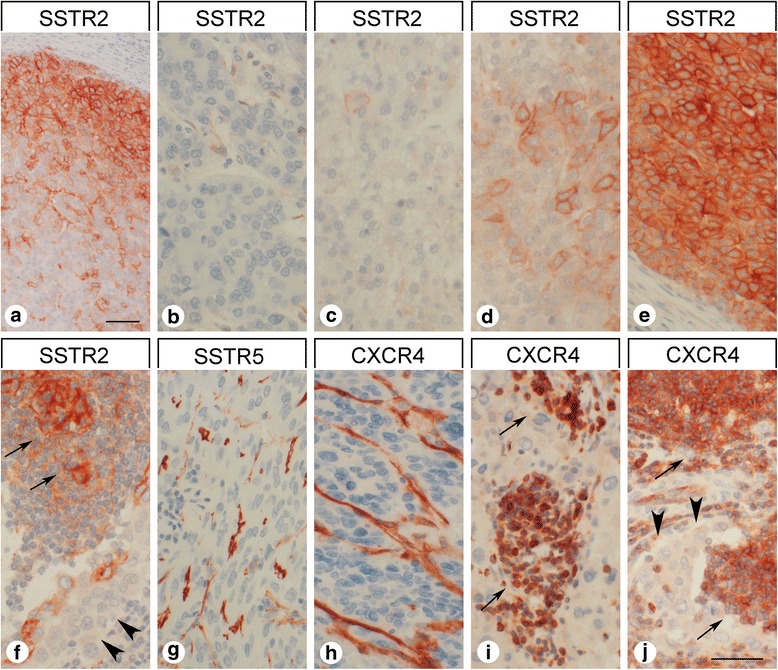
Expression of somatostatin receptor (SSTR) subtypes 1, 2A, 3, 4, and 5, and of CXCR4 was evaluated in a total of 71 HCCs and 27 CCCs by immunohistochemistry using well-characterized novel monoclonal antibodies.
In HCC tumor cells, frequency and intensity of expression of SSTRs and CXCR4 were only low. CXCR4 was present in about 40% of the HCCs, although at a low intensity. SSTR5, SSTR2, and SSTR3 were detected in about 15%, 8%, and 5% of the HCC tumors, respectively. SSTR and CXCR4 expression was much higher in CCC than in HCC. CXCR4 and SSTR1 were present in 60% and 67% of the CCC samples, respectively, followed by SSTR2 and SSTR5, which were detected in 30% and 11% of the tumors, respectively. Most notably, CXCR4 was intensely expressed on the tumor capillaries in about 50% of the HCCs and CCCs. CXCR4 expression on tumor vessels was associated with poor patient outcomes.
CCC, but not HCC, may be suitable for SSTR-based treatments. Because of the predominant expression of SSTR1, pan-somatostatin analogs should be preferred. In both HCC and CCC, indirect targeting of tumors via the CXCR4-positive tumor capillaries may represent a promising additional therapeutic strategy.
肝细胞癌(HCC)和胆管细胞癌(CCC)的预后极差。特别是对于晚期疾病,目前尚无有效的标准治疗方法。最近,生长抑素类似物已被评估用于治疗 HCC,但结果存在争议。此外,对于这两种恶性肿瘤,趋化因子受体 CXCR4 已被讨论为一种可能的新靶结构。
采用经过充分验证的新型单克隆抗体,通过免疫组织化学方法评估了总共 71 例 HCC 和 27 例 CCC 中生长抑素受体(SSTR)亚型 1、2A、3、4 和 5 以及 CXCR4 的表达。
在 HCC 肿瘤细胞中,SSTR 和 CXCR4 的表达频率和强度均较低。CXCR4 存在于约 40%的 HCC 中,尽管强度较低。SSTR5、SSTR2 和 SSTR3 分别在约 15%、8%和 5%的 HCC 肿瘤中检测到。与 HCC 相比,CCC 中 SSTR 和 CXCR4 的表达更高。CXCR4 和 SSTR1 分别存在于 60%和 67%的 CCC 样本中,其次是 SSTR2 和 SSTR5,分别存在于 30%和 11%的肿瘤中。值得注意的是,约 50%的 HCC 和 CCC 中肿瘤毛细血管强烈表达 CXCR4。肿瘤血管中的 CXCR4 表达与患者预后不良相关。
CCC 可能适合基于 SSTR 的治疗,而不是 HCC。由于 SSTR1 的表达占主导地位,应优先使用泛生长抑素类似物。在 HCC 和 CCC 中,通过 CXCR4 阳性肿瘤毛细血管间接靶向肿瘤可能代表一种有前途的额外治疗策略。