Wachelder Joyce J H, van Drunen Isabelle, Stassen Patricia M, Brouns Steffie H A, Lambooij Suze L E, Aarts Mieke J, Haak Harm R
Department of Internal Medicine, Maxima Medisch Centre, Eindhoven, The Netherlands.
Department of Health Services Research, Maastricht University, Maastricht, The Netherlands.
BMJ Open. 2017 Dec 26;7(12):e019318. doi: 10.1136/bmjopen-2017-019318.
Older adults frequently visit the emergency department (ED). Socioeconomic status (SES) has an important impact on health and ED utilisation; however, the association between SES and ED utilisation in elderly remains unclear. The aim of this study was to investigate the association between SES in older adult patients visiting the ED on outcomes.
A retrospective study.
Older adults (≥65 years) visiting the ED, in the Netherlands. SES was stratified into tertiles based on average household income at zip code level: low (<€1800/month), intermediate (€1800-€2300/month) and high (>€2300/month).
Hospitalisation, inhospital mortality and 30-day ED return visits. Effect of SES on outcomes for all groups were assessed by logistic regression and adjusted for confounders.
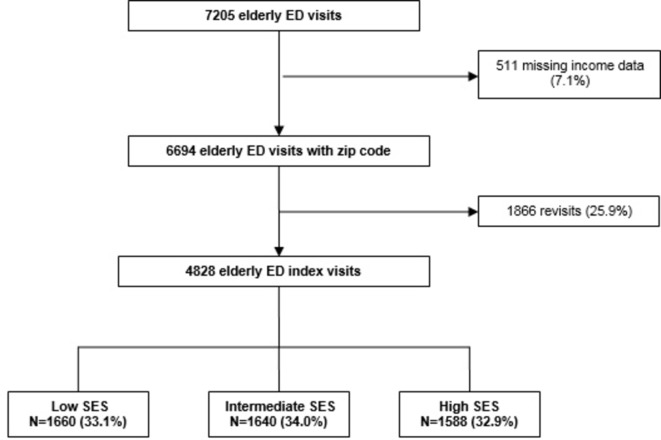
In total, 4828 older adults visited the ED during the study period. Low SES was associated with a higher risk of hospitalisation among community-dwelling patients compared with high SES (adjusted OR 1.3, 95% CI 1.1 to 1.7). This association was not present for intermediate SES (adjusted OR 1.1, 95% CI 0.95 to 1.4). Inhospital mortality was comparable between the low and high SES group, even after adjustment for age, comorbidity and triage level (low OR 1.4, 95% CI 0.8 to 2.6, intermediate OR 1.3, 95% CI 0.8 to 2.2). Thirty-day ED revisits among community-dwelling patients were also equal between the SES groups (low: adjusted OR 1.0, 95% CI 0.7 to 1.4, and intermediate: adjusted OR 0.8, 95% CI 0.6 to 1.1).
In older adult ED patients, low SES was associated with a higher risk of hospitalisation than high SES. However, SES had no impact on inhospital mortality and 30-day ED revisits after adjustment for confounders.
老年人经常前往急诊科就诊。社会经济地位(SES)对健康和急诊科利用率有重要影响;然而,老年人中SES与急诊科利用率之间的关联仍不明确。本研究的目的是调查老年急诊科就诊患者的SES与结局之间的关联。
一项回顾性研究。
荷兰≥65岁前往急诊科就诊的老年人。SES根据邮政编码区域的平均家庭收入分为三分位数:低(<1800欧元/月)、中(1800 - 2300欧元/月)和高(>2300欧元/月)。
住院治疗、住院死亡率和30天内急诊科复诊。通过逻辑回归评估SES对所有组结局的影响,并对混杂因素进行校正。
在研究期间,共有4828名老年人前往急诊科就诊。与高SES相比,低SES与社区居住患者更高的住院风险相关(校正比值比1.3,95%置信区间1.1至1.7)。中等SES组不存在这种关联(校正比值比1.1,95%置信区间0.95至1.4)。即使在调整年龄、合并症和分诊级别后,低SES组和高SES组的住院死亡率仍相当(低SES组比值比1.4,95%置信区间0.8至2.6,中等SES组比值比1.3,95%置信区间0.8至2.2)。社区居住患者中,SES组之间的30天急诊科复诊率也相等(低SES组:校正比值比1.0,95%置信区间0.7至1.4,中等SES组:校正比值比0.8,95%置信区间0.6至1.1)。
在老年急诊科患者中,低SES比高SES与更高的住院风险相关。然而,在调整混杂因素后,SES对住院死亡率和30天急诊科复诊率没有影响。