O'Neil Bert H, Wallmark John M, Lorente David, Elez Elena, Raimbourg Judith, Gomez-Roca Carlos, Ejadi Samuel, Piha-Paul Sarina A, Stein Mark N, Abdul Razak Albiruni R, Dotti Katia, Santoro Armando, Cohen Roger B, Gould Marlena, Saraf Sanatan, Stein Karen, Han Sae-Won
Department of Hematology/Oncology, Indiana University Simon Cancer Center, Indianapolis, Indiana, United States of America.
Department of Hematology/Oncology, Maryland Hematology Oncology, Rockville, Maryland, United States of America.
PLoS One. 2017 Dec 28;12(12):e0189848. doi: 10.1371/journal.pone.0189848. eCollection 2017.
Colorectal cancers (CRCs) expressing programmed death ligand 1 (PD-L1) have poor prognosis. In the multicohort KEYNOTE-028 trial, the anti-PD-1 antibody pembrolizumab was evaluated in 20 PD-L1-positive advanced solid tumors. Herein, we report results for the advanced CRC cohort.
Patients with advanced, treatment-resistant PD-L1-positive carcinoma of the colon or rectum were enrolled, regardless of microsatellite instability (MSI) status. Pembrolizumab 10 mg/kg was administered every 2 weeks for up to 2 years or until disease progression/unacceptable toxicity. Response was assessed every 8 weeks for the first 6 months and every 12 weeks thereafter. Primary end points were safety and overall response rate by investigator review per Response Evaluation Criteria in Solid Tumors version 1.1. Data cutoff was June 20, 2016.
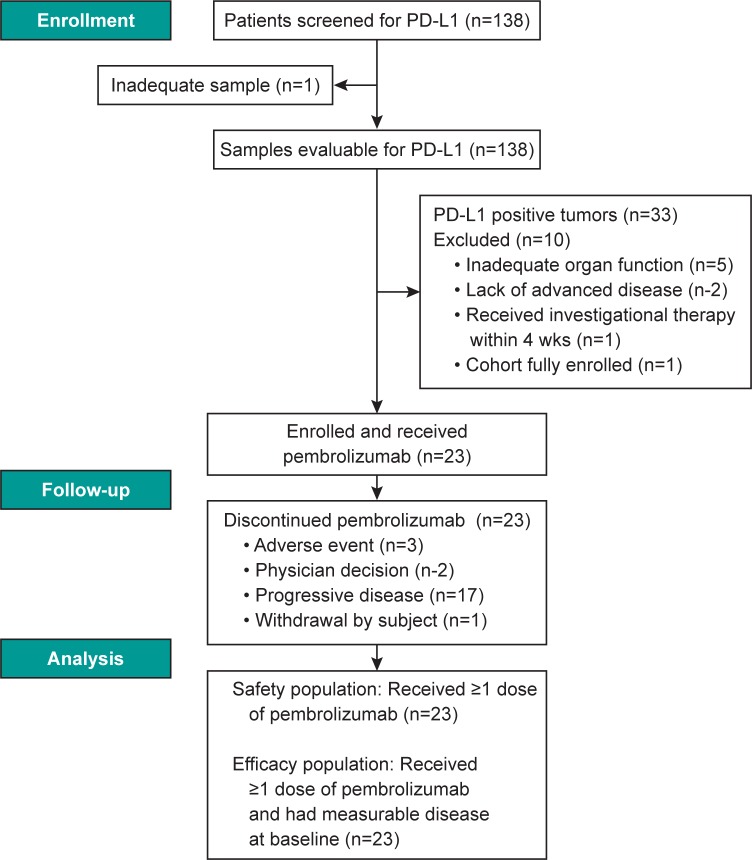
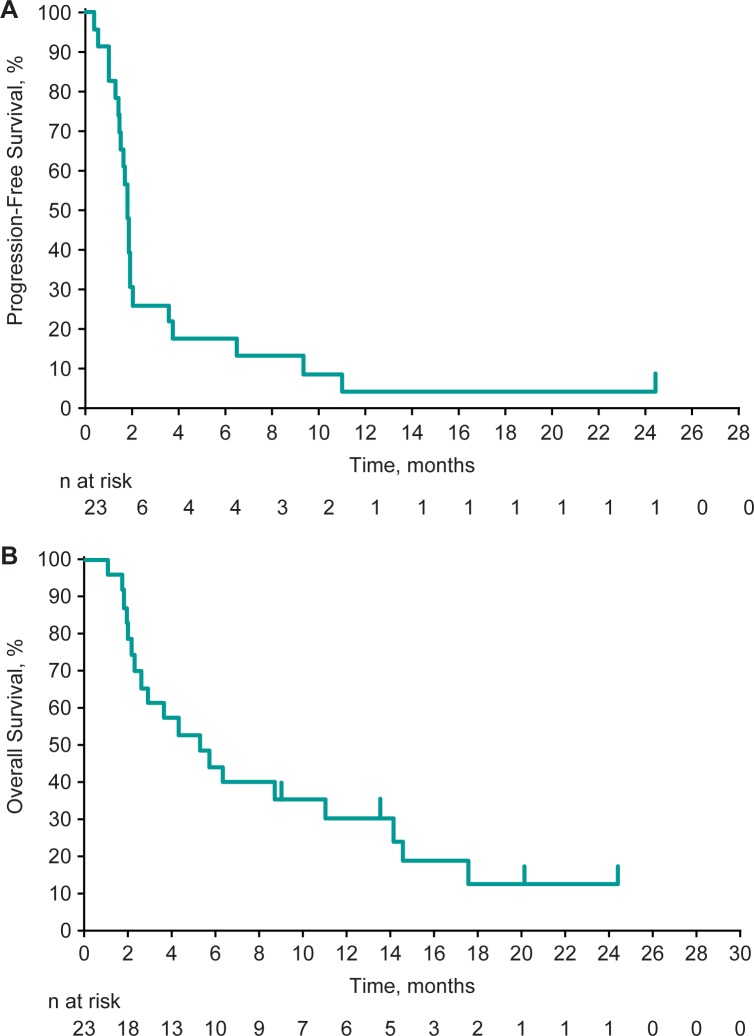
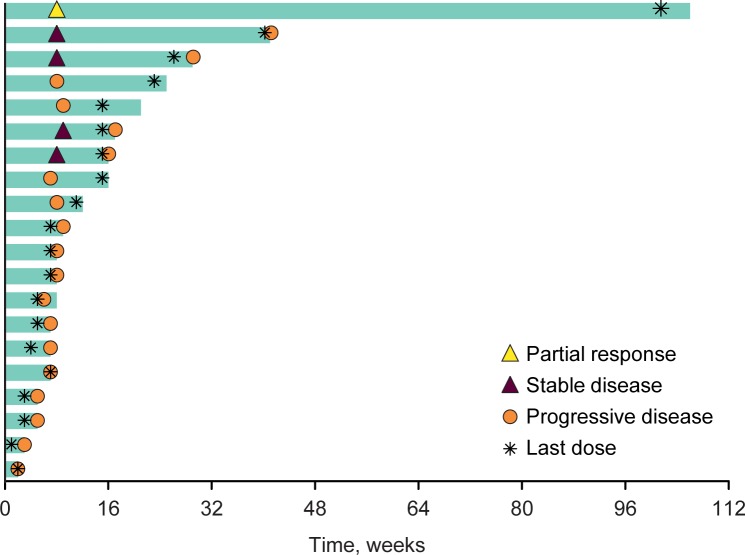
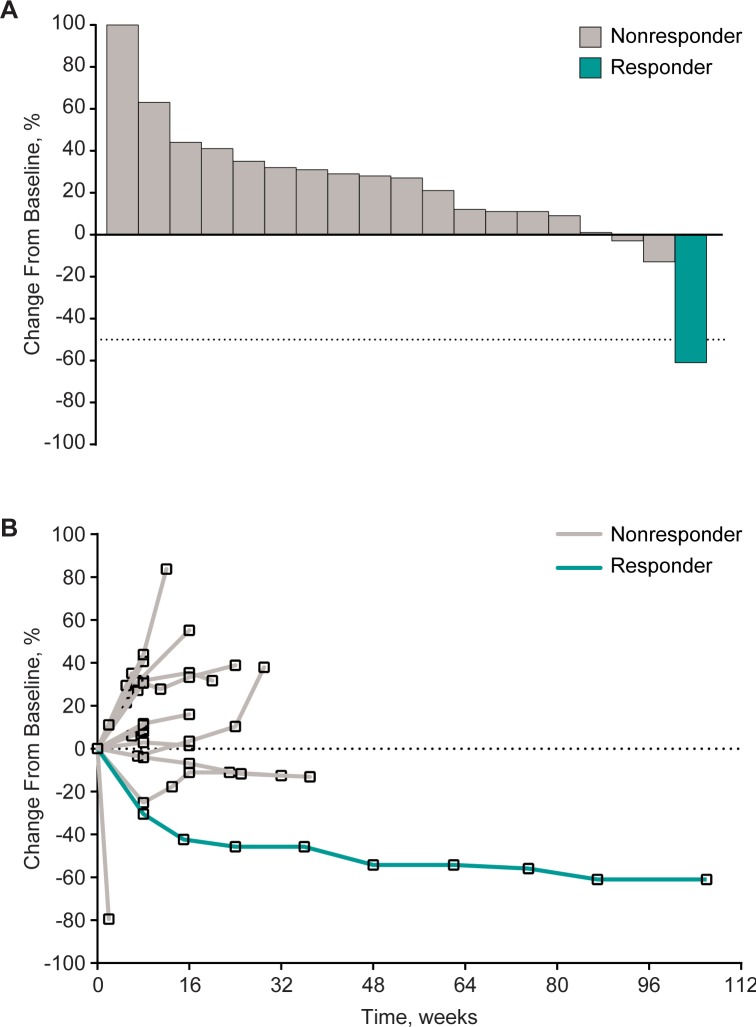
Of 137 patients with CRC and samples evaluable for PD-L1 expression, 33 (24%) had PD-L1-positive tumors, of which 23 were enrolled. Median follow-up was 5.3 months, and 8 patients (35%) reported treatment-related adverse events (AEs), most commonly fatigue (n = 3, 13%), stomatitis (n = 2, 9%), and asthenia (n = 2, 9%). One patient (4%) experienced grade 4 treatment-related increased blood bilirubin. No grade 3 AEs, discontinuations, or deaths were attributed to treatment. Most patients (n = 15, 65%) experienced progressive disease. One partial response occurred in a patient (4%) with MSI-high CRC.
Pembrolizumab demonstrated a favorable safety profile in advanced PD-L1-positive CRC. Antitumor activity was observed in a single patient with MSI-high CRC, warranting further evaluation in this patient population. (Clinicaltrials.gov registration: NCT02054806).
表达程序性死亡配体1(PD-L1)的结直肠癌(CRC)预后较差。在多队列KEYNOTE-028试验中,对20例PD-L1阳性晚期实体瘤患者评估了抗PD-1抗体帕博利珠单抗。在此,我们报告晚期CRC队列的结果。
纳入晚期、治疗抵抗的PD-L1阳性结肠癌或直肠癌患者,无论微卫星不稳定性(MSI)状态如何。每2周给予帕博利珠单抗10mg/kg,最多2年或直至疾病进展/出现不可接受的毒性。在最初6个月内每8周评估一次反应,此后每12周评估一次。主要终点是根据实体瘤疗效评价标准1.1版由研究者评估的安全性和总缓解率。数据截止日期为2016年6月20日。
在137例有CRC且可评估PD-L1表达样本的患者中,33例(24%)肿瘤为PD-L1阳性,其中23例入组。中位随访时间为5.3个月,8例患者(35%)报告了治疗相关不良事件(AE),最常见的是疲劳(n = 3,13%)、口腔炎(n = 2,9%)和乏力(n = 2,9%)。1例患者(4%)出现4级治疗相关血胆红素升高。无3级AE、停药或死亡归因于治疗。大多数患者(n = 15,65%)出现疾病进展。1例微卫星高度不稳定(MSI-H)的CRC患者出现部分缓解(4%)。
帕博利珠单抗在晚期PD-L1阳性CRC中显示出良好的安全性。在1例MSI-H的CRC患者中观察到抗肿瘤活性,值得在该患者群体中进一步评估。(Clinicaltrials.gov注册号:NCT02054806)