Syriac Gibi, Joseph Elizabeth, Rupesh S, Philip John, Cherian Sunu Alice, Mathew Josey
Department of Pedodontics and Preventive Dentistry, Pushpagiri College of Dental Sciences, Tiruvalla, Kerala, India.
Department of Conservative Dentistry and Endodontics, Pushpagiri College of Dental Sciences, Tiruvalla, Kerala, India.
J Pharm Bioallied Sci. 2017 Nov;9(Suppl 1):S231-S236. doi: 10.4103/jpbs.JPBS_154_17.
Supernumerary teeth are the presence of more number of teeth over the normal dental formula and may occur in permanent as well as early mixed dentition. This study determined the prevalence, characteristics, and complications caused by supernumerary teeth in nonsyndromic South Indian pediatric population.
Characteristics of supernumerary teeth determined by clinical and radiographic examination were recorded. The age, sex, number of supernumerary teeth, eruption status, morphology, position, orientation, and complications (if any) associated with supernumerary teeth were recorded for each patient who had supernumerary teeth. The data collected were statistically analyzed.
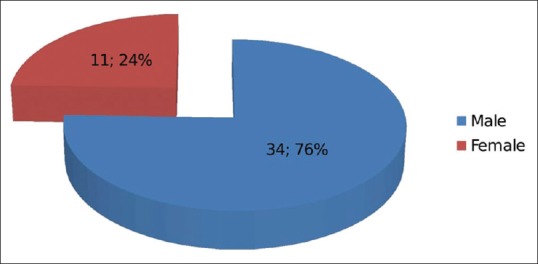
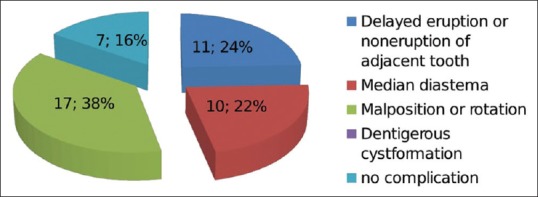
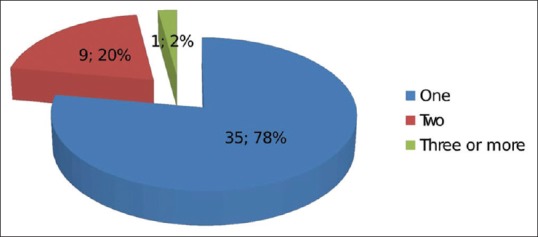
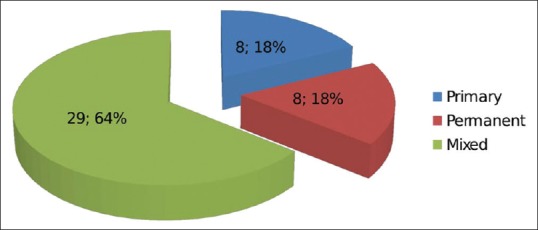
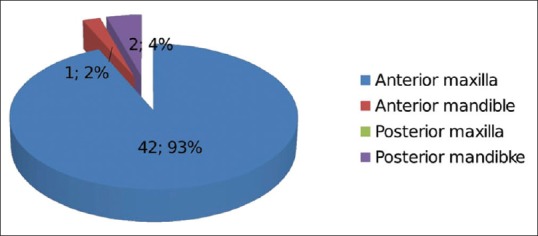
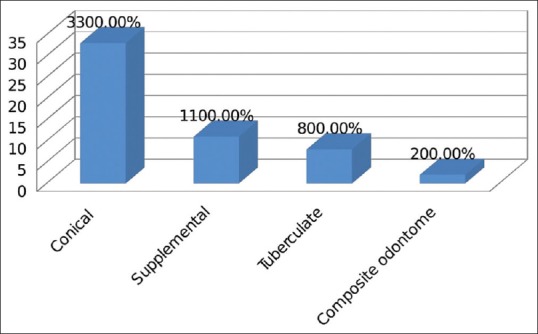
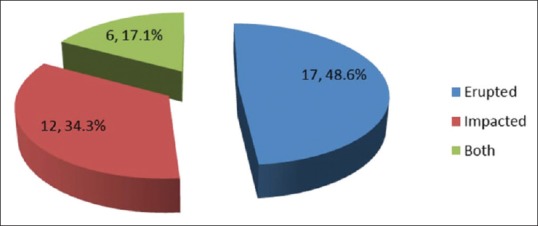
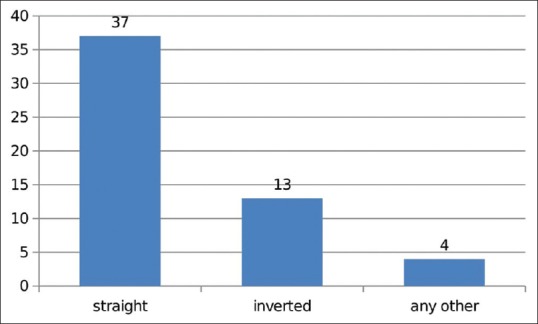
Supernumerary teeth were detected in 45 subjects (1.1%), of which 34 (75.6%) were male and 11 (24.4%) were female. There was no association between the number of supernumerary teeth and the gender of the patient. The total number of supernumerary teeth among the affected 45 patients was 54. The average number of supernumerary teeth per person was 1.2. The number of supernumerary teeth was one in 35 cases, two in 8 cases, and 3 in 1 case. Of the 45 patients, 8 patients with supernumerary teeth were in deciduous dentition stage, 29 patients were in mixed dentition stage, and 8 patients were in permanent dentition stage. Most supernumerary teeth presented in the anterior maxilla. Morphologically, conical-shaped supernumerary teeth were the most common finding. 68.5% of supernumerary teeth presented with straight orientation and inverted orientation was seen in 24.1%. Complications seen in patients with supernumerary teeth were delayed or noneruption of adjacent tooth malposition or rotation of adjacent teeth, diastema formation, and formation of dentigerous cyst.
Supernumerary teeth have an incidence of 1.1% in South Indian population and can cause many complications that can harm the developing occlusion. Knowledge about supernumerary teeth may help the dentist in early diagnosis and early intervention.
多生牙是指牙齿数量超过正常牙列,可出现在恒牙列以及早期混合牙列中。本研究确定了非综合征性南印度儿童人群中多生牙的患病率、特征及并发症。
记录通过临床和影像学检查确定的多生牙特征。为每位有多生牙的患者记录年龄、性别、多生牙数量、萌出状态、形态、位置、方向以及与多生牙相关的并发症(如有)。对收集的数据进行统计学分析。
在45名受试者中检测到多生牙(1.1%),其中男性34名(75.6%),女性11名(24.4%)。多生牙数量与患者性别之间无关联。45名受影响患者的多生牙总数为54颗。人均多生牙数量为1.2颗。35例多生牙数量为1颗,8例为2颗,1例为3颗。45例患者中,8例有多生牙的患者处于乳牙列期,29例处于混合牙列期,8例处于恒牙列期。大多数多生牙位于上颌前部。形态上,锥形多生牙最为常见。68.5%的多生牙方向为直立,24.1%为倒置。多生牙患者出现的并发症包括相邻牙齿萌出延迟或未萌出、相邻牙齿错位或旋转、牙间隙形成以及含牙囊肿形成。
多生牙在南印度人群中的发生率为1.1%,可导致许多危害发育中咬合的并发症。了解多生牙可能有助于牙医进行早期诊断和早期干预。