Stollery Children's Hospital, University of Alberta Hospital, Edmonton, Alberta, Canada.
Riley Hospital for Children, Indianapolis, Indiana.
Pediatr Blood Cancer. 2018 Apr;65(4). doi: 10.1002/pbc.26913. Epub 2017 Dec 29.
In this report, we characterize the timing and behavior of malignant ovarian germ cell tumors (GCTs) in pediatric patients with dysgenetic gonads compared to those with normal gonadal development.
Patients from the Children's Oncology Group AGCT0132 with malignant ovarian GCTs were included. Within this population, we sought to identify patients with gonadoblastoma, streak ovaries, or other evidence of gonadal dysgenesis (GD). Patients with malignant GCTs containing one or more of the following histologies-yolk sac tumor, embryonal carcinoma, or choriocarcinoma-were included. Patients were compared with respect to event-free survival (EFS) and overall survival (OS).
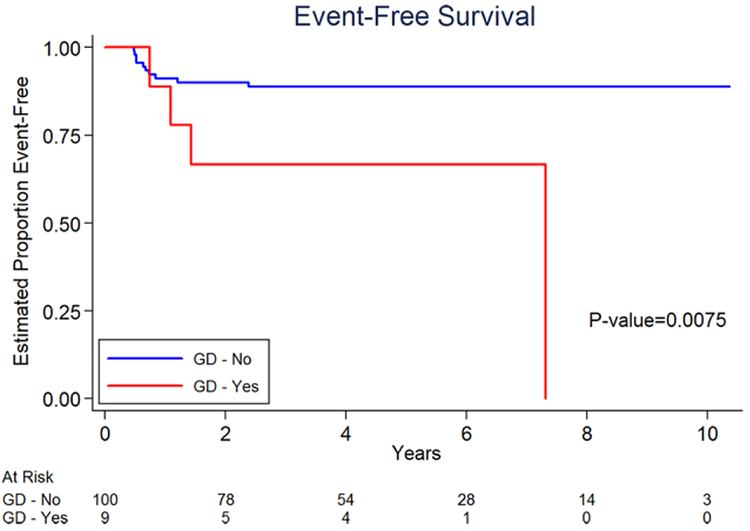
Nine patients with GD, including seven with gonadoblastoma (mean age, 9.3 years), were compared to 100 non-GD patients (mean age, 12.1 years). The estimated 3-year EFS for patients with GD was 66.7% (95% CI 28.2-87.8%) and for non-GD patients was 88.8% (95% CI 80.2-93.8%). The estimated 3-year OS for patients with GD was 87.5% (95% CI 38.7-98.1%) and for non-GD patients was 97.6% (95% CI of 90.6-99.4%).
Patients presenting with nongerminomatous malignant ovarian GCTs in the context of GD have a higher rate of events and death than counterparts with normal gonads. These findings emphasize the importance of noting a contralateral streak ovary or gonadoblastoma at histology for any ovarian GCT and support the recommendation for early bilateral gonadectomy in patients known to have GD with Y chromosome material. In contrast to those with pure dysgerminoma, these patients may represent a high-risk group that requires a more aggressive chemotherapy regimen.
在本报告中,我们对性腺发育不良与正常性腺发育的儿童患者中恶性卵巢生殖细胞肿瘤(GCT)的发生时间和行为进行了描述。
本研究纳入了儿童肿瘤协作组 AGCT0132 中患有恶性卵巢 GCT 的患者。在该人群中,我们试图确定患有性腺母细胞瘤、条索状卵巢或其他性腺发育不良(GD)证据的患者。包含一种或多种以下组织学类型(卵黄囊瘤、胚胎癌或绒毛膜癌)的恶性 GCT 患者包括在内。对这些患者进行无事件生存(EFS)和总生存(OS)比较。
9 例 GD 患者(7 例伴有性腺母细胞瘤,平均年龄 9.3 岁)与 100 例非 GD 患者(平均年龄 12.1 岁)进行了比较。GD 患者的 3 年 EFS 估计为 66.7%(95%CI 28.2-87.8%),而非 GD 患者为 88.8%(95%CI 80.2-93.8%)。GD 患者的 3 年 OS 估计为 87.5%(95%CI 38.7-98.1%),而非 GD 患者为 97.6%(95%CI 90.6-99.4%)。
在 GD 背景下表现为非生殖细胞瘤性恶性卵巢 GCT 的患者比具有正常性腺的患者发生事件和死亡的风险更高。这些发现强调了在任何卵巢 GCT 组织学中注意到对侧条索状卵巢或性腺母细胞瘤的重要性,并支持对已知存在 Y 染色体物质的 GD 患者进行早期双侧性腺切除术的建议。与单纯的无性细胞瘤不同,这些患者可能代表一个高危群体,需要更积极的化疗方案。