Jiang Chang, Cai Xiuyu, Zhang Hongxia, Xia Xiaojun, Zhang Bei, Xia Liangping
VIP Region, Sun Yat-Sen University Cancer Center, Guangzhou, Guangdong, 510060, R.P. China.
State Key Laboratory of Oncology in South China, Sun Yat-Sen University Cancer Center, Guangzhou, Guangdong, 510060, R.P. China.
J Cancer. 2018 Jan 1;9(1):205-212. doi: 10.7150/jca.21414. eCollection 2018.
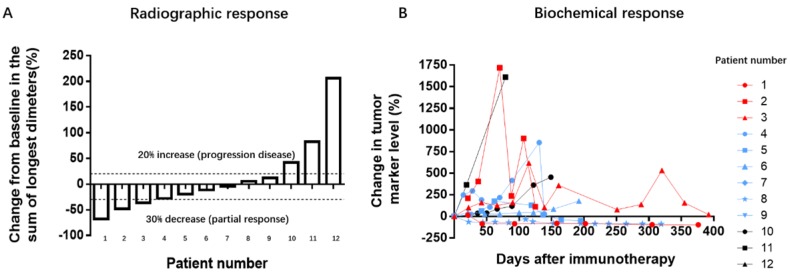
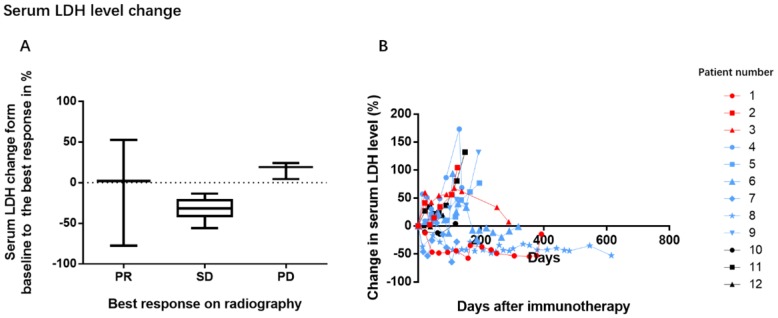
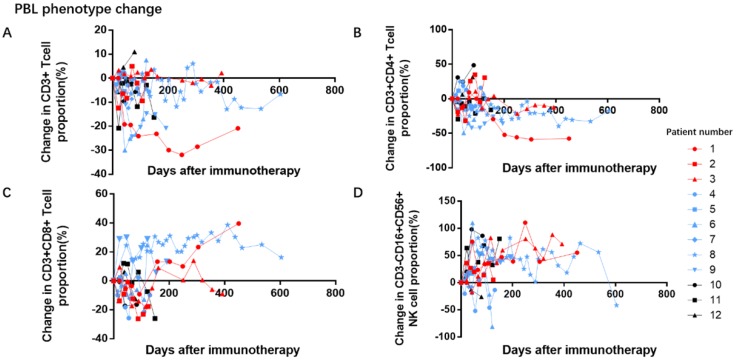
: Blockade of programmed death 1 (PD-1), an inhibitory T lymphocyte receptor, is associated with immune system enhancement and tumor remission in various tumors. We assessed the anti-tumor activity and immune correlates of cancer patients treated with an anti-PD-1 antibody. : Twelve patients with advanced metastatic tumors were treated with anti-PD-1 antibody. Responses were assessed after a 12-week treatment regimen. Biochemical and immunological indexes were measured before each cycle. : Among the 12 patients, 3 patients showed partial response while 6 patients had stable disease (objective response rate: 3/12, 25%; disease control rate: 9/12, 75%). During immunotherapy, the proportion of circulating CD3 T lymphocytes remained stable, with decreasing trends of CD3CD4 T helper cell and increase in CD3CD8 T memory cells, in patients with stable disease. Additionally, an increase in serum lactate dehydrogenase levels seemed to correlate with tumor progression. : An anti-PD-1 antibody produced objective responses in approximately 25% patients with various solid tumors, demonstrating that it could improve the immune system .
程序性死亡1(PD-1)是一种抑制性T淋巴细胞受体,阻断该受体与多种肿瘤的免疫系统增强及肿瘤缓解相关。我们评估了接受抗PD-1抗体治疗的癌症患者的抗肿瘤活性及免疫相关性。12例晚期转移性肿瘤患者接受了抗PD-1抗体治疗。在12周治疗方案后评估反应。在每个周期前测量生化和免疫指标。12例患者中,3例显示部分缓解,6例疾病稳定(客观缓解率:3/12,25%;疾病控制率:9/12,75%)。在免疫治疗期间,疾病稳定患者的循环CD3 T淋巴细胞比例保持稳定,CD3CD4辅助性T细胞呈下降趋势,CD3CD8 T记忆细胞增加。此外,血清乳酸脱氢酶水平升高似乎与肿瘤进展相关。抗PD-1抗体在约25%的各种实体瘤患者中产生了客观反应,表明其可改善免疫系统。