Hu Xiaowen, Liu Yang, Wang Changmei, Hou Lulu, Zheng Xiaoyan, Xu Yeqiu, Ding Lin, Pang Shuguang
Department of Infectious Diseases, Jinan Central Hospital Affiliated to Shandong University, Jinan 250013, China.
School of Chemistry and Molecular Biosciences, The University of Queensland, St Lucia Qld 4072, Australia.
Oncotarget. 2017 Nov 20;8(64):107589-107595. doi: 10.18632/oncotarget.22536. eCollection 2017 Dec 8.
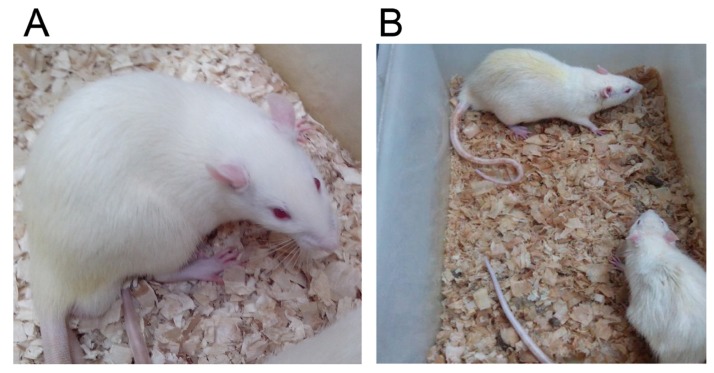
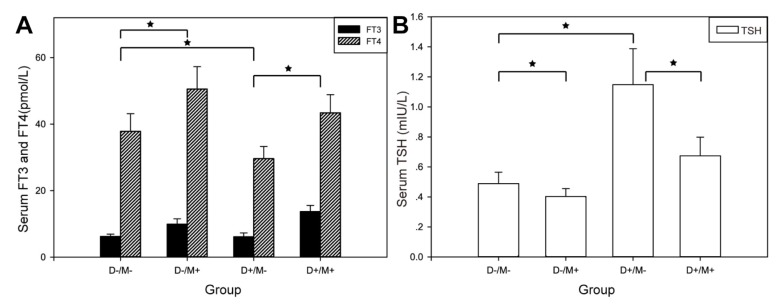
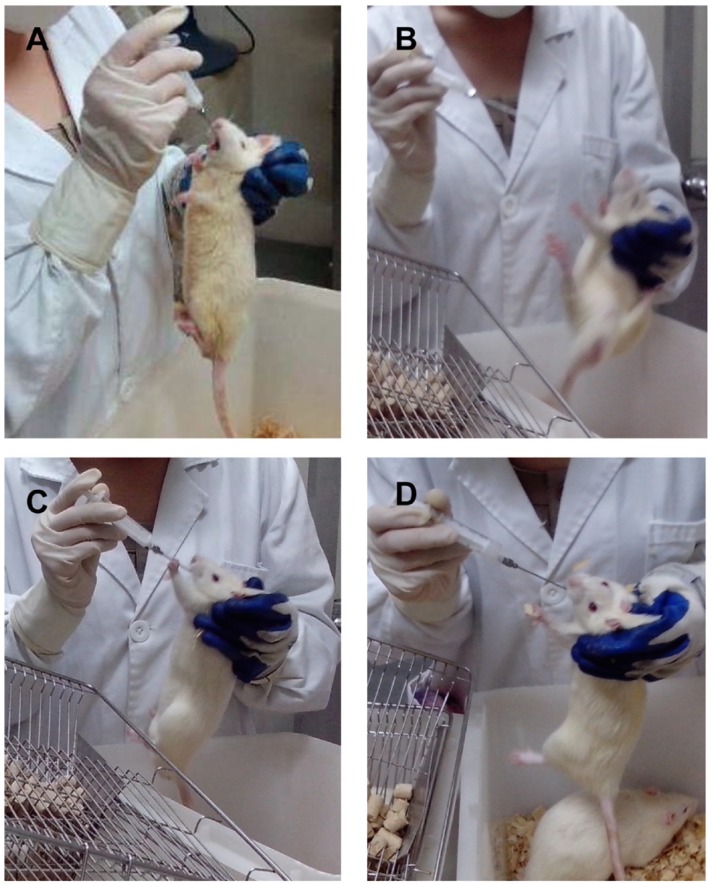
An intriguing area of research in type 2 diabetes recently discovered association of metformin therapy with thyroid functional and morphological changes. We aimed to evaluate the external symptoms and biochemical indicators concerning thyroid function in rats treated with metformin. Male wistar rats were randomly divided into four groups: Group (D-/M-), Group (D-/M+), Group (D+/M-), and Group (D+/M+), according to whether they were induced to diabetic model or placed on metformin. Characteristics of food intake, body weight, and other external symptoms were recorded. Thyroid function, concluding serum thyrotropin (TSH), free triiodothyronine (FT3), free thyroxine (FT4), were measured. We found a significantly higher TSH and lower FT4 in rats in Group (D+/M-), compared with rats in Group (D-/M-), but no significant change in FT3 level. Rats on metformin treatment exhibited relatively lower body weight and symptoms like irritability and diarrhea, concomitant with marked increase in FT3 and FT4 , no matter if they were induced to diabetic model or not . A slight but significant reduction in TSH concentration was also observed in rats received metformin. These data reveal that metformin can modify thyroid function with corresponding clinical symptoms of hyperthyroidism in male rats. Metformin's contribution to suppress TSH and increase FT3, FT4 should arise our attention to its treatment interference in clinical practice.
2型糖尿病研究中一个有趣的领域是最近发现二甲双胍治疗与甲状腺功能及形态变化之间存在关联。我们旨在评估接受二甲双胍治疗的大鼠甲状腺功能的外部症状和生化指标。雄性Wistar大鼠根据是否诱导为糖尿病模型或给予二甲双胍,随机分为四组:(D-/M-)组、(D-/M+)组、(D+/M-)组和(D+/M+)组。记录食物摄入量、体重和其他外部症状的特征。测量甲状腺功能,包括血清促甲状腺激素(TSH)、游离三碘甲状腺原氨酸(FT3)、游离甲状腺素(FT4)。我们发现,与(D-/M-)组大鼠相比,(D+/M-)组大鼠的TSH显著升高,FT4降低,但FT3水平无显著变化。无论是否诱导为糖尿病模型,接受二甲双胍治疗的大鼠体重相对较低,出现易怒和腹泻等症状,同时FT3和FT4显著升高。在接受二甲双胍的大鼠中还观察到TSH浓度略有但显著降低。这些数据表明,二甲双胍可改变雄性大鼠的甲状腺功能,并伴有甲状腺功能亢进的相应临床症状。二甲双胍对抑制TSH和升高FT3、FT4的作用应引起我们对其在临床实践中治疗干扰的关注。