Department of Paediatrics and Adolescent Medicine, The University of Hong Kong, Pok Fu Lam, Hong Kong, China.
Department of Paediatrics and Adolescent Medicine, The Duchess of Kent Children's Hospital, Pok Fu Lam, Hong Kong, China.
Mol Autism. 2017 Dec 20;8:66. doi: 10.1186/s13229-017-0182-4. eCollection 2017.
Macrocephaly, which is defined as a head circumference greater than or equal to + 2 standard deviations, is a feature commonly observed in children with developmental delay and/or autism spectrum disorder. Although is a well-known gene identified in patients with this syndromic presentation, other genes in the PI3K-AKT-mTOR signalling pathway have also recently been suggested to have important roles. The aim of this study is to characterise the mutation spectrum of this group of patients.
We performed whole-exome sequencing of 21 patients with macrocephaly and developmental delay/autism spectrum disorder. Sources of genomic DNA included blood, buccal mucosa and saliva. Germline mutations were validated by Sanger sequencing, whereas somatic mutations were validated by droplet digital PCR.
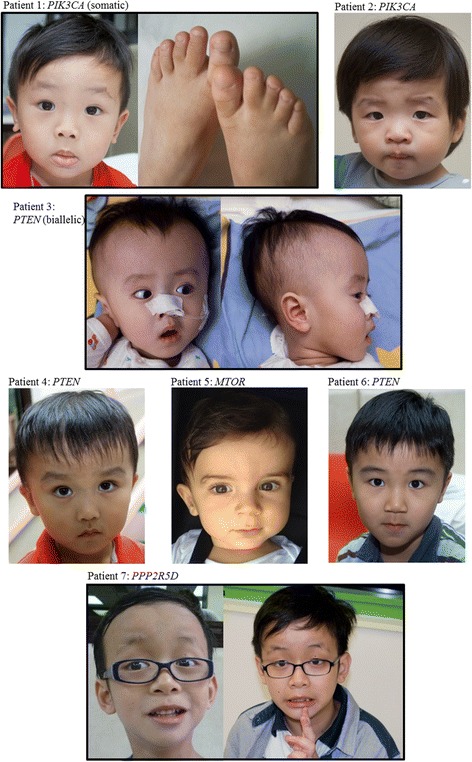
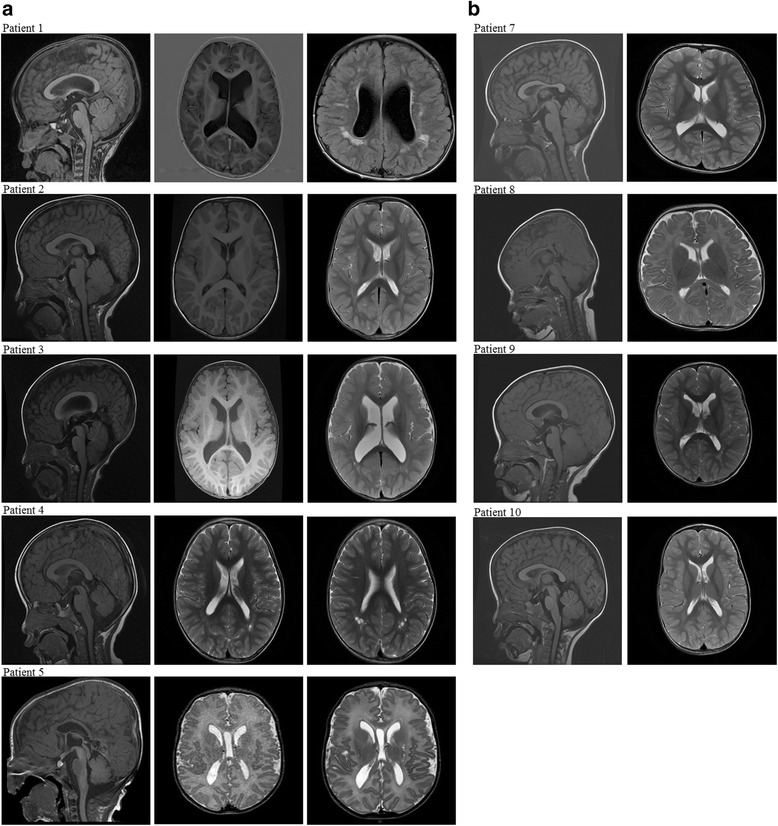
We identified ten pathogenic/likely pathogenic mutations in ( = 4), ( = 3), ( = 1) and ( = 2) in ten patients. An additional mutation, which was classified as variant of unknown significance, was identified in a patient with a pathogenic mutation, making him harbour bi-allelic germline mutations. Two patients harboured somatic mutations, and the level of somatic mosaicism in blood DNA was low. Patients who tested positive for mutations in the PI3K-AKT-mTOR pathway had a lower developmental quotient than the rest of the cohort (DQ = 62.8 vs. 76.1, p = 0.021). Their dysmorphic features were non-specific, except for macrocephaly. Among the ten patients with identified mutations, brain magnetic resonance imaging was performed in nine, all of whom showed megalencephaly.
We identified mutations in the PI3K-AKT-mTOR signalling pathway in nearly half of our patients with macrocephaly and developmental delay/autism spectrum disorder. These patients have subtle dysmorphic features and mild developmental issues. Clinically, patients with germline mutations are difficult to distinguish from patients with somatic mutations, and therefore, sequencing of buccal or saliva DNA is important to identify somatic mosaicism. Given the high diagnostic yield and the management implications, we suggest implementing comprehensive genetic testing in the PI3K-AKT-mTOR pathway in the clinical evaluation of patients with macrocephaly and developmental delay and/or autism spectrum disorder.
巨脑症是指头围大于或等于+2 个标准差,是发育迟缓及/或自闭症谱系障碍儿童的常见特征。虽然 是这种综合征患者中已知的一个重要基因,但最近也有研究表明,PI3K-AKT-mTOR 信号通路中的其他基因也具有重要作用。本研究旨在对这组患者的突变谱进行特征描述。
我们对 21 例巨脑症伴发育迟缓/自闭症谱系障碍患者进行了全外显子组测序。基因组 DNA 的来源包括血液、口腔黏膜和唾液。胚系突变通过 Sanger 测序验证,而体细胞突变通过液滴数字 PCR 验证。
我们在 10 例患者中发现了 10 个致病性/可能致病性突变,其中 ( = 4)、 ( = 3)、 ( = 1)和 ( = 2)各 1 个。在一位携带致病性 突变的患者中还发现了一个额外的 突变,被归类为意义不明的变异,使他携带双等位基因胚系 突变。两名患者携带体细胞 突变,血液 DNA 中的体细胞嵌合率较低。在 PI3K-AKT-mTOR 通路突变阳性的患者中,发育商低于队列中的其余患者(DQ = 62.8 对 76.1,p = 0.021)。他们的发育异常特征是非特异性的,除了巨脑症。在确定有突变的 10 例患者中,9 例进行了脑磁共振成像,均显示为巨脑症。
我们在近一半的巨脑症伴发育迟缓/自闭症谱系障碍患者中发现了 PI3K-AKT-mTOR 信号通路的突变。这些患者具有微妙的发育异常特征和轻度的发育问题。临床上,胚系突变的患者与体细胞突变的患者难以区分,因此,对口腔或唾液 DNA 进行测序对于识别体细胞嵌合很重要。鉴于高诊断率和管理意义,我们建议在巨脑症伴发育迟缓及/或自闭症谱系障碍患者的临床评估中,对 PI3K-AKT-mTOR 通路进行全面的基因检测。