Tefferi Ayalew, Lasho Terra L, Finke Christy M, Elala Yoseph, Hanson Curtis A, Ketterling Rhett P, Gangat Naseema, Pardanani Animesh
Division of Hematology, Department of Internal Medicine.
Division of Hematopathology, Department of Laboratory Medicine, and.
Blood Adv. 2016 Nov 30;1(2):105-111. doi: 10.1182/bloodadvances.2016000208. eCollection 2016 Dec 13.
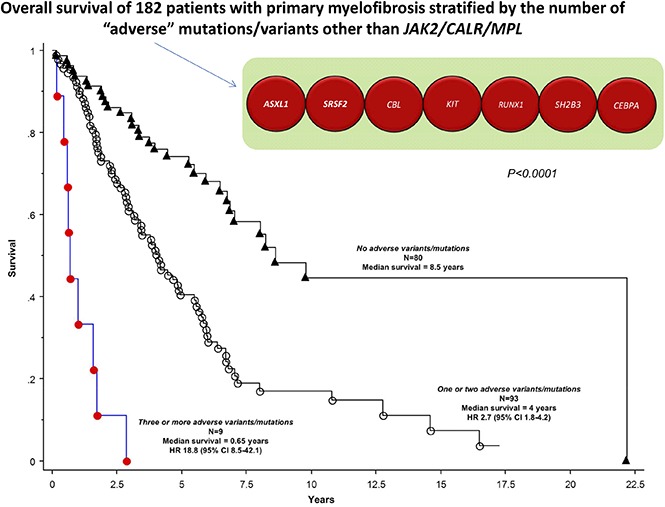
A myeloid neoplasm-relevant 27-gene panel was used for next-generation sequencing of bone marrow or whole blood DNA in 182 patients with primary myelofibrosis (PMF). DNA sequence variants/mutations other than / were detected in 147 patients (81%), with the most frequent being (36%), (18%), (18%), and (16%); furthermore, 35%, 26%, 10%, and 9% of the patients harbored 1, 2, 3, or 4 or more such variants/mutations, respectively. Adverse variants/mutations were identified by age-adjusted multivariable analysis of impact on overall survival or leukemia-free survival and included , , , , , , and ; their combined prevalence was 56%. Adverse variants/mutations were associated with inferior overall survival (median, 3.6 vs 8.5 years; < .001) and leukemia-free survival (7-year risk, 25% vs 4%; < .001), and the effect on survival was independent of both the Dynamic International Prognostic Scoring System Plus and // mutational status, with respective hazard ratios of 2.0 (95% confidence interval [CI], 1.3-3.1) and 2.9 (95% CI, 1.9-4.4). Additional prognostic information was obtained by considering the number of adverse variants/mutations; median survivals in patients with zero (n = 80), 1 or 2 (n = 93), or 3 or more (n = 9) adverse variants/mutations were 8.5, 4, and 0.7 years, respectively ( < .001). Additional data were obtained on pattern of mutation co-segregation and phenotypic correlation, including significant associations between and mutations ( = .04) and mutations and anemia ( = .003) and thrombocytopenia ( = .006). We conclude that DNA variants/mutations other than // are prevalent in PMF and are qualitatively and quantitatively relevant in predicting overall and leukemia-free survival.
采用一个与髓系肿瘤相关的27基因检测板,对182例原发性骨髓纤维化(PMF)患者的骨髓或全血DNA进行二代测序。在147例患者(81%)中检测到除//之外的DNA序列变异/突变,最常见的是(36%)、(18%)、(18%)和(16%);此外,分别有35%、26%、10%和9%的患者携带1个、2个、3个或4个及以上此类变异/突变。通过对总体生存或无白血病生存影响的年龄校正多变量分析,确定了不良变异/突变,包括、、、、、和;它们的合并患病率为56%。不良变异/突变与较差的总体生存(中位值,3.6年对8.5年;<.001)和无白血病生存(7年风险,25%对4%;<.001)相关,并且对生存的影响独立于动态国际预后评分系统升级版和//突变状态,各自的风险比分别为2.0(95%置信区间[CI],1.3 - 3.1)和2.9(95%CI,1.9 - 4.4)。通过考虑不良变异/突变的数量获得了额外的预后信息;不良变异/突变数为零(n = 80)、1或2个(n = 93)、3个或更多(n = 9)的患者的中位生存期分别为8.5年、4年和0.7年(<.001)。还获得了关于突变共分离模式和表型相关性的额外数据,包括与突变之间的显著关联(=.04)以及突变与贫血(=.003)和血小板减少症(=.006)之间的显著关联。我们得出结论,除//之外的DNA变异/突变在PMF中普遍存在,并且在预测总体生存和无白血病生存方面在质量和数量上都具有相关性。