Bangalore-Prakash Pradeep, Stunz Laura L, Mambetsariev Nurbek, Whillock Amy L, Hostager Bruce S, Bishop Gail A
Department of Pediatrics.
Department of Microbiology.
Blood Adv. 2017 Dec 18;1(27):2712-2723. doi: 10.1182/bloodadvances.2017009670. eCollection 2017 Dec 26.
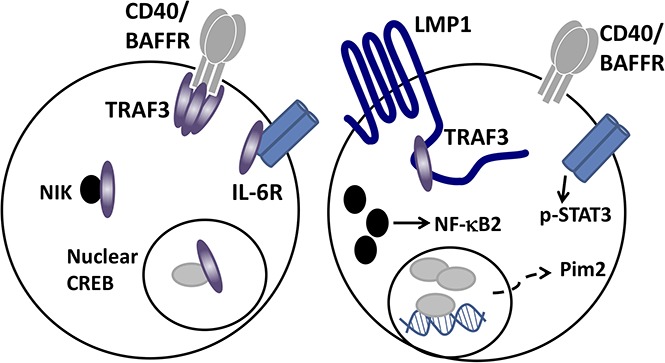
Loss-of-function mutations in genes encoding the signaling protein tumor necrosis factor receptor-associated factor 3 (TRAF3) are commonly found in human B-cell malignancies, especially multiple myeloma and B-cell lymphoma (BCL). B-cell TRAF3 deficiency results in enhanced cell survival, elevated activation receptor signaling, and increased activity of certain transcriptional pathways regulating expression of prosurvival proteins. A recent analysis of TRAF3 protein staining of ∼300 human BCL tissue samples revealed that a higher proportion of samples expressing the oncogenic Epstein-Barr virus-encoded protein latent membrane protein 1 (LMP1) showed low/negative TRAF3 staining than predicted. LMP1, a dysregulated mimic of the CD40 receptor, binds TRAF3 more effectively than CD40. We hypothesized that LMP1 may sequester TRAF3, reducing its availability to inhibit prosurvival signaling pathways in the B cell. This hypothesis was addressed via 2 complementary approaches: (1) comparison of TRAF3-regulated activation and survival-related events with relative LMP1 expression in human BCL lines and (2) analysis of the impact upon such events in matched pairs of mouse BCL lines, both parental cells and subclones transfected with inducible LMP1, either wild-type LMP1 or a mutant LMP1 with defective TRAF3 binding. Results from both approaches showed that LMP1-expressing B cells display a phenotype highly similar to that of B cells lacking genes, indicating that LMP1 can render B cells functionally TRAF3 deficient without gene mutations, a finding of significant relevance to selecting pathway-targeted therapies for B-cell malignancies.
编码信号蛋白肿瘤坏死因子受体相关因子3(TRAF3)的基因功能丧失突变常见于人类B细胞恶性肿瘤,尤其是多发性骨髓瘤和B细胞淋巴瘤(BCL)。B细胞中TRAF3缺乏会导致细胞存活率提高、激活受体信号增强,以及某些调节促生存蛋白表达的转录途径活性增加。最近对约300份人类BCL组织样本进行的TRAF3蛋白染色分析显示,与预期相比,表达致癌性爱泼斯坦-巴尔病毒编码蛋白潜伏膜蛋白1(LMP1)的样本中,显示低/阴性TRAF3染色的比例更高。LMP1是一种失调的CD40受体模拟物,比CD40更有效地结合TRAF3。我们推测LMP1可能会隔离TRAF3,降低其抑制B细胞中促生存信号通路的可用性。这一假设通过两种互补方法进行验证:(1)比较人类BCL细胞系中TRAF3调节的激活和生存相关事件与相对LMP1表达情况;(2)分析在配对的小鼠BCL细胞系(亲本细胞以及转染了可诱导LMP1的亚克隆,包括野生型LMP1或与TRAF3结合缺陷的突变型LMP1)中此类事件所受的影响。两种方法的结果均显示,表达LMP1的B细胞表现出与缺乏TRAF3基因的B细胞高度相似的表型,这表明LMP1可使B细胞在无基因突变的情况下功能上TRAF3缺乏,这一发现对于为B细胞恶性肿瘤选择靶向通路治疗具有重要意义。