Salehi Paria Motamen, Foroutan Tahereh, Javeri Arash, Taha Masoumeh Fakhr
Department of Stem Cells and Regenerative Medicine, Institute for Medical Biotechnology, National Institute of Genetic Engineering and Biotechnology (NIGEB), Tehran, Iran.
Department of Biology, Faculty of Basic Science, Kharazmi University, Tehran, Iran.
Iran J Basic Med Sci. 2017 Nov;20(11):1200-1206. doi: 10.22038/IJBMS.2017.9464.
In some previous studies, the extract of embryonic carcinoma cells (ECCs) and embryonic stem cells (ESCs) have been used to reprogram somatic cells to more dedifferentiated state. The aim of this study was to investigate the effect of mouse ESCs extract on the expression of some pluripotency markers in human adipose tissue-derived stem cells (ADSCs).
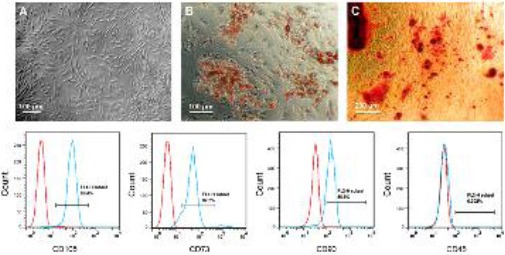
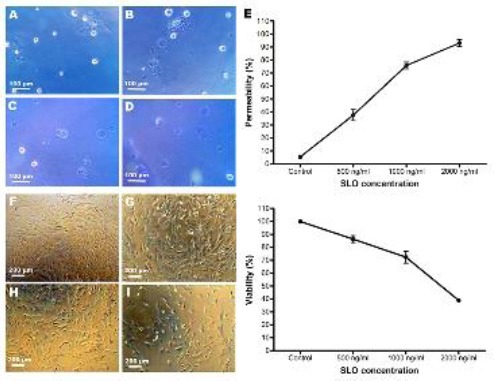
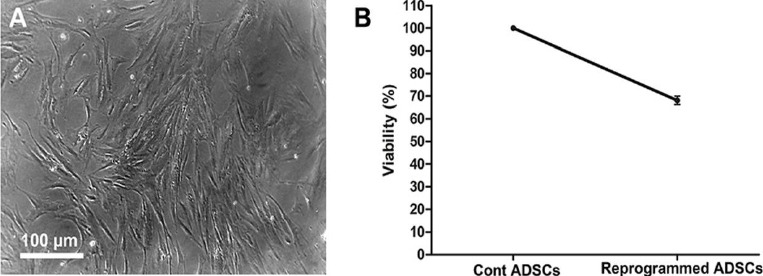
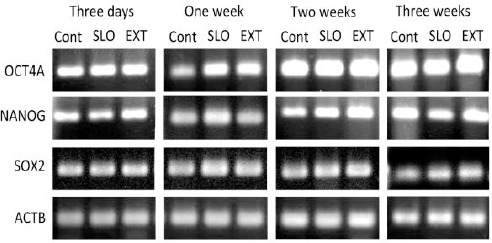
Human ADSCs were isolated from subcutaneous abdominal adipose tissue and characterized by flow cytometric analysis for the expression of some mesenchymal stem cell markers and adipogenic and osteogenic differentiation. Frequent freeze-thaw technique was used to prepare cytoplasmic extract of ESCs. Plasma membranes of the ADSCs were reversibly permeabilized by streptolysin-O (SLO). Then the permeabilized ADSCs were incubated with the ESC extract and cultured in resealing medium. After reprogramming, the expression of some pluripotency genes was evaluated by RT-PCR and quantitative real-time PCR (qPCR) analyses.
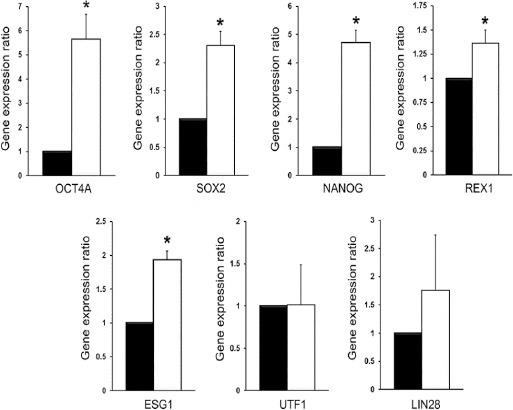
Third-passaged ADSCs showed a fibroblast-like morphology and expressed mesenchymal stem cell markers. They also showed adipogenic and osteogenic differentiation potential. QPCR analysis revealed a significant upregulation in the expression of some pluripotency genes including , , , and in the reprogrammed ADSCs compared to the control group.
These findings showed that mouse ESC extract can be used to induce reprogramming of human ADSCs. In fact, this method is applicable for reprogramming of human adult stem cells to a more pluripotent sate and may have a potential in regenerative medicine.
在一些先前的研究中,胚胎癌细胞(ECCs)和胚胎干细胞(ESCs)的提取物已被用于将体细胞重编程为更去分化的状态。本研究的目的是探讨小鼠胚胎干细胞提取物对人脂肪组织来源干细胞(ADSCs)中一些多能性标志物表达的影响。
从腹部皮下脂肪组织中分离出人脂肪组织来源干细胞,并通过流式细胞术分析其一些间充质干细胞标志物的表达以及成脂和成骨分化情况进行鉴定。采用反复冻融技术制备胚胎干细胞的细胞质提取物。用链球菌溶血素-O(SLO)使脂肪组织来源干细胞的质膜可逆性通透化。然后将通透化的脂肪组织来源干细胞与胚胎干细胞提取物一起孵育,并在重封培养基中培养。重编程后,通过逆转录聚合酶链反应(RT-PCR)和定量实时聚合酶链反应(qPCR)分析评估一些多能性基因的表达。
第三代脂肪组织来源干细胞呈现成纤维细胞样形态,并表达间充质干细胞标志物。它们还表现出成脂和成骨分化潜能。qPCR分析显示,与对照组相比,重编程后的脂肪组织来源干细胞中一些多能性基因(包括 、 、 、 和 )的表达显著上调。
这些研究结果表明,小鼠胚胎干细胞提取物可用于诱导人脂肪组织来源干细胞的重编程。事实上,这种方法适用于将成人干细胞重编程为更具多能性的状态,并且在再生医学中可能具有潜力。