Guns Laura-An, Monteagudo Silvia, Kvasnytsia Maryna, Kerckhofs Greet, Vandooren Jennifer, Opdenakker Ghislain, Lories Rik J, Cailotto Frederic
Department of Development and Regeneration, Laboratory of Tissue Homeostasis and Disease, Skeletal Biology and Engineering Research Center, Leuven, Belgium.
Tissue Engineering Unit, Department of Development and Regeneration, Skeletal Biology and Engineering Research Center, Leuven, Belgium.
RMD Open. 2017 Nov 30;3(2):e000604. doi: 10.1136/rmdopen-2017-000604. eCollection 2017.
Suramin is an old drug used for the treatment of African sleeping sickness. We investigated therapeutic repositioning of suramin to protect against cartilage damage, as suramin may interact with tissue inhibitor of metalloproteinase-3 (TIMP3).
In vitro extracellular matrix (ECM) accumulation and turnover in the presence or absence of suramin were studied in the ATDC5 micromass model of chondrogenesis and in pellet cultures of human articular chondrocytes from osteoarthritis and control patients, by gene expression, protein analysis, colorimetric staining, immunoprecipitation, fluorimetric analysis and immunohistochemistry. To study suramin in vivo, the drug was injected intra-articularly in the papain model of joint damage. Disease severity was analysed by histology, immunohistochemistry and contrast-enhanced nanofocus CT.
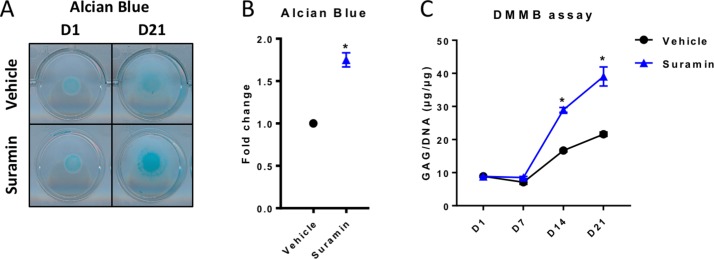
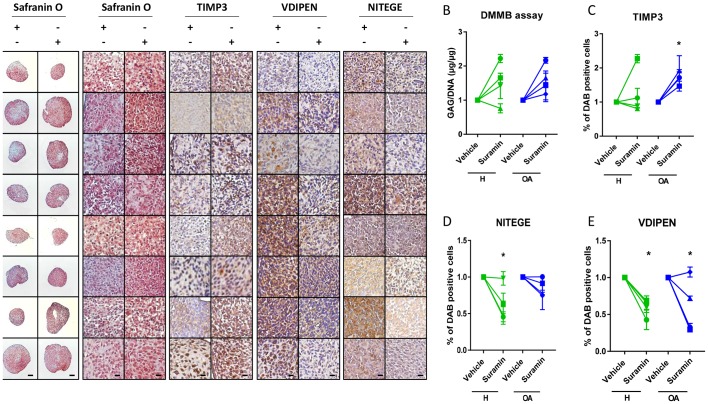
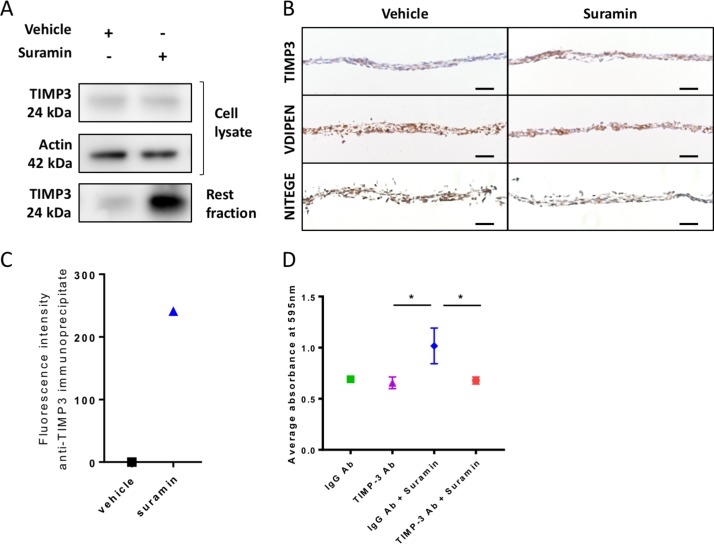
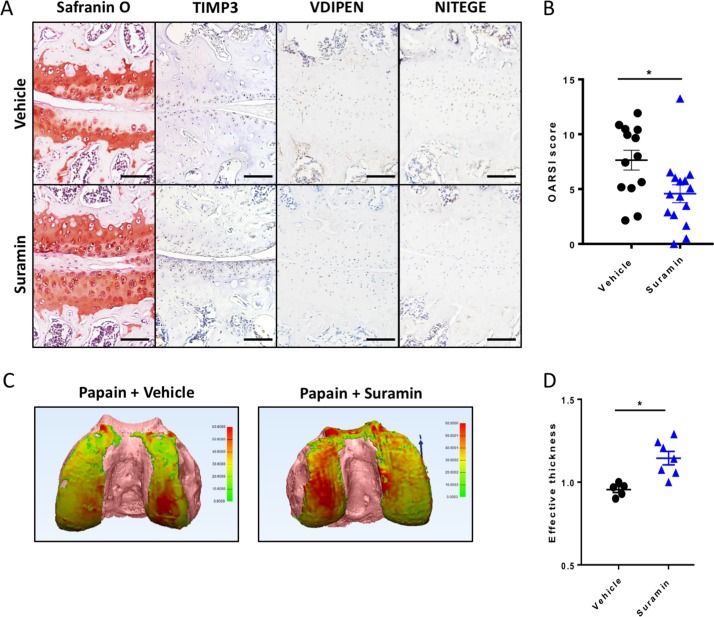
In ATDC5 micromasses, suramin increased TIMP3 levels and decreased the activity of matrix metalloproteinases (MMPs) and aggrecanases. Suramin treatment resulted in increased glycosaminoglycans. This effect on the ECM was blocked by an anti-TIMP3 antibody. Direct interaction between suramin and endogenous TIMP3 was demonstrated in immunoprecipitates. Mice treated intra-articularly with suramin injections showed reduced cartilage damage compared with controls, with increased TIMP3 and decreased MMP and aggrecanase activity. Translational validation in human chondrocytes confirmed increased TIMP3 function and reduced cartilage breakdown after suramin treatment.
Suramin prevented loss of articular cartilage in a mouse model of cartilage damage. The effects appear to be mediated by a functional increase of TIMP3 and a subsequent decrease in the activity of catabolic enzymes. Thus, suramin repositioning could be considered to prevent progressive cartilage damage and avoid evolution toward osteoarthritis.
苏拉明是一种用于治疗非洲昏睡病的老药。我们研究了苏拉明的治疗新用途,即预防软骨损伤,因为苏拉明可能与金属蛋白酶组织抑制剂-3(TIMP3)相互作用。
在软骨形成的ATDC5微团模型以及骨关节炎患者和对照患者的人关节软骨细胞团块培养物中,通过基因表达、蛋白质分析、比色染色、免疫沉淀、荧光分析和免疫组织化学,研究了有无苏拉明存在时细胞外基质(ECM)的积累和周转情况。为了在体内研究苏拉明,将该药物关节内注射到关节损伤的木瓜蛋白酶模型中。通过组织学、免疫组织化学和对比增强纳米聚焦CT分析疾病严重程度。
在ATDC5微团中,苏拉明增加了TIMP3水平,降低了基质金属蛋白酶(MMPs)和聚糖酶的活性。苏拉明治疗导致糖胺聚糖增加。抗TIMP3抗体阻断了这种对ECM的作用。免疫沉淀物中证实了苏拉明与内源性TIMP3之间的直接相互作用。与对照组相比,关节内注射苏拉明的小鼠软骨损伤减少,TIMP3增加,MMP和聚糖酶活性降低。在人软骨细胞中的转化验证证实,苏拉明治疗后TIMP3功能增强,软骨分解减少。
苏拉明在软骨损伤的小鼠模型中预防了关节软骨的丢失。其作用似乎是由TIMP3功能增强以及随后分解代谢酶活性降低介导的。因此,可以考虑重新定位苏拉明以预防进行性软骨损伤并避免发展为骨关节炎。