Department of Nephrology and Hypertension, University Hospital Erlangen, Ulmenweg 18, 91054, Erlangen, Germany.
Department for Diagnostic Radiology, University Hospital Erlangen, Erlangen, Germany.
Cardiovasc Diabetol. 2018 Jan 4;17(1):5. doi: 10.1186/s12933-017-0654-z.
Sodium tissue content by Na magnetic resonance imaging (Na-MRI) has been validated in experimental and human studies. SGLT-2 inhibition blocks the reabsorption of glucose and of sodium in the proximal tubular cells in a 1:1 fashion. We hypothesized that SGLT-2 inhibition in patients with type 2 diabetes characterized by sodium retention leads to decreased tissue sodium content due to its pharmacological action.
In a prospective double blind, placebo controlled, cross-over trial 59 patients (61 ± 7.6 years) with type 2 diabetes were randomized to either dapagliflozin 10 mg or placebo once daily for 6 weeks each. In addition to metabolic parameters and ambulatory blood pressure (BP) we analysed the sodium content in the skin and muscles of the lower leg by Na-MRI.
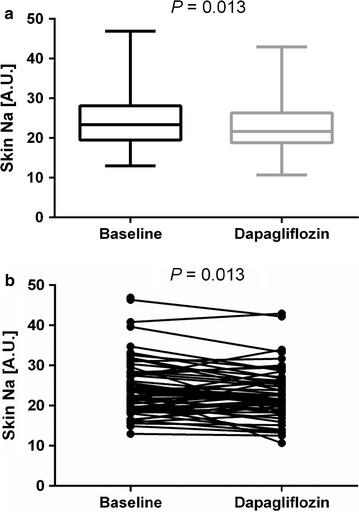
Compared to baseline 6 weeks treatment with the SGLT-2 inhibitor dapagliflozin decreased fasting (132 ± 28 vs. 114 ± 19 mg/dl, p < 0.001), postprandial blood glucose (178 ± 66 mg/dl vs. 153 ± 46 mg/dl, p < 0.001), body weight (87.6 vs. 86.6 kg, p < 0.001) and systolic (129 ± 12 vs. 126 ± 11 mmHg, p = 0.010), and diastolic (77.4 ± 9 vs. 75.6 ± 8 mmHg, p = 0.024), 24-h ambulatory BP. Tissue sodium content in the skin was reduced after 6 weeks treatment with dapagliflozin compared to baseline [24.1 ± 6.6 vs. 22.7 ± 6.4 A.U.(arbitrary unit) p = 0.013]. No significant reduction of tissue sodium content was observed in the muscle (M. triceps surae: 20.5 ± 3.5 vs. 20.4 ± 3.7 A.U. p = 0.801). No clear significant difference in tissue water content of muscle and skin was observed after 6 weeks of treatment with dapagliflozin, compared to baseline.
SGLT-2 inhibition with dapagliflozin resulted in a significant decrease in tissue sodium content of the skin after 6 weeks. This observation point to a decrease of total sodium content in patients with type 2 diabetes prone to cardiovascular complications, that might be mitigated by SGLT-2 inhibition. Trial registration The study was registered at http://www.clinicaltrials.gov (NCT02383238) retrospectively registered.
钠离子磁共振成像(Na-MRI)已在实验和人体研究中得到验证。SGLT-2 抑制剂以 1:1 的比例阻断葡萄糖和近端肾小管细胞中钠的重吸收。我们假设 SGLT-2 抑制剂在以钠潴留为特征的 2 型糖尿病患者中具有药理学作用,可导致组织钠含量降低。
在一项前瞻性、双盲、安慰剂对照、交叉试验中,59 名(61 ± 7.6 岁)2 型糖尿病患者随机分为达格列净 10mg 或安慰剂,每天一次,持续 6 周。除了代谢参数和动态血压(BP)外,我们还通过 Na-MRI 分析了小腿皮肤和肌肉中的钠含量。
与基线相比,6 周的 SGLT-2 抑制剂达格列净治疗可降低空腹血糖(132 ± 28 与 114 ± 19mg/dl,p<0.001)、餐后血糖(178 ± 66 与 153 ± 46mg/dl,p<0.001)、体重(87.6 与 86.6kg,p<0.001)和收缩压(129 ± 12 与 126 ± 11mmHg,p=0.010)、舒张压(77.4 ± 9 与 75.6 ± 8mmHg,p=0.024)。24 小时动态血压。与基线相比,达格列净治疗 6 周后皮肤组织钠含量降低[24.1 ± 6.6 与 22.7 ± 6.4A.U.(任意单位),p=0.013]。达格列净治疗 6 周后,肌肉(三头肌)组织钠含量无明显降低[20.5 ± 3.5 与 20.4 ± 3.7A.U.,p=0.801]。与基线相比,达格列净治疗 6 周后,肌肉和皮肤的组织水含量无明显差异。
达格列净抑制 SGLT-2 可导致皮肤组织钠含量在 6 周后显著降低。这一观察结果表明,易发生心血管并发症的 2 型糖尿病患者的总钠含量可能减少,而 SGLT-2 抑制可能减轻这种情况。试验注册:该研究在 http://www.clinicaltrials.gov(NCT02383238)上注册,为回顾性注册。