Kuo Chiu-Huang, Lin Yu-Li, Lee Chung-Jen, Wang Chih-Hsien, Lai Yu-Hsien, Liou Hung-Hsiang, Hsu Bang-Gee
Division of Nephrology, Buddhist Tzu Chi General Hospital, Hualien, Taiwan.
Department of Nursing, Tzu Chi University of Science and Technology, Hualien, Taiwan.
PLoS One. 2018 Jan 5;13(1):e0190694. doi: 10.1371/journal.pone.0190694. eCollection 2018.
Leptin plays a role in stimulating vascular inflammation, vascular smooth muscle hypertrophy, and augmenting blood pressure, which contributes to the pathogenesis of atherosclerosis and leads to arterial stiffness. This vascular damage, measured by carotid-femoral pulse wave velocity (cfPWV), is recognized as an independent predictor of cardiovascular mortality in hemodialysis (HD) patients. The aim of this study was to evaluate the relationship between serum leptin and arterial stiffness in HD patients.
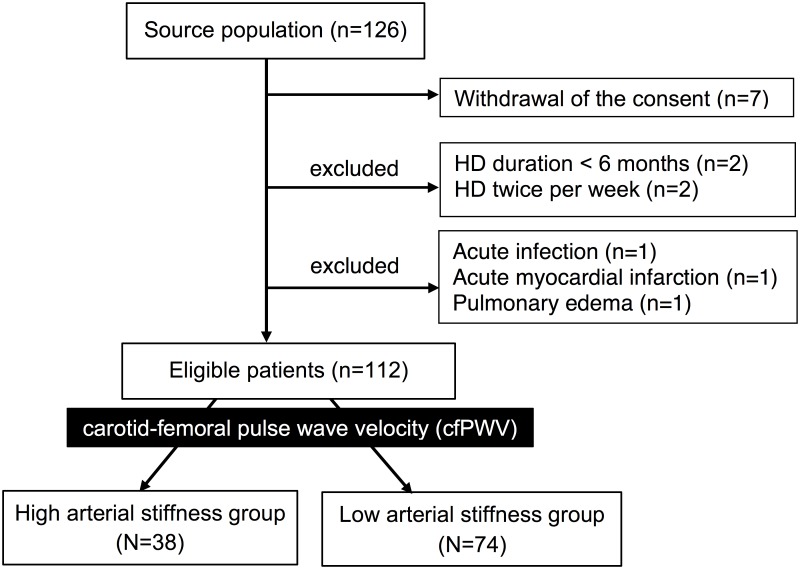
In 112 of the 126 HD patients were eligible and their biochemical data were collected for analysis. Serum leptin level was measured using a commercial enzyme-linked immunosorbent assay kit. Carotid-femoral pulse wave velocity was measured by a validated tonometry system (SphygmoCor). Those have cfPWV values above 10 m/s are defined as the high arterial stiffness group.
Among the participants, thirty-eight of them who were in the high arterial stiffness group, had a higher prevalence of diabetes mellitus (p = 0.002), age (p = 0.029), body mass index (BMI, p = 0.018), body fat mass (p = 0.001), hemoglobin (p = 0.040), and serum leptin levels (P<0.001). Multivariable logistic regression analysis showed that leptin (odds ratio [OR] 1.09; 95% confidence interval [CI] 1.04-1.14; p <0.001), diabetes (OR 7.17; CI 1.39-37.00; p = 0.019), body fat mass (OR 1.16; CI 1.02-1.33; p = 0.027); and hemoglobin (OR 2.11; CI 1.15-3.87; p = 0.015) were independently associated with arterial stiffness in HD patients.
In our study, hyperleptinemia was positively correlated to the high cfPWV and thus was related to high arterial stiffness in HD patients.
瘦素在刺激血管炎症、血管平滑肌肥大以及升高血压方面发挥作用,这有助于动脉粥样硬化的发病机制并导致动脉僵硬。通过颈股脉搏波速度(cfPWV)测量的这种血管损伤被认为是血液透析(HD)患者心血管死亡的独立预测指标。本研究的目的是评估HD患者血清瘦素与动脉僵硬之间的关系。
126例HD患者中有112例符合条件,并收集他们的生化数据进行分析。使用商用酶联免疫吸附测定试剂盒测量血清瘦素水平。通过经过验证的眼压测量系统(SphygmoCor)测量颈股脉搏波速度。cfPWV值高于10 m/s的患者被定义为高动脉僵硬组。
在参与者中,高动脉僵硬组的38名患者患糖尿病的患病率更高(p = 0.002)、年龄更大(p = 0.029)、体重指数(BMI,p = 0.018)、体脂量更高(p = 0.001)、血红蛋白水平更高(p = 0.040)以及血清瘦素水平更高(P<0.001)。多变量逻辑回归分析表明,瘦素(比值比[OR] 1.09;95%置信区间[CI] 1.04 - 1.14;p <0.001)、糖尿病(OR 7.17;CI 1.39 - 37.00;p = 0.019)、体脂量(OR 1.16;CI 1.02 - 1.33;p = 0.027)和血红蛋白(OR 2.11;CI 1.15 - 3.87;p = 0.015)与HD患者的动脉僵硬独立相关。
在我们的研究中,高瘦素血症与高cfPWV呈正相关,因此与HD患者的高动脉僵硬有关。