Babak Maria V, Meier Samuel M, Huber Kilian V M, Reynisson Jóhannes, Legin Anton A, Jakupec Michael A, Roller Alexander, Stukalov Alexey, Gridling Manuela, Bennett Keiryn L, Colinge Jacques, Berger Walter, Dyson Paul J, Superti-Furga Giulio, Keppler Bernhard K, Hartinger Christian G
School of Chemical Sciences , University of Auckland , Private Bag 92019 , Auckland 1142 , New Zealand . Email:
Institute of Inorganic Chemistry , University of Vienna , Waehringer Str. 42 , A-1090 Vienna , Austria.
Chem Sci. 2015 Apr 1;6(4):2449-2456. doi: 10.1039/c4sc03905j. Epub 2015 Feb 9.
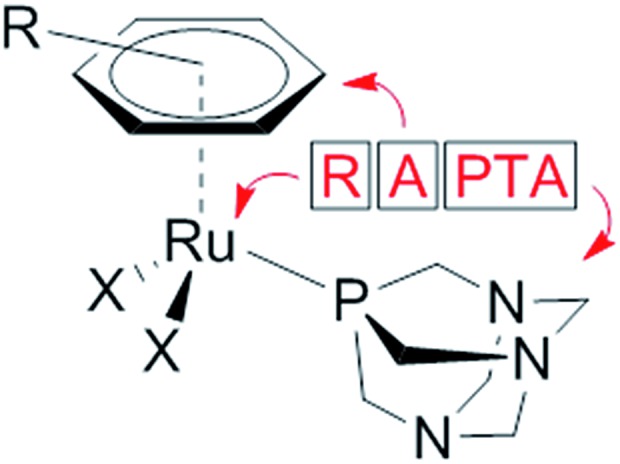
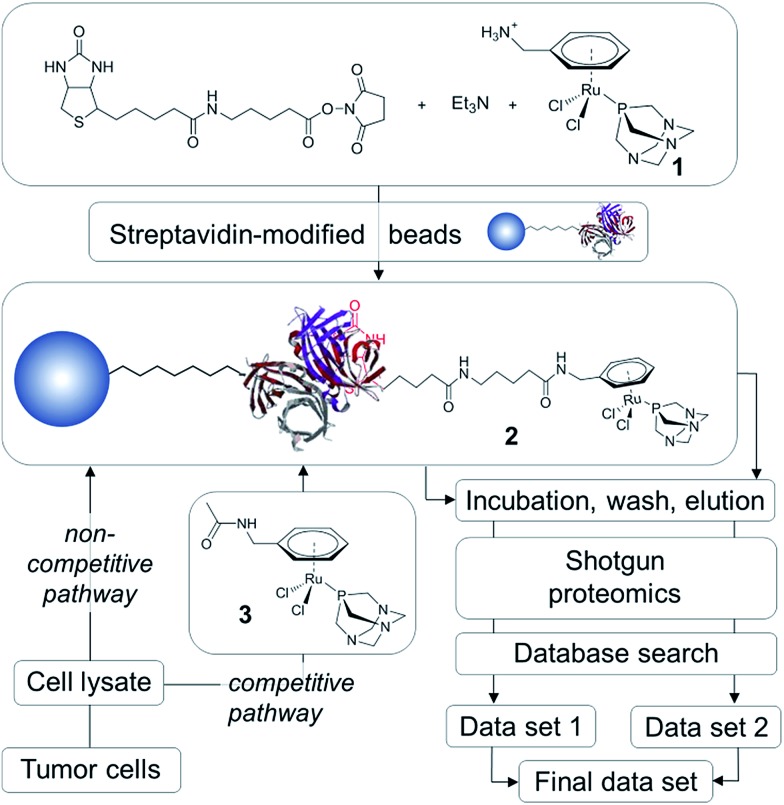
The clinical development of anticancer metallodrugs is often hindered by the elusive nature of their molecular targets. To identify the molecular targets of an antimetastatic ruthenium organometallic complex based on 1,3,5-triaza-7-phosphaadamantane (RAPTA), we employed a chemical proteomic approach. The approach combines the design of an affinity probe featuring the pharmacophore with mass-spectrometry-based analysis of interacting proteins found in cancer cell lysates. The comparison of data sets obtained for cell lysates from cancer cells before and after treatment with a competitive binder suggests that RAPTA interacts with a number of cancer-related proteins, which may be responsible for the antiangiogenic and antimetastatic activity of RAPTA complexes. Notably, the proteins identified include the cytokines midkine, pleiotrophin and fibroblast growth factor-binding protein 3. We also detected guanine nucleotide-binding protein-like 3 and FAM32A, which is in line with the hypothesis that the antiproliferative activity of RAPTA compounds is due to induction of a G/M arrest and histone proteins identified earlier as potential targets.
抗癌金属药物的临床开发常常因其分子靶点难以捉摸的特性而受阻。为了确定一种基于1,3,5-三氮杂-7-磷杂金刚烷(RAPTA)的抗转移钌有机金属配合物的分子靶点,我们采用了化学蛋白质组学方法。该方法将具有药效团的亲和探针设计与基于质谱的癌细胞裂解物中相互作用蛋白分析相结合。用竞争性结合剂处理前后癌细胞裂解物所获得数据集的比较表明,RAPTA与多种癌症相关蛋白相互作用,这些蛋白可能是RAPTA配合物抗血管生成和抗转移活性的原因。值得注意的是,鉴定出的蛋白包括细胞因子中期因子、多效生长因子和成纤维细胞生长因子结合蛋白3。我们还检测到鸟嘌呤核苷酸结合蛋白样3和FAM32A,这与RAPTA化合物的抗增殖活性是由于诱导G/M期阻滞这一假设相符,并且组蛋白之前已被确定为潜在靶点。