Yuan Ye, Meng Lin, Zhou Yan, Lu Na
Department of Anesthesiology Department of Cadre Ward Department of Pediatrics, the First Hospital of Jilin University, Changchun, Jilin, China.
Medicine (Baltimore). 2017 Dec;96(48):e8639. doi: 10.1097/MD.0000000000008639.
Genetic factors in the pathogenesis of cardiomyopathies have received a lot of attention during the past 2 decades. Some studies have reported that angiotensin-converting enzyme (ACE) gene has been associated with hypertrophic cardiomyopathy (HCM). However, there have been inconsonant results among different studies. To clarify the influence of ACE on HCM, a systemic review and meta-analysis of case-control studies were performed.
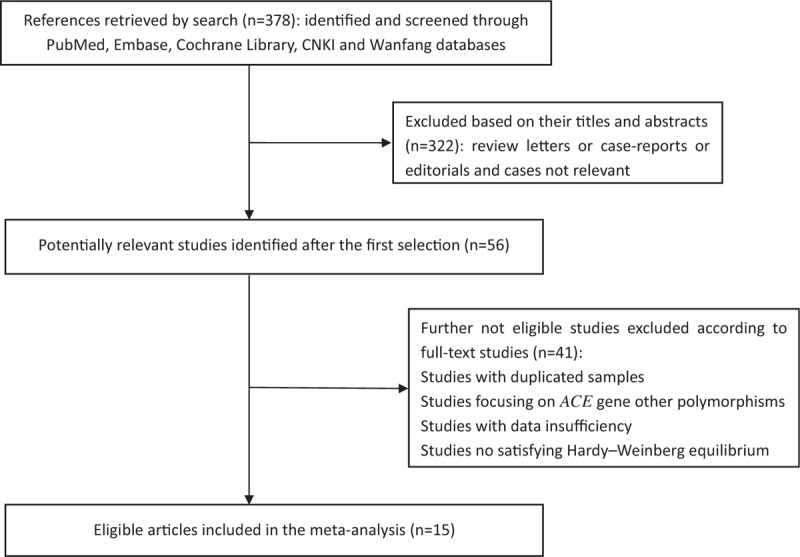
The following databases were searched to indentify related studies: PubMed database, the Embase database, the Cochrane Central Register of Controlled Trials database, China National Knowledge Information database, and Chinese Scientific and Technological Journal database. Search terms included "hypertrophic cardiomyopathy," "angiotensin converting enzyme" or "ACE," and "polymorphism or mutation."
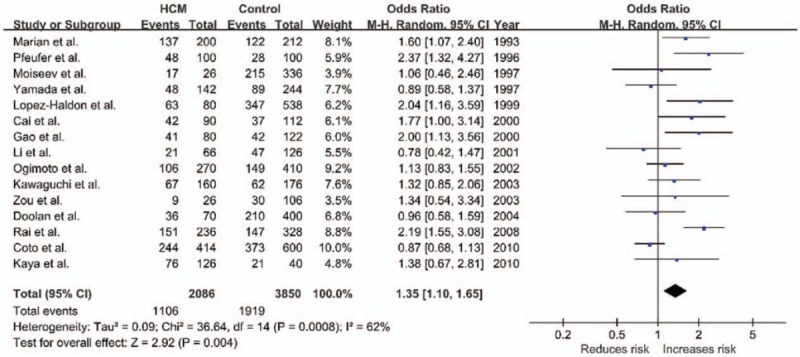
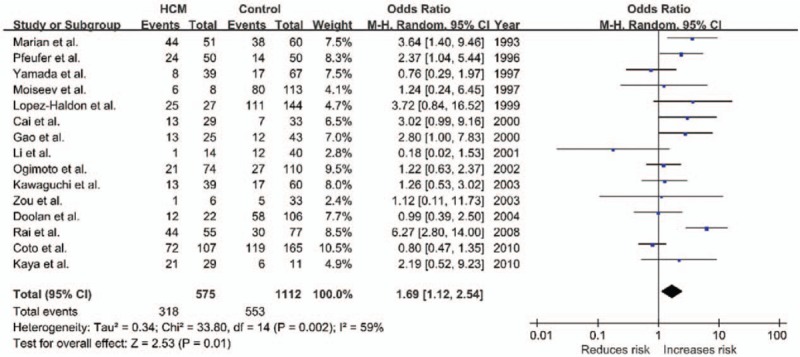
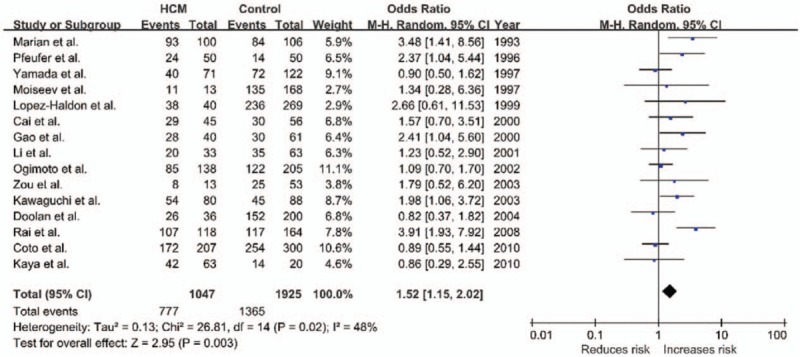
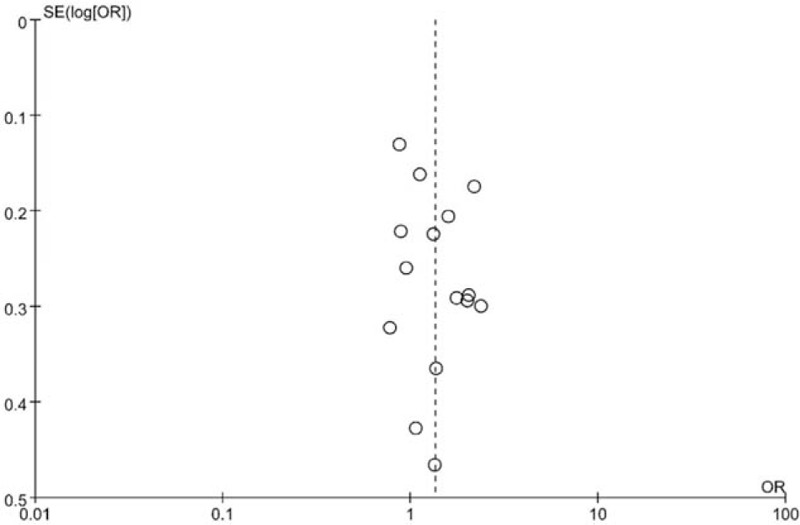
Fifteen separate studies were suitable for the inclusion criterion. The selected studies contained 2972 participants, including 1047 in HCM group and 1925 controls. Pooled odds ratios (ORs) were calculated to assess the association between ACE insertion/deletion (I/D) polymorphism and HCM. Our case-control data indicated that D allele carrier is a risk allele in all genetic models: allele contrast (D vs I: OR = 1.35, 95% confidence interval [CI]: 1.10-1.65, P = .004), homozygous comparison (DD vs II: OR = 1.69; 95% CI: 1.12-2.54; P = .01), dominant model (DD + ID vs II: OR = 1.52, 95% CI: 1.15-2.02, P = .003), and recessive model (DD vs ID + II: OR = 1.34, 95% CI: 0.99-1.81, P = .03).
In summary, the current meta-analysis provided solid evidence suggesting that ACE gene I/D polymorphism was probably a genetic risk factor for HCM.
在过去20年中,心肌病发病机制中的遗传因素受到了广泛关注。一些研究报告称,血管紧张素转换酶(ACE)基因与肥厚型心肌病(HCM)有关。然而,不同研究的结果并不一致。为了阐明ACE对HCM的影响,我们对病例对照研究进行了系统综述和荟萃分析。
检索以下数据库以识别相关研究:PubMed数据库、Embase数据库、Cochrane对照试验中央注册数据库、中国知网数据库和中国科技期刊数据库。检索词包括“肥厚型心肌病”、“血管紧张素转换酶”或“ACE”以及“多态性或突变”。
15项独立研究符合纳入标准。所选研究共纳入2972名参与者,其中HCM组1047名,对照组1925名。计算合并比值比(OR)以评估ACE插入/缺失(I/D)多态性与HCM之间的关联。我们的病例对照数据表明,在所有遗传模型中,D等位基因携带者均为风险等位基因:等位基因对比(D vs I:OR = 1.35,95%置信区间[CI]:1.10 - 1.65,P = 0.004)、纯合子比较(DD vs II:OR = 1.69;95% CI:1.12 - 2.54;P = 0.01)、显性模型(DD + ID vs II:OR = 1.52,95% CI:1.15 - 2.02,P = 0.003)和隐性模型(DD vs ID + II:OR = 1.34,95% CI:0.99 - 1.81,P = 0.03)。
总之,当前的荟萃分析提供了确凿证据,表明ACE基因I/D多态性可能是HCM的遗传风险因素。