Park Donghwi, Lee Jong-Hak, Han Seungwoo
Department of Rehabilitation Medicine Department of Internal Medicine, Daegu Fatima Hospital, Daegu, Republic of Korea.
Medicine (Baltimore). 2017 Dec;96(48):e8769. doi: 10.1097/MD.0000000000008769.
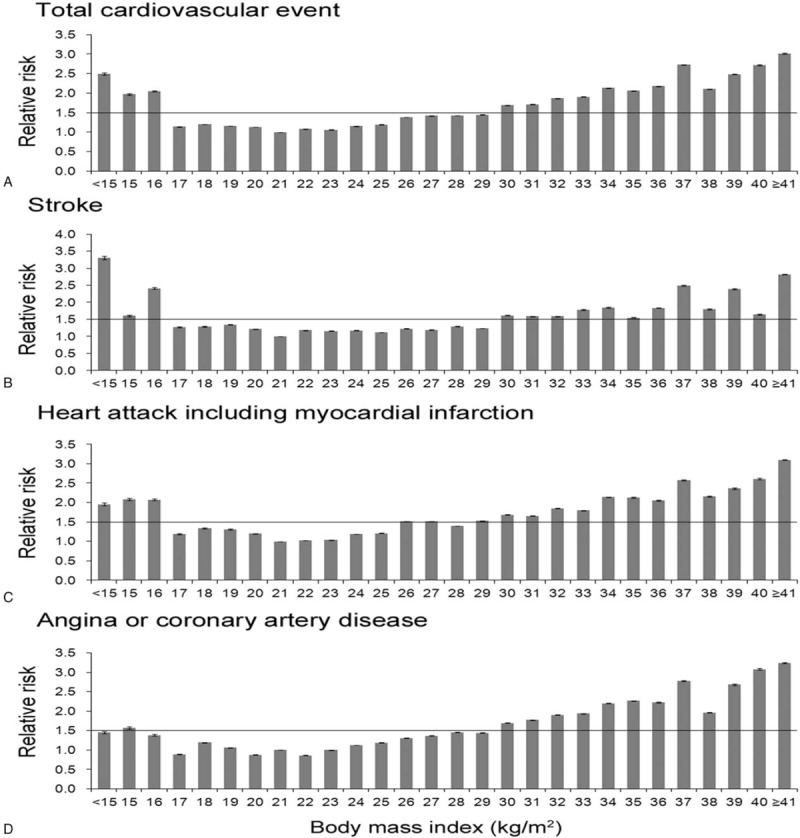
Obesity is a well-established risk factor for cardiovascular disease (CVD), but the underweight population of body mass index (BMI) below 18.5 kg/m has not been an object of concern. The objective of this study is to investigate whether underweight could be an independent risk factor for CVD in a population-based cross-sectional study.Cross-sectional data of 2013 Behavioral Risk Factor Surveillance System (BRFSS) database encompassing 491,773 US adult subjects were used to assess risk for CVD. Primary outcomes were the incidence and relative risks (RRs) of CVD including stroke, heart attack/myocardial infarction, or coronary artery disease according to BMI category. All analyses used weighted sampling probabilities of data source.The underweight population had a 19.7% greater risk of CVD than did the normal-weight, and the overweight and obese population had a 50% and 96% increased risk, respectively. When adjusted with covariates, the relative risk for CVD elevated in underweight population (adjusted RR 1.34 [95% confidence interval (CI) 1.335-1.348]). Conversely, the adjusted relative risk was significantly attenuated in the obese group (adjusted RR 1.149 [95% CI 1.147-1.151]) and it was even insignificant in the overweight group (adjusted RR 1.00 [95% CI 1.000-1.003]). In subanalysis for each CVD category, being underweight among BMI status was the strongest independent risk factor for stroke (adjusted RR 1.441 [95% CI 1.431-1.450]), heart attack/ myocardial infarction (MI) (adjusted RR 1.23 [95% CI 1.217-1.233]), and angina/coronary artery disease (adjusted RR 1.20 [95% CI 1.189-1.206]). Especially among the population below 40-year old, relative risk estimates remained increased in the underweight population; persons who were underweight had a 2.3-fold greater adjusted relative risk of CVD as compared with those with normal weight when we stratified with age.Underweight below BMI 18.5 kg/m may be another risk factor for CVD, and CVD risk of the overweight and obese population largely depended on other comorbidities accompanied by obesity.
肥胖是心血管疾病(CVD)公认的危险因素,但体重指数(BMI)低于18.5kg/m²的体重过轻人群一直未受到关注。本研究的目的是在一项基于人群的横断面研究中调查体重过轻是否可能是CVD的独立危险因素。利用2013年行为危险因素监测系统(BRFSS)数据库中包含491773名美国成年受试者的横断面数据来评估CVD风险。主要结局是根据BMI类别划分的CVD(包括中风、心脏病发作/心肌梗死或冠状动脉疾病)的发病率和相对风险(RRs)。所有分析均使用数据源的加权抽样概率。体重过轻人群患CVD的风险比正常体重人群高19.7%,超重和肥胖人群的风险分别增加50%和96%。在对协变量进行调整后,体重过轻人群中CVD的相对风险升高(调整后的RR为1.34[95%置信区间(CI)1.335 - 1.348])。相反,肥胖组的调整后相对风险显著降低(调整后的RR为1.149[95%CI 1.147 - 1.151]),超重组甚至不显著(调整后的RR为1.00[95%CI 1.000 - 1.003])。在对每种CVD类别的亚分析中,BMI状态下体重过轻是中风(调整后的RR为1.441[95%CI 1.431 - 1.450])、心脏病发作/心肌梗死(MI)(调整后的RR为1.23[95%CI 1.217 - 1.233])和心绞痛/冠状动脉疾病(调整后的RR为1.20[95%CI 1.189 - 1.206])的最强独立危险因素。特别是在40岁以下人群中,体重过轻人群的相对风险估计值仍然增加;当我们按年龄分层时,体重过轻的人与正常体重的人相比,调整后的CVD相对风险高2.3倍。BMI低于18.5kg/m²的体重过轻可能是CVD的另一个危险因素,超重和肥胖人群的CVD风险很大程度上取决于伴随肥胖的其他合并症。