Department of Developmental Biology and Cancer Research, The Institute for Medical Research, Faculty of Medicine, The Hebrew University, Ein Kerem, P.O. Box 12271, Jerusalem, 91120, Israel.
Lautenberg Center for Immunology and Cancer Research, The Institute for Medical Research, Faculty of Medicine, The Hebrew University, Ein Kerem, P.O. Box 12271, Jerusalem, 91120, Israel.
Sci Rep. 2018 Jan 8;8(1):93. doi: 10.1038/s41598-017-18551-z.
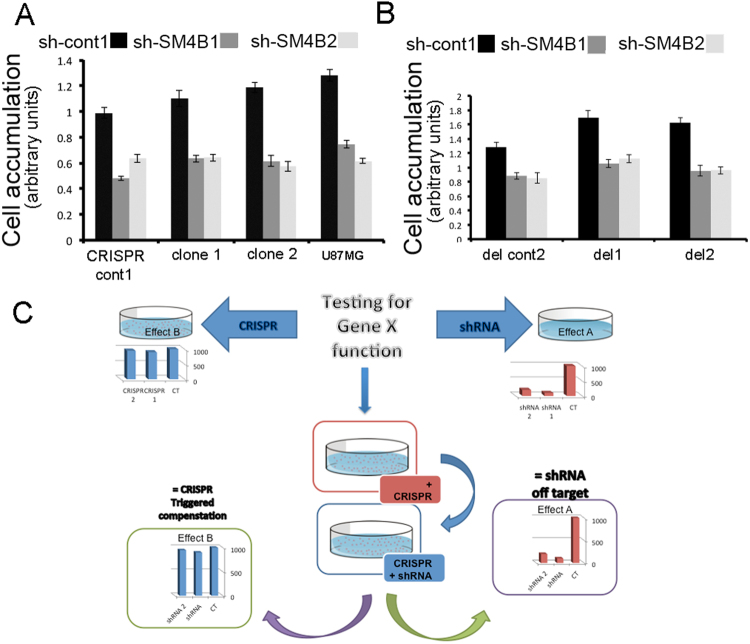
Inhibition of genes is a powerful approach to study their function. While RNA interference is a widely used method to achieve this goal, mounting evidence indicates that such an approach is prone to off-target effects. An alternative approach to gene function inhibition is genetic mutation, such as the CRISPR/cas9 method. A recent report, however, demonstrated that genetic mutation and inhibition of gene expression do not always give corresponding results. This can be explained by off-target effects, but it was recently shown, at least in one case, that these differences are the result of a compensatory mechanism induced only by genetic mutation. We present here a combination of RNA inhibition and CRISPR/cas9 methods to identify possible off targets as well as potential compensatory effects. This approach is demonstrated by testing a possible role for Sema4B in glioma biology, in which our results implicate Sema4B as having a critical function. In stark contrast, by using shRNA over CRISPR/cas9 combined methodology, we clearly demonstrate that the Sema4B targeted shRNA effects on cell proliferation is the result of off-target effects. Nevertheless, it also revealed that certain splice variants of Sema4B are important for the ability of glioma cells to grow as individual clones.
基因抑制是研究其功能的一种有效方法。虽然 RNA 干扰是实现这一目标的常用方法,但越来越多的证据表明,这种方法容易产生脱靶效应。基因功能抑制的另一种方法是基因突变,如 CRISPR/cas9 方法。然而,最近的一份报告表明,基因突变和基因表达抑制并不总是产生相应的结果。这可以用脱靶效应来解释,但最近有研究表明,至少在一种情况下,这些差异是仅由基因突变诱导的补偿机制的结果。我们在这里提出了 RNA 抑制和 CRISPR/cas9 方法的组合,以确定可能的脱靶效应和潜在的补偿效应。我们通过测试 Sema4B 在神经胶质瘤生物学中的可能作用来证明这种方法,结果表明 Sema4B 具有关键作用。相比之下,通过使用 shRNA 而非 CRISPR/cas9 联合方法,我们清楚地表明,针对 Sema4B 的 shRNA 对细胞增殖的影响是脱靶效应的结果。然而,它还表明,Sema4B 的某些剪接变体对于神经胶质瘤细胞作为单个克隆生长的能力很重要。