Hammer Anna, Waschbisch Anne, Knippertz Ilka, Zinser Elisabeth, Berg Johannes, Jörg Stefanie, Kuhbandner Kristina, David Christina, Pi Jingbo, Bayas Antonios, Lee De-Hyung, Haghikia Aiden, Gold Ralf, Steinkasserer Alexander, Linker Ralf A
Department of Neurology, University Hospital Erlangen, Friedrich-Alexander-University Erlangen-Nürnberg, Erlangen, Germany.
Department of Immune Modulation, University Hospital Erlangen, Friedrich-Alexander-University Erlangen-Nürnberg, Erlangen, Germany.
Front Immunol. 2017 Dec 22;8:1922. doi: 10.3389/fimmu.2017.01922. eCollection 2017.
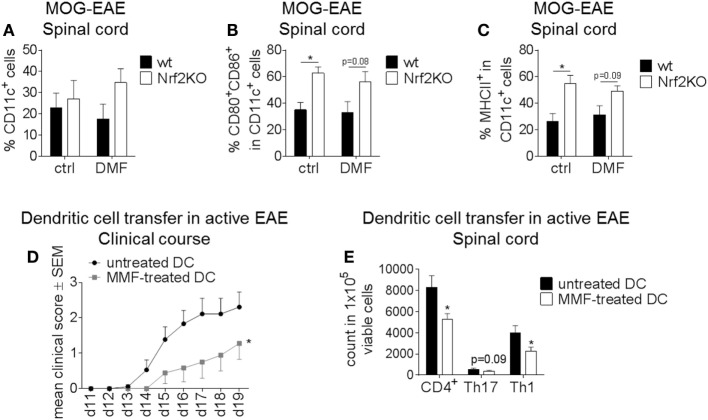
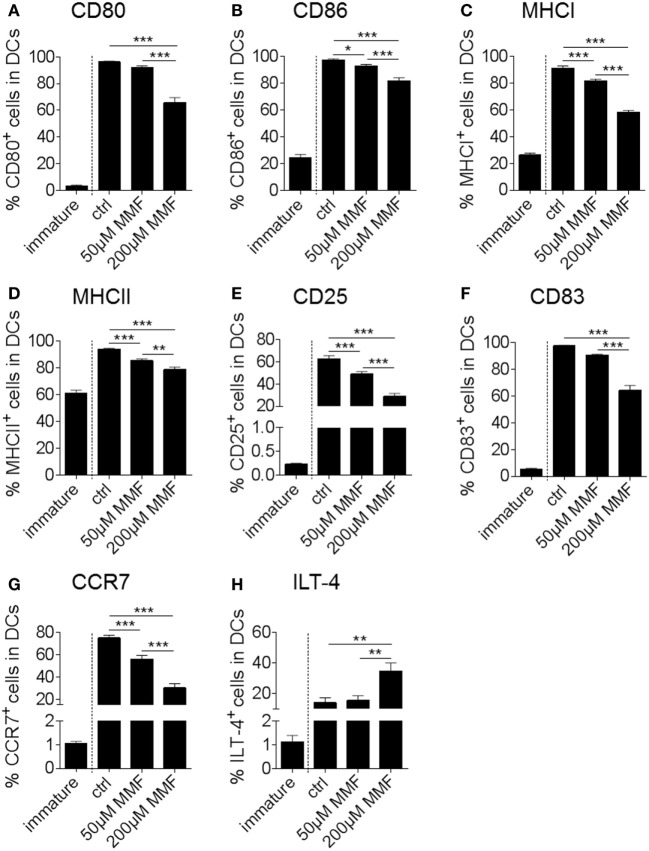
To date, the intracellular signaling pathways involved in dendritic cell (DC) function are poorly understood. The antioxidative transcription factor nuclear factor (erythroid-derived 2)-like 2 (Nrf2) has been shown to affect maturation, function, and subsequent DC-mediated T cell responses of murine and human DCs. In experimental autoimmune encephalomyelitis (EAE), as prototype animal model for a T helper cell-mediated autoimmune disease, antigen presentation, cytokine production, and costimulation by DCs play a major role. We explore the role of Nrf2 in DC function, and DC-mediated T cell responses during T cell-mediated autoimmunity of the central nervous system using genetic ablation and pharmacological activation in mice and men to corroborate our data in a translational setting. In murine and human DCs, monomethyl fumarate induced Nrf2 signaling inhibits DC maturation and DC-mediated T cell proliferation by reducing inflammatory cytokine production and expression of costimulatory molecules. In contrast, Nrf2-deficient DCs generate more activated T helper cells (Th1/Th17) but fewer regulatory T cells and foster T cell proliferation. Transfer of DCs with Nrf2 activation during active EAE reduces disease severity and T cell infiltration. Our data demonstrate that Nrf2 signaling modulates autoimmunity in murine and human systems inhibiting DC maturation and function thus shedding further light on the mechanism of action of antioxidative stress pathways in antigen-presenting cells.
迄今为止,人们对参与树突状细胞(DC)功能的细胞内信号通路了解甚少。抗氧化转录因子核因子(红系衍生2)样2(Nrf2)已被证明会影响小鼠和人类DC的成熟、功能以及随后DC介导的T细胞反应。在实验性自身免疫性脑脊髓炎(EAE)中,作为T辅助细胞介导的自身免疫性疾病的原型动物模型,DC的抗原呈递、细胞因子产生和共刺激起着主要作用。我们利用小鼠和人类的基因敲除和药理学激活方法,探讨Nrf2在中枢神经系统T细胞介导的自身免疫过程中DC功能以及DC介导的T细胞反应中的作用,以在转化背景下证实我们的数据。在小鼠和人类DC中,富马酸单甲酯诱导的Nrf2信号传导通过减少炎性细胞因子的产生和共刺激分子的表达来抑制DC成熟和DC介导的T细胞增殖。相比之下,Nrf2缺陷型DC产生更多活化的T辅助细胞(Th1/Th17),但调节性T细胞较少,并促进T细胞增殖。在活动性EAE期间转移具有Nrf2激活的DC可降低疾病严重程度和T细胞浸润。我们的数据表明,Nrf2信号传导在小鼠和人类系统中调节自身免疫,抑制DC成熟和功能,从而进一步阐明了抗原呈递细胞中抗氧化应激途径的作用机制。