Chen Yu-Lan, Lin Jian-Zi, Mo Ying-Qian, Liang Jin-Jian, Li Qian-Hua, Zhou Cheng-Jing, Wei Xiu-Ning, Ma Jian-Da, Yang Ze-Hong, Zheng Dong-Hui, Dai Lie
Department of Rheumatology, Sun Yat-Sen Memorial Hospital, Sun Yat-Sen University, Guangzhou, China.
Zhongshan School of Medicine, Sun Yat-Sen University, Guangzhou, China.
PeerJ. 2018 Jan 4;6:e4216. doi: 10.7717/peerj.4216. eCollection 2018.
Autoimmune thyroid disease (AITD), which is characterized by an increased presence of thyroid autoantibodies (TAbs), such as antibodies against thyroid peroxidase (TPOAbs) and antibodies against thyroglobulin (TgAbs), has been reported to be associated with rheumatoid arthritis (RA) because AITD and RA both involve autoimmunity. However, few data are available on the incidence of TAbs in Chinese RA patients, and studies on the association between TAbs and joint damage as well as synovitis in RA patients remain sparse. Here, we aimed to evaluate the incidence of TAbs in a consecutive Chinese RA cohort and to investigate whether the elevated presence of TAbs is associated with joint damage and synovitis in RA patients.
A total of 125 hospitalized RA patients were consecutively recruited. Clinical data and available synovial tissues were collected at baseline, and TAbs and thyroid function were detected by chemiluminescent immunoassay. Patients who tested positive for TPOAbs or TgAbs were classified as the TAbs-positive group, and patients who tested positive for neither TPOAbs nor TgAbs were recruited as the TAbs-negative group. Disease activity was assessed using DAS28-ESR (the disease activity score in 28 joints and including the erythrocyte sedimentation rate). X-ray assessment of the hand/wrist was performed according to the Sharp/van der Heijde-modified Sharp score (mTSS), and patients with an mTSS score >10 were defined as having radiographic joint damage (RJD). Serial tissue sections were stained immunohistochemically for CD3, CD15, CD20, CD34, CD38, and CD68, and synovitis were assessed according to Krenn's synovitis score.
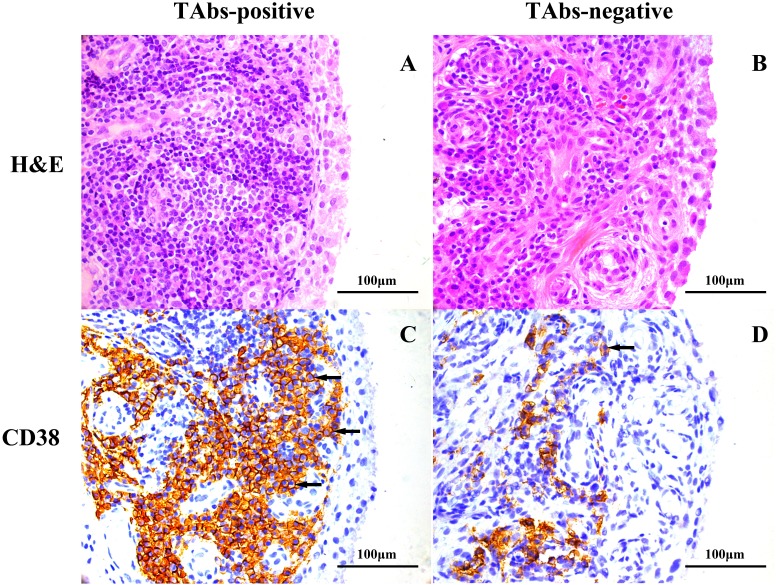
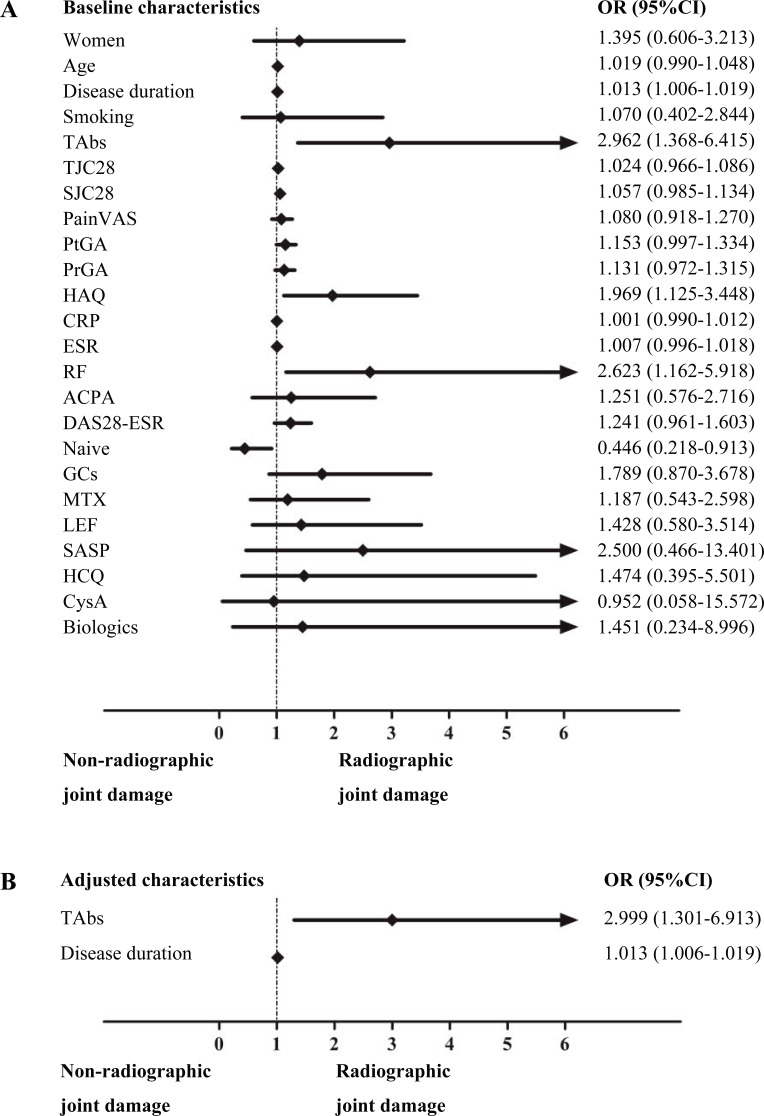
A total of 44 (35%) patients were positive for either TPOAbs or TgAbs. Importantly, there was a significantly greater percentage of patients with RJD in the TAbs-positive group versus the TAbs-negative group (68% vs. 42%, = 0.005). Compared with the TAbs-negative group, significantly more CD38-positive plasma cells infiltrated the TAbs-positive synovium, and a higher percentage of patients with high-grade synovitis were observed in the TAbs-positive group (5/8, 63% vs. 5/14, 36%). Moreover, RF positivity and disease activity indicators, including TJC28, DAS28-ESR, and CDAI, were significantly higher in the TAbs-positive group (all < 0.05). Adjusted logistic regression analysis revealed that positive TAbs (OR 2.999, 95% CI [1.301-6.913]; = 0.010) and disease duration (OR 1.013, 95% CI [1.006-1.019]; < 0.001) were independently associated with RJD, and an odds ratio of 2.845 (95% CI [1.062-7.622]) was found for RJD in women with positive TAbs ( = 37) compared with those without TAbs ( = 59) ( = 0.038).
Our data showed that joint destruction was amplified in RA patients with an elevated presence of TAbs, which supports the importance and necessity of TAbs and thyroid function screening and monitoring in RA patient management in clinical practice.
自身免疫性甲状腺疾病(AITD)的特征是甲状腺自身抗体(TAbs)增多,如抗甲状腺过氧化物酶抗体(TPOAbs)和抗甲状腺球蛋白抗体(TgAbs)。据报道,AITD与类风湿关节炎(RA)有关,因为AITD和RA都涉及自身免疫。然而,关于中国RA患者中TAbs发生率的数据很少,关于TAbs与RA患者关节损伤及滑膜炎之间关联的研究也仍然较少。在此,我们旨在评估连续入选的中国RA队列中TAbs的发生率,并调查TAbs水平升高是否与RA患者的关节损伤及滑膜炎有关。
连续招募了125例住院的RA患者。在基线时收集临床数据和可用的滑膜组织,通过化学发光免疫分析法检测TAbs和甲状腺功能。TPOAbs或TgAbs检测呈阳性的患者被分类为TAbs阳性组,TPOAbs和TgAbs检测均为阴性的患者被纳入TAbs阴性组。使用DAS28-ESR(28个关节的疾病活动评分,包括红细胞沉降率)评估疾病活动度。根据Sharp/van der Heijde改良Sharp评分(mTSS)对手部/腕部进行X线评估,mTSS评分>10的患者被定义为有影像学关节损伤(RJD)。对连续组织切片进行免疫组织化学染色,检测CD3、CD15、CD20、CD34、CD38和CD68,并根据Krenn滑膜炎评分评估滑膜炎情况。
共有44例(35%)患者TPOAbs或TgAbs呈阳性。重要的是,TAbs阳性组中发生RJD的患者百分比显著高于TAbs阴性组(68%对42%,P = 0.005)。与TAbs阴性组相比,TAbs阳性的滑膜中有更多CD38阳性浆细胞浸润,TAbs阳性组中重度滑膜炎患者的百分比更高(5/8,63%对5/14,36%)。此外,TAbs阳性组的RF阳性率和疾病活动指标,包括TJC28、DAS28-ESR和CDAI,均显著更高(均P < 0.05)。校正后的逻辑回归分析显示,TAbs阳性(比值比2.999,95%置信区间[1.301 - 6.913];P = 0.010)和病程(比值比1.013,95%置信区间[1.006 - 1.019];P < 0.001)与RJD独立相关,与无TAbs的女性(n = 59)相比,TAbs阳性的女性(n = 37)发生RJD的比值比为2.845(95%置信区间[1.062 - 7.622])(P = 0.038)。
我们的数据表明,TAbs水平升高的RA患者关节破坏加剧,这支持了在临床实践中对RA患者进行TAbs和甲状腺功能筛查及监测的重要性和必要性。