1 Department of Anesthesiology and Perioperative Medicine, University of Alabama at Birmingham, Birmingham, AL, USA.
Mol Pain. 2018 Jan-Dec;14:1744806917750995. doi: 10.1177/1744806917750995.
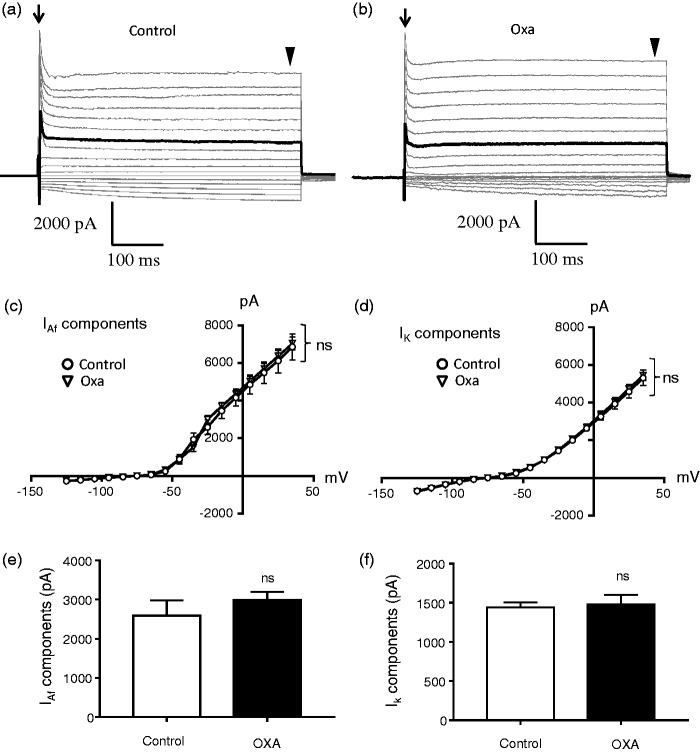
Chemotherapy drugs such as oxaliplatin can increase nociceptive neuron excitability to result in neuropathic pain in orofacial and other regions in patients following chemotherapy. However, mechanisms underlying chemotherapy-induced increases of nociceptive neuron excitability are not fully understood. Kv4.3 channels are voltage-gated K channels mediating A-type K (I) currents to control neuronal excitability. In the present study, we examined Kv4.3 channel expression on trigeminal neurons that innervate orofacial regions (V2 TG neurons) of rats using immunostaining method. We showed that strong Kv4.3 immunoreactivity (Kv4.3-ir) was present mainly in small-sized V2 TG neurons. The numbers of Kv4.3-ir positive V2 TG neurons were significantly reduced in oxaliplatin-treated rats, suggesting down-regulation of Kv4.3 channel expression on V2 TG neurons by the chemotherapy drug. Patch-clamp recordings from acutely dissociated rat V2 TG neurons showed that almost all nociceptive-like V2 TG neurons displayed I currents with slow inactivation kinetics. The amplitudes of I currents were significantly reduced in these nociceptive-like V2 TG neurons of oxaliplatin-treated group. Furthermore, we found that the excitability of nociceptive-like V2 TG neurons was significantly higher in the oxaliplatin-treated group than in the control group. These findings raise a possibility that down-regulation of Kv4.3 channels and I currents in nociceptive V2 TG neurons is an underlying mechanism of oxaliplatin-induced orofacial neuropathic pain.
化疗药物如奥沙利铂可增加伤害感受神经元的兴奋性,导致接受化疗的患者出现口腔和其他部位的神经性疼痛。然而,化疗引起伤害感受神经元兴奋性增加的机制尚不完全清楚。Kv4.3 通道是电压门控钾通道,介导 A 型钾(I)电流,从而控制神经元兴奋性。在本研究中,我们使用免疫染色法检查了支配口腔区域的三叉神经神经元(V2 TG 神经元)上 Kv4.3 通道的表达。我们发现,强烈的 Kv4.3 免疫反应性(Kv4.3-ir)主要存在于小尺寸的 V2 TG 神经元中。奥沙利铂处理的大鼠中 Kv4.3-ir 阳性 V2 TG 神经元的数量明显减少,表明化疗药物下调了 V2 TG 神经元上 Kv4.3 通道的表达。急性分离的大鼠 V2 TG 神经元的膜片钳记录显示,几乎所有伤害感受样 V2 TG 神经元都显示出具有缓慢失活动力学的 I 电流。这些伤害感受样 V2 TG 神经元中的 I 电流幅度在奥沙利铂处理组中明显降低。此外,我们发现奥沙利铂处理组中伤害感受样 V2 TG 神经元的兴奋性明显高于对照组。这些发现提示 Kv4.3 通道和 I 电流在伤害感受 V2 TG 神经元中的下调可能是奥沙利铂诱导口腔神经性疼痛的潜在机制。