Genetech Research Institute, Colombo, Sri Lanka.
Faculty of Health Sciences and Medicine, Marshall Centre, School of Biomedical Sciences, University of Western Australia, Perth, Western Australia, Australia.
Am J Trop Med Hyg. 2018 Feb;98(2):607-615. doi: 10.4269/ajtmh.17-0441. Epub 2018 Jan 4.
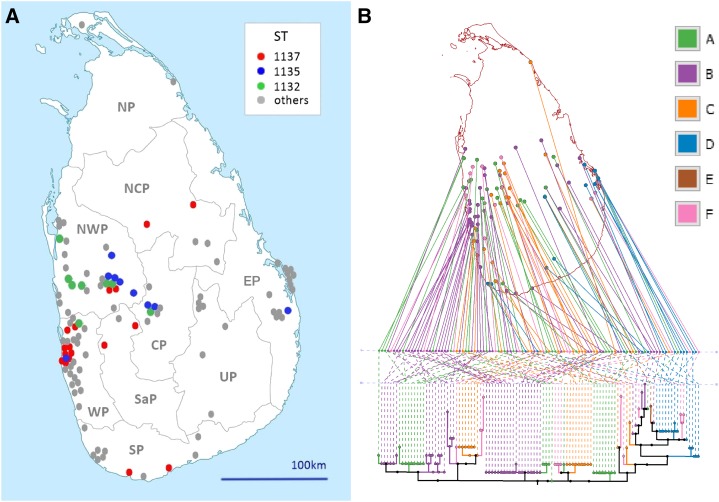
Melioidosis, a potentially fatal tropical infection, is said to be underdiagnosed in low-income countries. An increase in melioidosis cases in Sri Lanka allowed us to analyze the relationship among clinical outcome, bacteriology, epidemiology, and geography in the first 108 laboratory-confirmed cases of melioidosis from a nationwide surveillance program. The additional 76 cases of laboratory-confirmed melioidosis confirmed further associations between multilocus sequence typing (MLST) and infection phenotype; ST1137/unifocal bacteremic infection (χ = 3.86, < 0.05), ST1136/multifocal infection without bacteremia (χ = 15.8, < 0.001), and ST1132/unifocal nonbacteremic infection (χ = 6.34, = 0.02). ST1137 infections were predominantly seen in the Western Province, whereas ST1132, 1135, and 1136 infections predominated in the Northwestern Province. Early participating centers in the surveillance program had a lower melioidosis-associated mortality than later participants (χ = 3.99, < 0.05). The based upon related sequence types (eBURST) algorithm, a MLST clustering method that infers founding genotypes and patterns of descent for related isolates and clonal complexes in an unrooted tree, showed uneven distribution of sequence types (STs). There was spatial clustering of the commonest STs (ST1132, 1136, and 1137) in the Western, Northwestern, and Central provinces. The recent increase in melioidosis in Sri Lanka uncovered by laboratory-enhanced surveillance is likely to be the result of a combination of improved laboratory detection, increased clinician awareness, recruitment of clinical centers, and small outbreaks. Further development of the surveillance program into a national genotyping-supported melioidosis registry will improve melioidosis diagnosis, treatment, and prevention where underdiagnosis and mortality rates remain high.
类鼻疽病是一种潜在致命的热带感染病,据说在低收入国家的诊断率较低。斯里兰卡类鼻疽病病例的增加使我们能够分析首次从全国性监测计划中,对 108 例经实验室确认的类鼻疽病的临床结果、细菌学、流行病学和地理因素之间的关系。另外 76 例经实验室确认的类鼻疽病病例进一步证实了多位点序列分型(MLST)和感染表型之间的关系;ST1137/单病灶菌血症感染(χ = 3.86,<0.05)、ST1136/多病灶无菌血症感染(χ = 15.8,<0.001)和 ST1132/单病灶非菌血症感染(χ = 6.34,= 0.02)。ST1137 感染主要见于西部省,而 ST1132、1135 和 1136 感染则主要见于西北部省。早期参与监测计划的中心类鼻疽病相关死亡率低于后期参与者(χ = 3.99,<0.05)。基于相关序列类型(eBURST)算法的分析表明,这是一种 MLST 聚类方法,用于推断无根树中相关分离株和克隆复合体的创始基因型和遗传模式,结果显示序列类型的分布不均匀。在西部、西北部和中部省,最常见的 STs(ST1132、1136 和 1137)存在空间聚类。斯里兰卡通过实验室增强监测发现的类鼻疽病近期增加,可能是由于实验室检测能力提高、临床医生认识提高、临床中心招募以及小范围暴发的综合结果。进一步将监测计划发展为全国基因型支持的类鼻疽病登记系统,将改善类鼻疽病的诊断、治疗和预防,因为这些地区的诊断不足和死亡率仍然很高。