State Key Laboratory of Oncology in South China, Collaborative Innovation Center for Cancer Medicine, Department of Neurosurgery, Sun Yat-sen University Cancer Center, Guangzhou, China.
Zhongshan School of Medicine, Sun Yat-sen University, Guangzhou, China.
J Cell Mol Med. 2018 Mar;22(3):2023-2027. doi: 10.1111/jcmm.13445. Epub 2018 Jan 4.
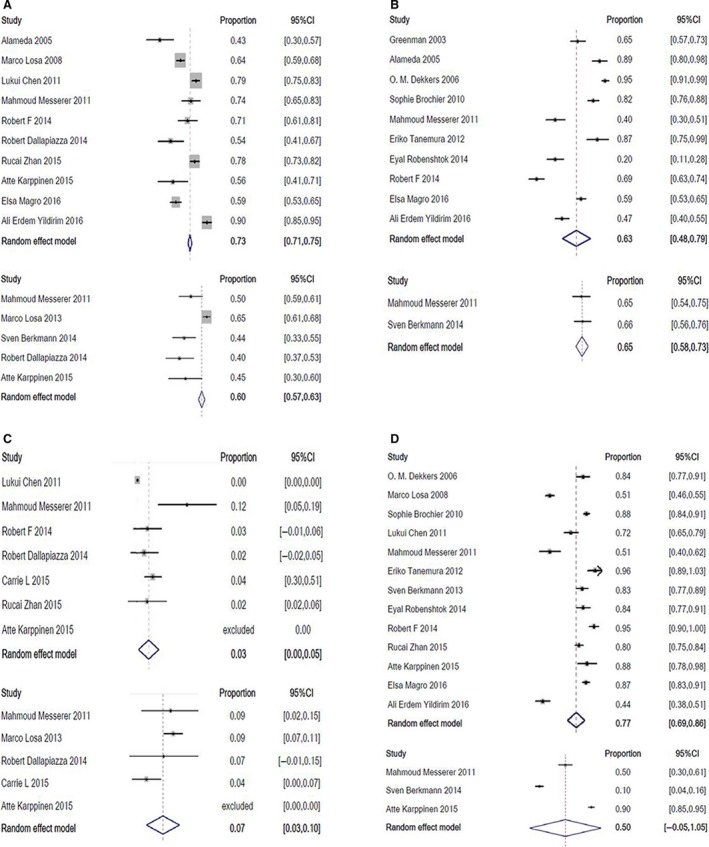
Both microscopic and endoscopic transsphenoidal surgery are effective approaches for nonfunctioning pituitary adenomas. The issue on the comparison of their efficacy and safety remains inconsistent. A thorough search of the literatures (PubMed, EMBASE, MEDLINE) were performed up to March 2017. Studies reporting outcomes of microscopic or endoscopic transsphenoidal surgery on nonfunctioning pituitary adenomas were included. A meta-analysis was performed focusing on the early stage and long term outcomes. The final search yielded 19 eligible studies enrolling 3847 patients, 389 of them underwent microscopic approach and 3458 of them with endoscopic approach. As to the early stage outcomes, the rate of gross tumor resection was significantly higher in the endoscopic group than that in microscopic group (73% versus 60%, P < 0.001). Meanwhile, endoscopic approach showed priority over microscopy on postoperative hypopituitarism (63% versus 65%, P < 0.001) and CSF leakage (3% versus 7%, P < 0.001). For the long term outcomes, the rate of visual improvement was significant higher in the endoscopic group than that in microscopic group (77% versus 50%, P < 0.001). However, there was no significant difference between the groups regarding the rate of permanent diabetic insipidus and meningitis. The endoscopic approach may be associated with higher rate of gross tumor movement and lower risk of postoperatively complications for treating nonfunctioning pituitary adenoma, when compared with microscopic approach. However, the confidence was shorted due to limited high quality evidence (largely randomized and controlled studies).
经蝶窦显微手术和内镜手术治疗无功能垂体腺瘤均有效,但两者的疗效和安全性比较仍存在争议。我们对PubMed、EMBASE 和 MEDLINE 等数据库进行了全面检索,检索时限截至 2017 年 3 月。纳入比较经蝶窦显微手术和内镜手术治疗无功能垂体腺瘤的研究,采用 Meta 分析方法对近期和远期疗效进行分析。最终共纳入 19 项研究,包括 3847 例患者,其中 389 例行经蝶窦显微手术,3458 例行经蝶窦内镜手术。近期疗效方面,内镜组肿瘤全切率显著高于显微组(73%比 60%,P<0.001),但术后垂体功能低下(63%比 65%,P<0.001)和脑脊液漏(3%比 7%,P<0.001)发生率低于显微组。远期疗效方面,内镜组视力改善率显著高于显微组(77%比 50%,P<0.001)。但两组永久性尿崩症和脑膜炎发生率差异无统计学意义。与经蝶窦显微手术相比,内镜手术治疗无功能垂体腺瘤可能具有肿瘤全切率高、术后并发症风险低的优势,但由于证据质量不高(主要为随机对照研究),其结论可信度有限。