Institute of Clinical Pharmacology, School of Pharmaceutical Sciences, Sun Yat-Sen University, Guangzhou, 510006, China.
State Key Laboratory of Oncology in South China, Collaborative Innovation Center for Cancer Medicine, Sun Yat-Sen University Cancer Center, Guangzhou, 510060, China.
Cancer Med. 2018 Feb;7(2):317-324. doi: 10.1002/cam4.1286. Epub 2018 Jan 7.
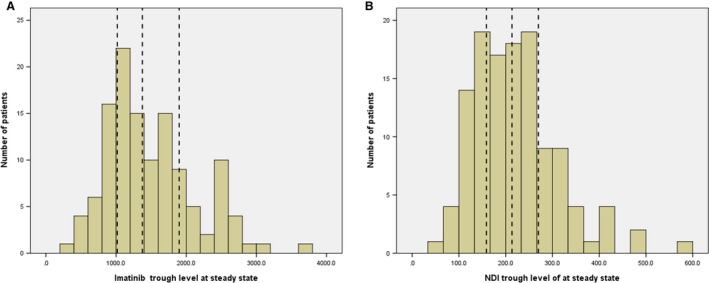
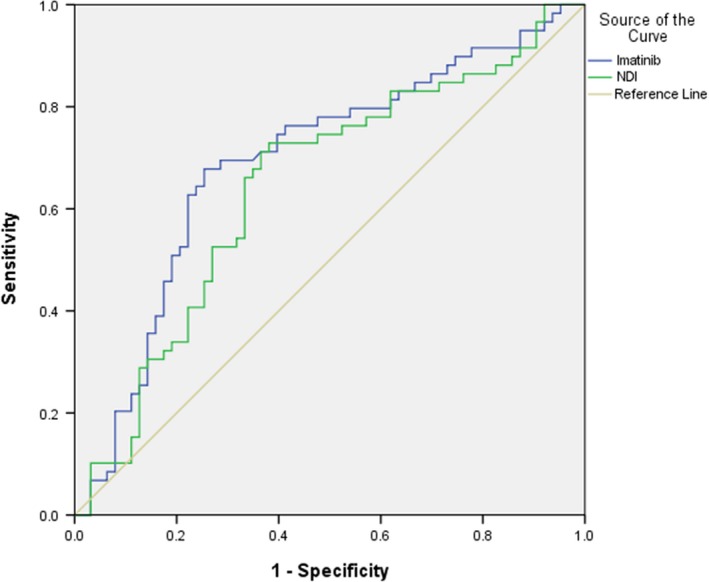
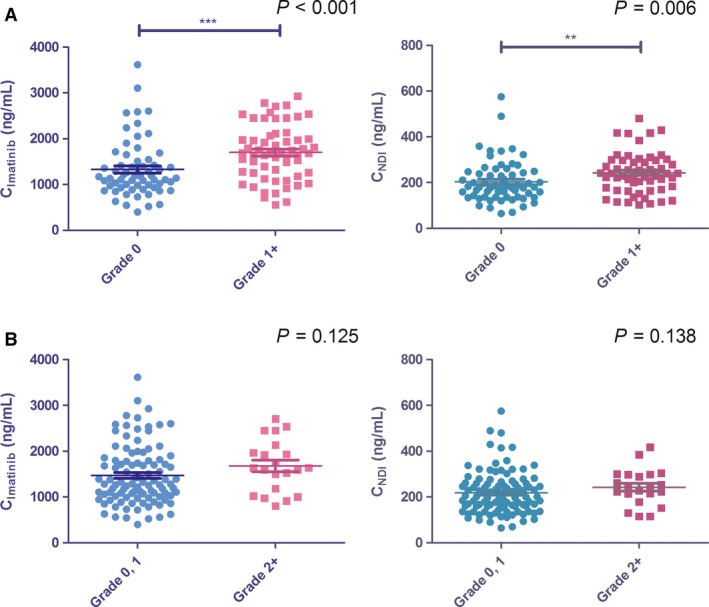
Imatinib at 400 mg daily is the standard treatment for patients affected with CML and GIST. The intervariability in plasma concentration is very significant. In many reports, a good therapeutic effect is attributed to an adequate concentration of Imatinib. However, few studies have been conducted to investigate the association between plasma concentration and side effects. Besides, no upper concentration limit of Imatinib plasma concentration detection has been established. The correlation of Imatinib trough concentrations (C ) with adverse effects (AEs) was described here. Plasma samples were obtained from patients after 3 months treatment with Imatinib (steady state, n = 122). Liquid chromatography/ tandem mass spectrometry was used to determine the concentration of Imatinib and its metabolite NDI. The incidence of myelosuppression was increased significantly with the increased Imatinib trough plasma concentration. The plasma level of Imatinib and NDI in patients who developed myelosuppression are 1698.3 ± 598.6 ng/mL and 242.1 ng/mL, respectively, which were significantly higher than those in patients who did not (1327.2 ± 623.4 ng/mL, P = 1.75 × 10 ; 206.3 ng/mL, P = 0.006). Estimated exposure thresholds of Imatinib and NDI were 1451.6 ng/mL with ROC (95%CI) of 0.693 (0.597-0.789) and 207.1 ng/mL with ROC (95%CI) of 0.646 (0.546-0.745), respectively. Multivariate regression confirmed the correlation of Imatinib C with myelosuppression. Other side effects such as fluid retention and rash were not found to be correlated with Imatinib concentrations. These results suggest that trough concentration of Imatinib should be taken into consideration to increase the safety of Imatinib therapy in GIST patients.
伊马替尼每天 400 毫克是 CML 和 GIST 患者的标准治疗方法。血浆浓度的变异性非常显著。在许多报告中,良好的治疗效果归因于伊马替尼的适当浓度。然而,很少有研究探讨血浆浓度与副作用之间的关系。此外,尚未建立伊马替尼血浆浓度检测的上限。本研究描述了伊马替尼谷浓度(C)与不良反应(AE)的相关性。从接受伊马替尼治疗 3 个月的患者中获得血浆样本(稳定状态,n=122)。采用液相色谱/串联质谱法测定伊马替尼及其代谢物 NDI 的浓度。随着伊马替尼谷血浆浓度的增加,骨髓抑制的发生率显著增加。发生骨髓抑制的患者的伊马替尼和 NDI 血浆水平分别为 1698.3±598.6ng/ml 和 242.1ng/ml,明显高于未发生骨髓抑制的患者(1327.2±623.4ng/ml,P=1.75×10-5;206.3ng/ml,P=0.006)。伊马替尼和 NDI 的估计暴露阈值分别为 1451.6ng/ml(ROC(95%CI)为 0.693(0.597-0.789))和 207.1ng/ml(ROC(95%CI)为 0.646(0.546-0.745))。多变量回归证实了伊马替尼 C 与骨髓抑制的相关性。其他副作用,如体液潴留和皮疹,与伊马替尼浓度无关。这些结果表明,应考虑伊马替尼谷浓度以提高 GIST 患者伊马替尼治疗的安全性。