Department of Oncology-Pathology, Karolinska University Hospital, Karolinska Institutet, Radiumhemmet, 171 76, Stockholm, Sweden.
Department of Oncology-Pathology, Karolinska University Hospital/Södersjukhuset, Stockholm, Sweden.
Breast Cancer Res Treat. 2018 Apr;168(3):655-666. doi: 10.1007/s10549-017-4639-0. Epub 2018 Jan 9.
To evaluate the sensitivity and specificity of different screening modalities in women with a family history of breast cancer.
Our blinded, prospective, comparative cohort analysis included three types of screening, mammography, ultrasound, and clinical breast examination once per year for 6 years. Eligible patients for this study were healthy women with ≥ 17% lifetime risk of breast cancer or with a mutation in BRCA1 or BRCA2.
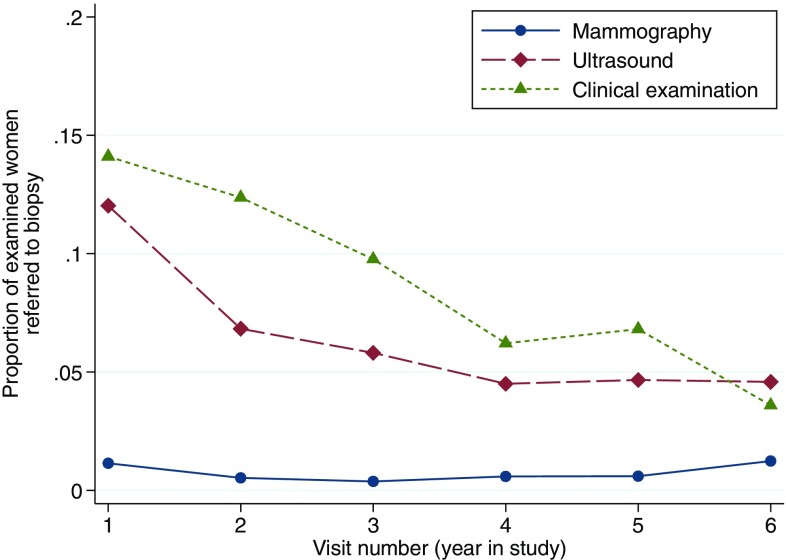
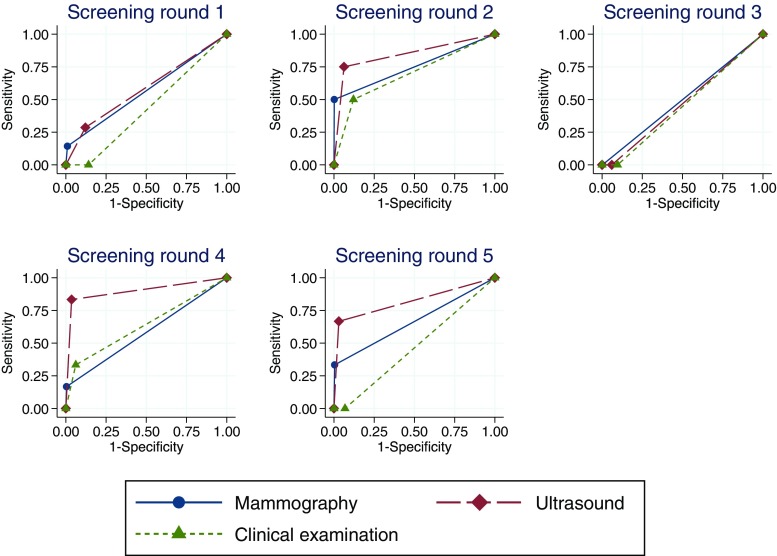
A total of 632 women were screened between 2002 and 2012 (each for 6 years). During the study, 30 women were diagnosed with breast cancer, with 10 of these diagnoses occurring between screening visits, and six of the 10 diagnosed women were gene carriers. The clinical presentation for the women diagnosed with breast cancer was followed until 2017. No consistent patterns for the diagnostic capacity of the different screening modalities were found, although mammography showed low sensitivity, whereas ultrasound showed better sensitivity in three of the six rounds. The specificity was high in mammography and improved in ultrasound over time. Most importantly, clinical breast examination provided no additional information toward the diagnosis of breast cancer.
Neither mammography nor ultrasound performed yearly were sensitive enough as standalone modalities, although high specificity was confirmed. Our findings indicate that high risk (> 29% life time risk) individuals and gene carriers can be screened biannually, using the same protocol as used in mutation carriers. Our results also suggest that low-risk groups (< 20%) may continue to be referred to population mammography screening program, while clinical breast examination may be omitted in all risk groups, and could be optional in gene carriers.
评估有乳腺癌家族史的女性使用不同筛查方式的敏感性和特异性。
我们进行了盲法、前瞻性、对照队列分析,包括三种筛查方式:每年一次的乳腺 X 线摄影、超声和临床乳房检查,共持续 6 年。这项研究的合格患者为具有≥17%终生乳腺癌风险或 BRCA1 或 BRCA2 基因突变的健康女性。
2002 年至 2012 年间共有 632 名女性接受了筛查(每人筛查 6 年)。在研究期间,30 名女性被诊断患有乳腺癌,其中 10 例诊断发生在筛查期间,而这 10 名诊断为乳腺癌的女性中有 6 名是基因携带者。这些被诊断患有乳腺癌的女性的临床表现一直跟踪到 2017 年。虽然乳腺 X 线摄影显示敏感性较低,但并未发现不同筛查方式诊断能力的一致模式,而超声在其中 6 轮中有 3 轮显示出了更好的敏感性。乳腺 X 线摄影的特异性较高,且随着时间的推移,超声的特异性有所提高。最重要的是,临床乳房检查对乳腺癌的诊断没有提供额外的信息。
每年进行的乳腺 X 线摄影或超声检查作为独立的筛查方式都不够敏感,尽管证实了较高的特异性。我们的研究结果表明,高风险(>29%终生风险)个体和基因携带者可以使用与突变携带者相同的方案,每两年进行一次筛查。我们的结果还表明,低风险人群(<20%)可以继续参加人群乳腺 X 线摄影筛查计划,而所有风险人群都可以省略临床乳房检查,且基因携带者可以选择进行。