Uchida Naohiro, Fujita Kohei, Nakatani Koichi, Mio Tadashi
Division of Respiratory Medicine National Hospital Organization Kyoto Medical Center Kyoto Japan.
Respirol Case Rep. 2017 Dec 22;6(2):e00289. doi: 10.1002/rcr2.289. eCollection 2018 Feb.
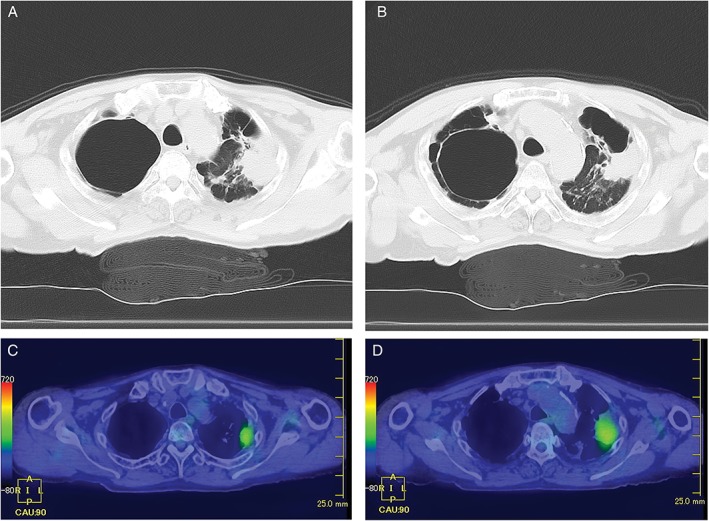
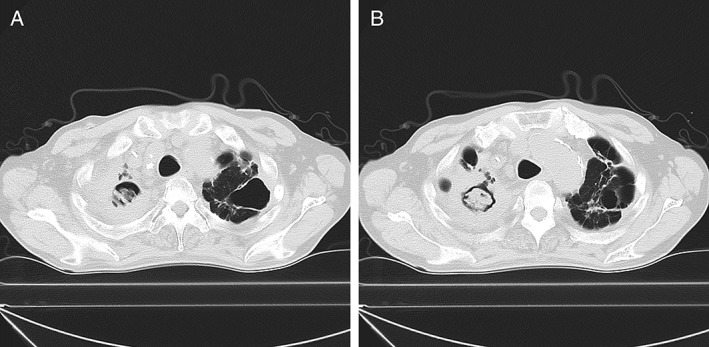
A 65-year-old man with chronic progressive pulmonary aspergillosis (CPPA) was admitted for the treatment of lung adenocarcinoma while receiving an immune checkpoint inhibitor, nivolumab. The tumour responded well to the therapy, but the cavity of CPPA became large in contrast to the tumour after 20 courses of therapy. He was diagnosed as having exacerbation of CPPA and successfully and concurrently treated with an antifungal agent and nivolumab. Since there was absence of obvious immunosuppression and the presence of a drastic effect on tumour remission during nivolumab therapy, this phenomenon suggested that the trigger of CPPA progression was dependent not on immunosuppression but on a hyperreaction to microorganisms, which was similar to the immune reconstitution inflammatory syndrome caused by nivolumab. This was a thought-provoking case in which the immune checkpoint inhibitor had a paradoxical effect for the tumour and infection.
一名65岁患有慢性进行性肺曲霉病(CPPA)的男性在接受免疫检查点抑制剂纳武单抗治疗期间因肺腺癌入院治疗。肿瘤对该治疗反应良好,但在20个疗程的治疗后,与肿瘤相比,CPPA的空洞变大。他被诊断为CPPA病情加重,并成功地同时接受了抗真菌药物和纳武单抗治疗。由于在纳武单抗治疗期间没有明显的免疫抑制,且对肿瘤缓解有显著效果,这种现象表明CPPA进展的触发因素并非依赖于免疫抑制,而是对微生物的过度反应,这与纳武单抗引起的免疫重建炎症综合征相似。这是一个发人深省的病例,其中免疫检查点抑制剂对肿瘤和感染产生了矛盾的作用。