Wellcome Trust Sanger Institute, Wellcome Genome Campus, Hinxton, Cambridge, UK.
University of Exeter Medical School, Institute of Biomedical and Clinical Science, Royal Devon & Exeter Hospital, Exeter, UK.
Genet Med. 2018 Oct;20(10):1216-1223. doi: 10.1038/gim.2017.246. Epub 2018 Jan 11.
Given the rapid pace of discovery in rare disease genomics, it is likely that improvements in diagnostic yield can be made by systematically reanalyzing previously generated genomic sequence data in light of new knowledge.
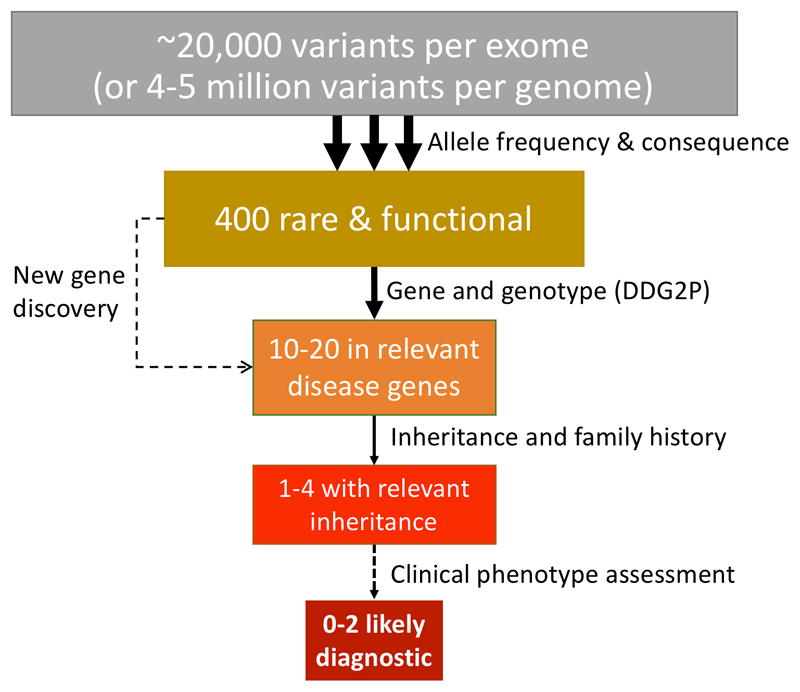
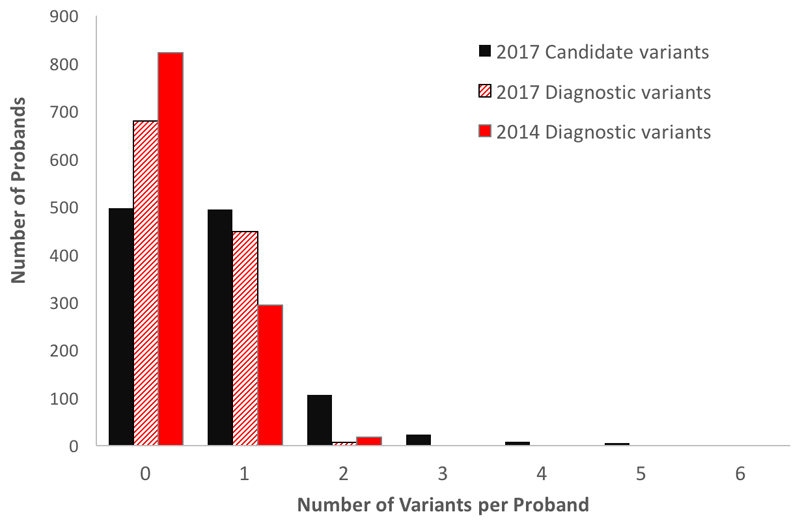
We tested this hypothesis in the United Kingdom-wide Deciphering Developmental Disorders study, where in 2014 we reported a diagnostic yield of 27% through whole-exome sequencing of 1,133 children with severe developmental disorders and their parents. We reanalyzed existing data using improved variant calling methodologies, novel variant detection algorithms, updated variant annotation, evidence-based filtering strategies, and newly discovered disease-associated genes.
We are now able to diagnose an additional 182 individuals, taking our overall diagnostic yield to 454/1,133 (40%), and another 43 (4%) have a finding of uncertain clinical significance. The majority of these new diagnoses are due to novel developmental disorder-associated genes discovered since our original publication.
This study highlights the importance of coupling large-scale research with clinical practice, and of discussing the possibility of iterative reanalysis and recontact with patients and health professionals at an early stage. We estimate that implementing parent-offspring whole-exome sequencing as a first-line diagnostic test for developmental disorders would diagnose >50% of patients.
鉴于罕见病基因组学的发现速度很快,通过根据新知识系统地重新分析先前生成的基因组序列数据,很可能可以提高诊断率。
我们在英国范围内的发育障碍解析研究中测试了这一假设,我们在 2014 年通过对 1133 名患有严重发育障碍及其父母的个体进行全外显子组测序,报告了 27%的诊断率。我们使用改进的变异调用方法、新的变异检测算法、更新的变异注释、基于证据的过滤策略以及新发现的与疾病相关的基因,重新分析了现有数据。
我们现在能够诊断另外 182 个人,使我们的总体诊断率达到 454/1133(40%),另有 43 人(4%)的发现具有不确定的临床意义。这些新诊断的大多数是由于我们最初发表后发现的新的发育障碍相关基因所致。
本研究强调了将大规模研究与临床实践相结合的重要性,并强调了在早期就讨论迭代重新分析和重新与患者和卫生专业人员联系的可能性。我们估计,实施父母-子女全外显子组测序作为发育障碍的一线诊断测试,将诊断出>50%的患者。