K Pinjari M Jakir S, Somani Rahul, Gilhotra Ritu M
Department of Research, School of Pharmacy, Suresh Gyan Vihar University, Mahal Jagatpura, Jaipur, Rajasthan, India.
Indian J Pharmacol. 2017 Jul-Aug;49(4):297-303. doi: 10.4103/ijp.IJP_651_16.
The objective of this study is to investigate Caco2 permeability, metabolism and pharmacokinetic (PK) properties of paromomycin to develop an efficient dosage form with improved oral bioavailability.
For the purpose, Caco2 permeability assay, mouse microsomal stability assay and PKs in male BALB/c mice were performed.
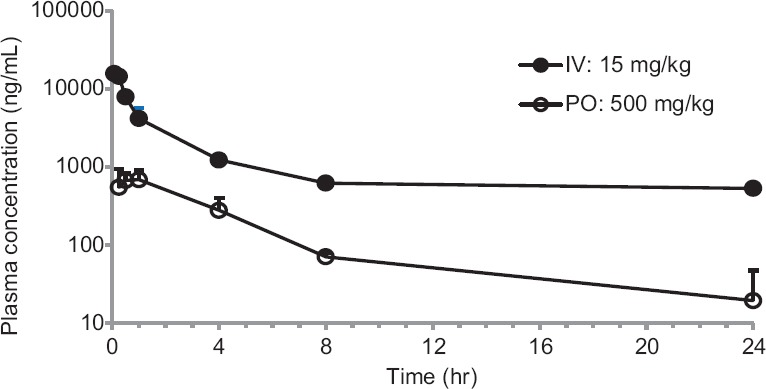
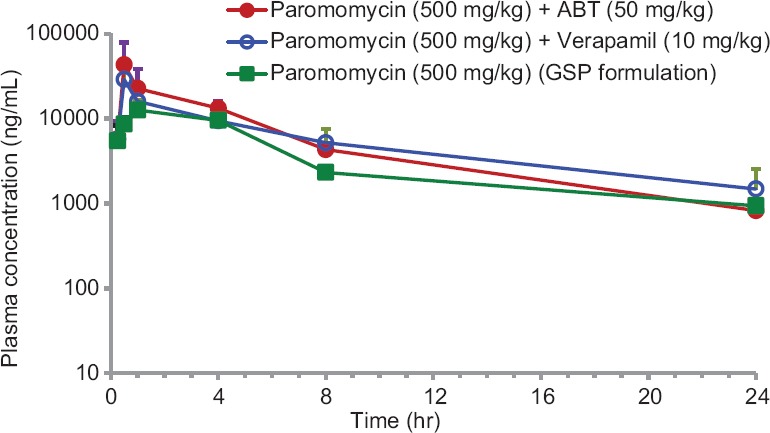
In Caco-2 permeability assay, paromomycin showed negligible permeability in the apical to basolateral (A-to-B) direction and vice versa (B-to-A). Marginal increase in permeability with the use of P-glycoprotein (P-gp) inhibitor, namely, verapamil suggesting paromomycin could be a P-gp substrate. Paromomycin was unstable in liver microsomes of mouse. Paromomycin showed good PK properties after intravenous dose in male BALB/c mice which included low plasma clearance, i.e., <10% of hepatic blood flow in mice, high volume of distribution (V), and half-life (T) of 2.6 h. Following per oral dose, it exhibits low oral bioavailability (0.3%) with carboxymethyl cellulose formulation. Oral plasma exposure increased in mice by 10% and 15% after pretreatment with P-gp inhibitor verapamil and CYP inhibitor 1-Aminobenztriazole, respectively.
Comparatively significant increase in oral plasma exposure of paromomycin was observed with an alternative oral formulation approach, use of P-gp and CYP inhibitors resulting in improved oral bioavailability up to 16%.
本研究的目的是研究巴龙霉素的Caco2渗透性、代谢和药代动力学(PK)特性,以开发一种具有更高口服生物利用度的高效剂型。
为此,进行了Caco2渗透性测定、小鼠微粒体稳定性测定以及雄性BALB/c小鼠的药代动力学研究。
在Caco-2渗透性测定中,巴龙霉素在顶侧到基底侧(A到B)方向的渗透性可忽略不计,反之亦然(B到A)。使用P-糖蛋白(P-gp)抑制剂维拉帕米后渗透性略有增加,表明巴龙霉素可能是P-gp底物。巴龙霉素在小鼠肝脏微粒体中不稳定。巴龙霉素在雄性BALB/c小鼠静脉给药后表现出良好的药代动力学特性,包括低血浆清除率,即小于小鼠肝血流量的10%,高分布容积(V)和2.6小时的半衰期(T)。口服羧甲基纤维素制剂后,其口服生物利用度较低(0.3%)。用P-gp抑制剂维拉帕米和CYP抑制剂1-氨基苯并三唑预处理后,小鼠口服血浆暴露量分别增加了10%和15%。
采用替代口服制剂方法、使用P-gp和CYP抑制剂可使巴龙霉素的口服血浆暴露量显著增加,口服生物利用度提高至16%。