Sabatini Luigi, Risitano Salvatore, Parisi Gennaro, Tosto Ferdinando, Indelli Pier Francesco, Atzori Francesco, Massè Alessandro
Department of Orthopaedics and Traumatology, Città della Salute e della Scienza di Torino, CTO Hospital, Turin, Italy.
University of Turin, Turin, Italy.
Clin Med Insights Arthritis Musculoskelet Disord. 2018 Jan 4;11:1179544117751431. doi: 10.1177/1179544117751431. eCollection 2018.
Traditional total knee implants designs, usually, are not able to reproduce the physiological kinematics of the knee, leaving almost 20% of the patients, those who underwent a total knee arthroplasty (TKA), not fully satisfied. Modern inserts are nowadays designed with a fully congruent medial compartment to reproduce the normal medial pivoting biomechanics of the knee. The aim of this article was to evaluate preliminary clinical improvement using the Medial Congruent (MC) insert as specific level of constraint.
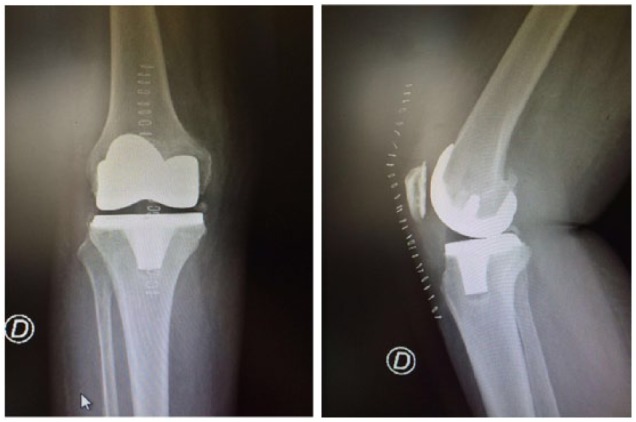
A total of 10 consecutive patients have been enrolled in this study and treated using an MC tibial polyethylene insert. The Oxford Knee Score (OKS) and the Knee Society Score (KSS) have been assessed preoperatively and at 3-month, 6-month, and 1-year follow-up (FU) and used as validated measurements to evaluate early clinical improvements. Postoperative radiological examination was reviewed looking for radiolucent lines or loosening of the components.
Average improvement in OKS was from 19.5 to 41.2, whereas KSS improved with an average score from 64.7 preoperatively to 167.5 at the final FU showing good to excellent results in 95% of the treated knees. Evaluating the range of motion, the average maximum active movement was 124° and none of the patients needing for a revision surgery or manipulation under anesthesia. No complications were observed at the final FU as septic or aseptic loosening or vascular or neurologic injury.
Medial Congruent insert showed good to excellent clinical results at 1-year FU. Range of motion and subjective outcomes were satisfying and comparable with results obtained in literature using traditional TKA design.
传统的全膝关节植入物设计通常无法重现膝关节的生理运动学,导致接受全膝关节置换术(TKA)的患者中近20%不完全满意。如今,现代衬垫的设计采用了完全贴合的内侧间室,以重现膝关节正常的内侧旋转生物力学。本文旨在评估使用内侧贴合(MC)衬垫作为特定约束水平的初步临床改善情况。
本研究共纳入10例连续患者,使用MC胫骨聚乙烯衬垫进行治疗。术前以及术后3个月、6个月和1年随访时评估牛津膝关节评分(OKS)和膝关节协会评分(KSS),并将其用作评估早期临床改善情况的有效测量指标。复查术后放射学检查,查找透光线或植入物松动情况。
OKS平均改善从19.5提高到41.2,而KSS改善,术前平均评分为64.7,最终随访时为167.5,95%接受治疗的膝关节显示出良好至优异的结果。评估活动范围,平均最大主动活动度为124°,且没有患者需要进行翻修手术或麻醉下手法治疗。最终随访时未观察到如感染性或无菌性松动或血管或神经损伤等并发症。
内侧贴合衬垫在1年随访时显示出良好至优异的临床结果。活动范围和主观结果令人满意,与使用传统TKA设计在文献中获得的结果相当。