Department of Psychosomatic Medicine and Psychotherapy, University Medical Center Hamburg-Eppendorf, Martinistraße 52, 20251, Hamburg, Germany.
Schön Klinik Hamburg Eilbek, University Clinic for Psychosomatic Medicine and Psychotherapy, Dehnhaide 120, 20081, Hamburg, Germany.
Breast Cancer Res Treat. 2018 Apr;168(3):667-677. doi: 10.1007/s10549-017-4637-2. Epub 2018 Jan 12.
To identify modifiable factors predictive of long-term adherence to adjuvant endocrine therapy (AET).
As part of a 2-year cohort study in primary care (n = 116), we investigated whether initial treatment expectations predict adherence at 24 months after controlling for demographic, medical, and psychosocial variables. Treatment expectations were measured as necessity-concern beliefs, expected side-effect severity, and expected coping with side effects. Their stability over time and differences of trajectories between the adherent and nonadherent group were examined.
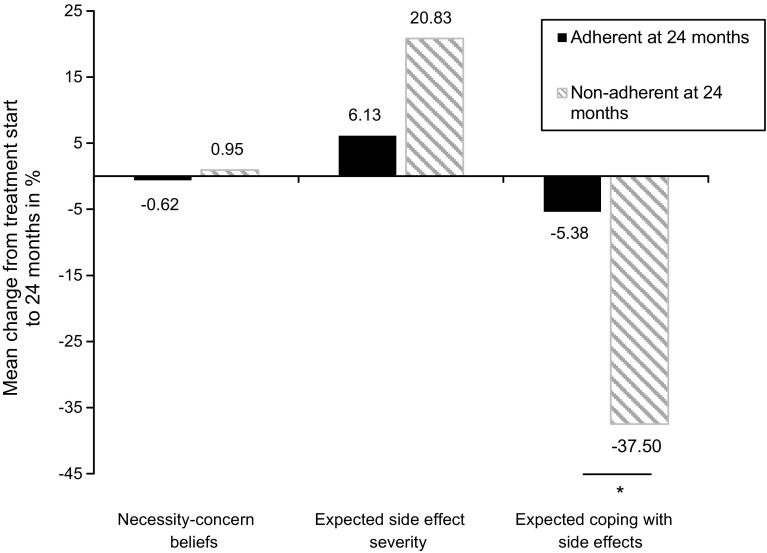
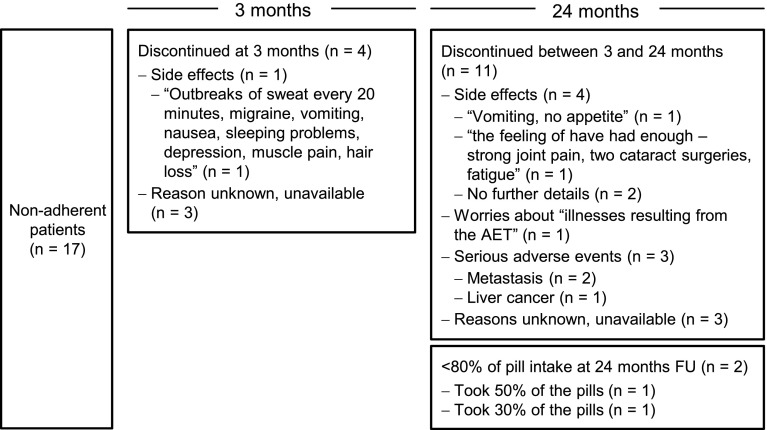
Nonadherence at 24 months was 14.7% (n = 17). Side-effect severity at 3 months [OR 0.25, 95% CI (0.08, 0.81), p = 0.02] and necessity-concern beliefs [OR 2.03, 95% CI (1.11, 3.72), p = 0.02] were the sole predictors of adherence. Necessity-concern beliefs remained stable over 2 years, whereas expected side-effect severity (p = 0.01, η = 0.07) and expected coping with side effects became less optimistic over time (p < 0.001, η = 0.19), the latter particularly among nonadherers (p < 0.01, η = 0.10).
Patients' initial necessity-concern beliefs about the AET and early severity of side effects affect long-term adherence. Expecting poor management of side effects may also facilitate nonadherence. We suggest that discussing benefits, addressing concerns of AET, and providing side-effect coping strategies could constitute a feasible and promising option to improve adherence in clinical practice.
确定可改变的因素,预测长期接受辅助内分泌治疗(AET)的依从性。
作为初级保健 2 年队列研究的一部分(n=116),我们调查了在控制人口统计学、医学和心理社会变量后,初始治疗期望是否能预测 24 个月后的依从性。治疗期望被测量为必要性-关注信念、预期副作用严重程度和预期应对副作用的能力。还检查了它们随时间的稳定性以及在依从组和非依从组之间的轨迹差异。
24 个月时的不依从率为 14.7%(n=17)。3 个月时的副作用严重程度[OR 0.25,95%CI(0.08,0.81),p=0.02]和必要性-关注信念[OR 2.03,95%CI(1.11,3.72),p=0.02]是唯一的依从性预测因素。必要性-关注信念在 2 年内保持稳定,而预期的副作用严重程度(p=0.01,η =0.07)和预期应对副作用的能力随时间变得不那么乐观(p<0.001,η =0.19),尤其是在不依从者中(p<0.01,η =0.10)。
患者对 AET 的初始必要性-关注信念和早期副作用严重程度影响长期依从性。预期对副作用的管理不善也可能导致不依从。我们建议,讨论益处、解决对 AET 的担忧以及提供应对副作用的策略可能是改善临床实践中依从性的可行和有前途的选择。