Department of Epidemiology, Gillings School of Global Public Health.
Institute for Global Health & Infectious Diseases, The University of North Carolina at Chapel Hill, Chapel Hill, North Carolina.
AIDS. 2018 Mar 13;32(5):653-661. doi: 10.1097/QAD.0000000000001745.
One in four persons living with HIV is coinfected with hepatitis C virus (HCV). Biological and behavioral mechanisms may increase HIV viral load among coinfected persons. Therefore, we estimated the longitudinal effect of chronic HCV on HIV suppression after ART initiation among women with HIV (WWH).
HIV RNA was measured every 6 months among 441 WWH in the Women's Interagency HIV Study who initiated ART from 2000 to 2015.
Log-binomial regression models were used to compare the proportion of study visits with detectable HIV RNA between women with and without chronic HCV. Robust sandwich variance estimators accounted for within-person correlation induced by repeated HIV RNA measurements during follow-up. We controlled for confounding and selection bias (because of loss to follow-up and death) using inverse probability-of-exposure-and-censoring weights.
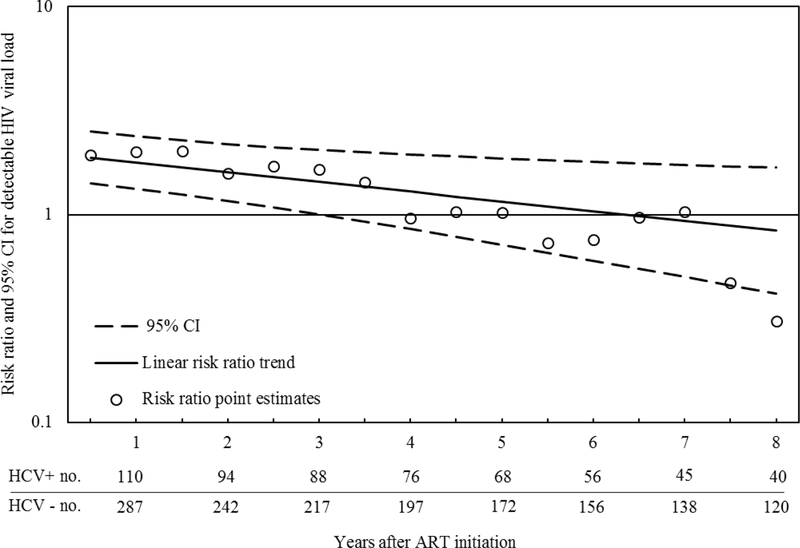
One hundred and fourteen women (25%) had chronic HCV before ART initiation. Overall, the proportion of visits with detectable HIV RNA was similar among women with and without chronic HCV [relative risk (RR) 1.19 (95% CI 0.72, 1.95)]. Six months after ART initiation, the proportion of visits with detectable HIV RNA among women with chronic HCV was 1.88 (95% CI 1.41-2.51) times that among women without HCV, at 2 years, the ratio was 1.60 (95% CI 1.17-2.19), and by 6 years there was no difference (1.03; 95% CI 0.60-1.79).
Chronic HCV may negatively impact early HIV viral response to ART. These findings reaffirm the need to test persons with HIV for HCV infection, and increase engagement in HIV care and access to HCV treatment among persons with HIV/HCV coinfection.
每四名感染艾滋病毒的人中就有一人同时感染丙型肝炎病毒(HCV)。生物和行为机制可能会增加合并感染人群中的艾滋病毒载量。因此,我们评估了慢性 HCV 对开始抗逆转录病毒治疗(ART)后感染艾滋病毒的女性(WHW)中 HIV 抑制的纵向影响。
2000 年至 2015 年间,在妇女艾滋病研究机构中接受 ART 治疗的 441 名 WHW 中,每 6 个月测量一次 HIV RNA。
使用对数二项式回归模型比较了有和无慢性 HCV 的女性中研究就诊时可检测到 HIV RNA 的比例。稳健的夹层方差估计值考虑了随访期间重复 HIV RNA 测量引起的个体内相关性。我们使用逆概率暴露和删失权重来控制混杂和选择偏差(由于失访和死亡)。
114 名女性(25%)在开始 ART 之前患有慢性 HCV。总体而言,有和无慢性 HCV 的女性中可检测到 HIV RNA 的就诊比例相似[相对风险(RR)1.19(95%CI 0.72,1.95)]。ART 开始后 6 个月,慢性 HCV 女性中可检测到 HIV RNA 的就诊比例是无 HCV 女性的 1.88(95%CI 1.41-2.51)倍,2 年后,比值为 1.60(95%CI 1.17-2.19),6 年后无差异(1.03;95%CI 0.60-1.79)。
慢性 HCV 可能对 ART 早期 HIV 病毒反应产生负面影响。这些发现再次证实了需要对感染 HIV 的人进行 HCV 感染检测,并增加对 HIV/HCV 合并感染人群的 HIV 护理和 HCV 治疗的参与。