Division of Chest Medicine, Department of Internal Medicine, Taichung Veterans General Hospital, Taichung, Taiwan.
Division of Critical Care and Respiratory Therapy, Department of Internal Medicine, Taichung Veterans General Hospital, Taichung, Taiwan.
Cancer Res Treat. 2018 Oct;50(4):1294-1303. doi: 10.4143/crt.2017.512. Epub 2018 Jan 4.
The main objective of this study was to investigate the relationship among the clinical characteristics and the frequency of T790M mutation in advanced epidermal growth factor receptor (EGFR)‒mutant lung adenocarcinoma patients with acquired resistance after firstline EGFR‒tyrosine kinase inhibitor (TKI) treatment.
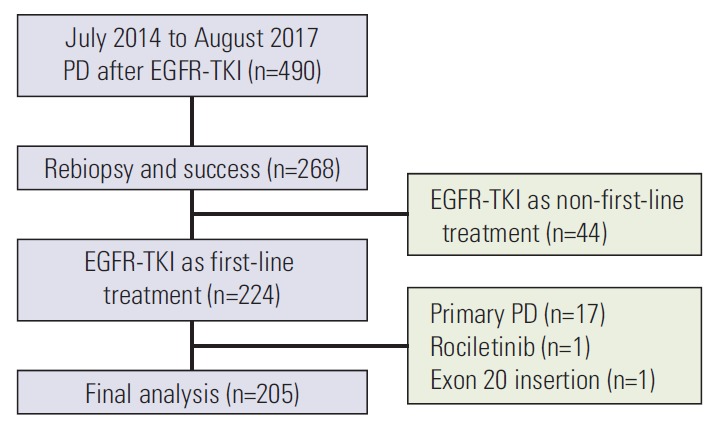
We enrolled EGFR-mutant stage IIIB-IV lung adenocarcinoma patients, who had progressed to prior EGFR-TKI therapy, and evaluated their rebiopsy EGFR mutation status.
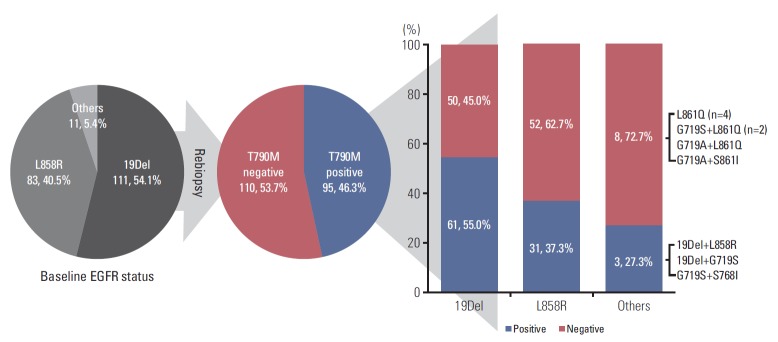
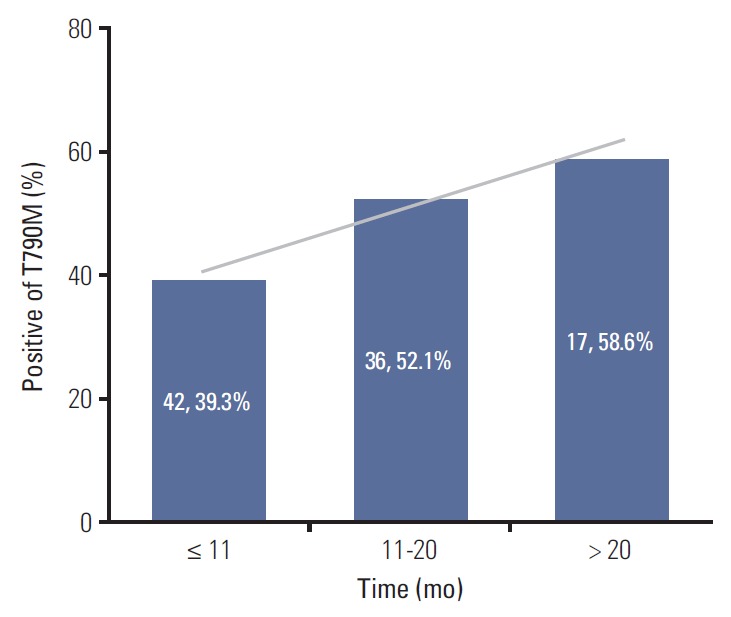
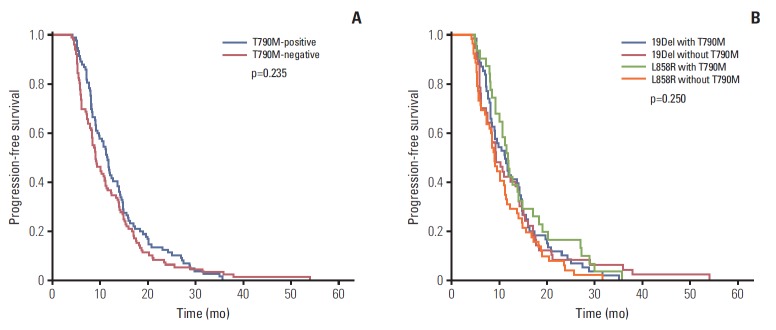
A total of 205 patients were enrolled for analysis. The overall T790M mutation rate of rebiopsy was 46.3%. The T790M mutation rates among patients with exon 19 deletion mutation, exon 21 L858R point mutation, and other mutations were 55.0%, 37.3%, and 27.3%, respectively. Baseline exon 19 deletion was associated with a significantly higher frequency of T790M mutation (adjusted odds ratio, 2.14; 95% confidence interval [CI], 1.20 to 3.83; p=0.010). In the exon 19 deletion subgroup, there was a greater prevalence of T790M mutation than other exon 19 deletion subtypes in patients with the Del E746-A750 mutation (61.6% vs. 40.6%; odds ratio, 2.35; 95% CI, 1.01 to 5.49; p=0.049). The progression-free survival (PFS) of first-line TKI treatment > 11 months was also associated with a higher T790M mutation rate (54.1% vs. 39.3%; adjusted odds ratio, 1.82; 95% CI, 1.02 to 3.25; p=0.044). Patients who underwent rebiopsy at metastatic sites had more chance to harbor T790M mutation (52.6% vs. 33.8%; adjusted odds ratio, 1.97; 95% CI, 1.06 to 3.67; p=0.032).
PFS of first-line EGFR-TKI, rebiopsy site, EGFR exon 19 deletion and its subtype Del E746- A750 mutation are associated with the frequency of T790M mutation.
本研究的主要目的是探讨表皮生长因子受体(EGFR)突变型晚期肺腺癌患者一线 EGFR 酪氨酸激酶抑制剂(TKI)治疗后获得性耐药时临床特征与 T790M 突变频率之间的关系。
我们纳入了进展期 IIIB-IV 期 EGFR 突变型肺腺癌患者,这些患者在接受 EGFR-TKI 治疗后进展,评估了他们的再次活检 EGFR 突变状态。
共纳入 205 例患者进行分析。再次活检的 T790M 突变总体发生率为 46.3%。exon19 缺失突变、exon21 L858R 点突变和其他突变患者的 T790M 突变率分别为 55.0%、37.3%和 27.3%。基线 exon19 缺失与 T790M 突变的频率显著相关(调整优势比,2.14;95%置信区间 [CI],1.20 至 3.83;p=0.010)。在 exon19 缺失亚组中,Del E746-A750 突变患者的 T790M 突变率显著高于其他 exon19 缺失亚型(61.6% vs. 40.6%;比值比,2.35;95%CI,1.01 至 5.49;p=0.049)。一线 TKI 治疗的无进展生存期(PFS)>11 个月也与 T790M 突变率较高相关(54.1% vs. 39.3%;调整优势比,1.82;95%CI,1.02 至 3.25;p=0.044)。在转移性部位进行再次活检的患者更有可能存在 T790M 突变(52.6% vs. 33.8%;调整优势比,1.97;95%CI,1.06 至 3.67;p=0.032)。
一线 EGFR-TKI 的 PFS、再次活检部位、EGFR exon19 缺失及其亚型 Del E746-A750 突变与 T790M 突变的频率有关。