Population Health, Health Systems and Innovation, Human Sciences Research Council, HSRC Building, 134 Pretorius Street, Pretoria, 0002, South Africa.
Department of Health Services Research; CAPHRI, Maastricht University Medical Centre, Faculty of Health, Medicine and Life Sciences, Maastricht University, Maastricht, The Netherlands.
Global Health. 2018 Jan 16;14(1):3. doi: 10.1186/s12992-017-0318-5.
There is an increasing recognition that non communicable diseases impose large economic costs on households, societies and nations. However, not much is known about the magnitude of diabetes expenditure in African countries and to the best of our knowledge no systematic assessment of the literature on diabetes costs in Africa has been conducted. The aim of this paper is to capture the evidence on the cost of diabetes in Africa, review the methods used to calculate costs and identify areas for future research.
A desk search was conducted in Pubmed, Medline, Embase, and Science direct as well as through other databases, namely Google Scholar. The following eligibility criteria were used: peer reviewed English articles published between 2006 and 2016, articles that reported original research findings on the cost of illness in diabetes, and studies that covered at least one African country. Information was extracted using two data extraction sheets and results organized in tables. Costs presented in the studies under review are converted to 2015 international dollars prices (I$).
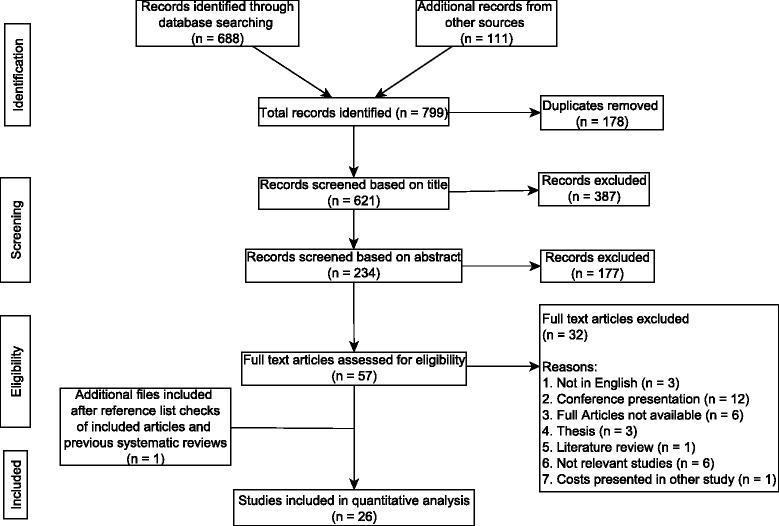
Twenty six articles are included in this review. Annual national direct costs of diabetes differed between countries and ranged from I$3.5 billion to I$4.5 billion per annum. Indirect costs per patient were generally higher than the direct costs per patient of diabetes. Outpatient costs varied by study design, data source, perspective and healthcare cost categories included in the total costs calculation. The most commonly included healthcare items were drug costs, followed by diagnostic costs, medical supply or disposable costs and consultation costs. In studies that reported both drug costs and total costs, drug costs took a significant portion of the total costs per patient. The highest burden due to the costs associated with diabetes was reported in individuals within the low income group.
Estimation of the costs associated with diabetes is crucial to make progress towards meeting the targets laid out in Sustainable Development Goal 3 set for 2030. The studies included in this review show that the presence of diabetes leads to elevated costs of treatment which further increase in the presence of complications. The cost of drugs generally contributed the most to total direct costs of treatment. Various methods are used in the estimation of diabetes healthcare costs and the costs estimated between countries differ significantly. There is room to improve transparency and make the methodologies used standard in order to allow for cost comparisons across studies.
人们越来越认识到,非传染性疾病给家庭、社会和国家带来了巨大的经济成本。然而,我们对非洲国家糖尿病支出的规模知之甚少,据我们所知,尚未对非洲糖尿病成本的文献进行系统评估。本文旨在收集非洲糖尿病成本的证据,回顾计算成本的方法,并确定未来研究的领域。
在 Pubmed、Medline、Embase 和 Science direct 以及其他数据库(如 Google Scholar)中进行了文献检索。使用了以下纳入标准:2006 年至 2016 年期间发表的同行评议的英文文章、报告糖尿病疾病成本原始研究结果的文章以及至少涵盖一个非洲国家的研究。使用两张数据提取表提取信息,并将结果整理成表格。审查中的研究报告的成本已转换为 2015 年国际美元价格(I$)。
本综述共纳入 26 篇文章。各国糖尿病的年度国家直接成本不同,每年从 35 亿至 45 亿美元不等。每位患者的间接成本通常高于糖尿病的直接成本。门诊费用因研究设计、数据源、视角和纳入总成本计算的医疗保健费用类别而异。最常包括的医疗保健项目是药物成本,其次是诊断成本、医疗用品或一次性成本和咨询成本。在报告药物成本和总费用的研究中,药物成本占每位患者总费用的很大一部分。在低收入群体中,与糖尿病相关的费用负担最大。
估计与糖尿病相关的成本对于实现 2030 年可持续发展目标 3 规定的目标至关重要。本综述中纳入的研究表明,糖尿病的存在导致治疗费用增加,如果出现并发症,费用会进一步增加。药物成本通常占治疗总直接费用的最大份额。在估计糖尿病医疗保健成本时使用了各种方法,各国之间的估计成本差异很大。有改进的空间,提高透明度并使所使用的方法标准化,以便在研究之间进行成本比较。